
Insights
Behavioral Health Coaching: Leadership Case-Study Guide
A leadership decision matters when it changes how the organization works. Behavioral health executive coaching can help leaders connect their choices to the systems shaping staffing, operations, and clinical priorities, but coaching alone doesn’t guarantee consistent change. The key question is whether it can help your leadership team address the challenges affecting organizational performance. It can when the work is tied to a defined organizational need and observable shifts in leadership practice.
Behavioral health leaders often carry responsibilities across people, operations, and care delivery. A strategy may be sound yet still fail to take hold across teams. Coaching provides structured space to clarify priorities, strengthen decision-making, and identify where leadership actions need to align with organizational goals.
This guide takes an analytical case-study approach to assessing that fit, without relying on invented client examples or outcomes. You’ll learn how to connect coaching goals to business challenges, define meaningful indicators of progress, and distinguish developmental coaching from day-to-day management. The aim is a practical basis for deciding whether executive coaching fits your organization’s needs.
Key Takeaways
- Map competing workforce, operational, and clinical demands to identify the organizational issue leadership support should address.
- Use behavioral health executive coaching to align leadership choices with strategic priorities, while assigning broader system changes to the appropriate operational work.
- Assess a case study by its documented context, coaching focus, actions, and follow-up, not by unsupported claims of impact.
- Before selecting support, clarify the sponsor, goals, progress measures, decision authority, and time leaders can protect for reflection.
- Prioritize behavioral health context, confidentiality, evidence discipline, and organizational alignment when evaluating coaching fit.
Table of Contents
- Why behavioral health executives consider coaching when organizational demands collide
- How behavioral health executive coaching connects leadership behavior to organizational strategy
- What a credible behavioral health executive coaching case study should demonstrate
- How to evaluate coaching fit, progress, and organizational readiness
- Choosing behavioral health executive coaching support and taking the next step
Why behavioral health executives consider coaching when organizational demands collide
A behavioral health executive may need to address workforce capacity, keep operations aligned, and protect clinical priorities at the same time. Those responsibilities can pull attention in different directions. A staffing decision may affect service delivery, while an operational change may need to account for clinical practice and team experience. The challenge is not simply having too much to do. It is keeping priorities, authority, and execution aligned.
Leadership misalignment can make an organizational plan harder to carry out. If senior leaders communicate different priorities or decision rights are unclear, managers may not know what to implement or when to escalate an issue. Staff experience and operational follow-through may also be affected, although the pattern and impact depend on the organization. A useful case study begins with the actual organizational challenge rather than assuming coaching is the answer.
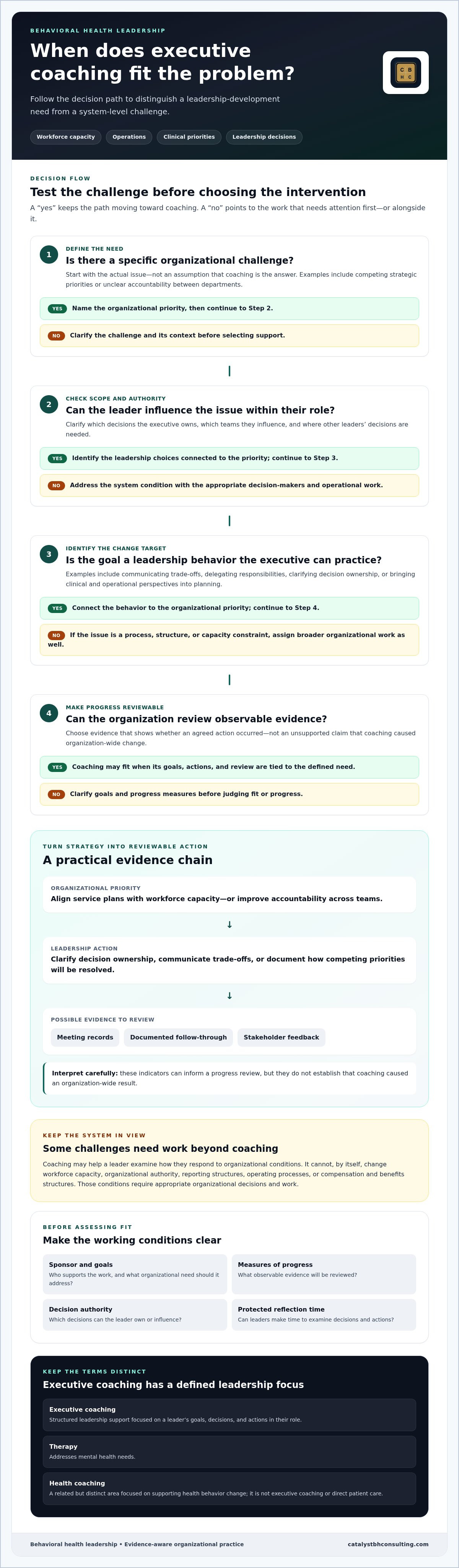
Executive coaching is structured leadership support focused on a leader’s goals, decisions, and actions in their role. It is distinct from therapy, which addresses mental health needs, and from direct patient care. The term Health coaching refers to a related but distinct area focused on supporting health behavior change. It should not be confused with executive coaching for organizational leadership. A useful case-study question is: what specific organizational challenge should coaching help this leader address, and what can the leader influence within their authority?
Which behavioral health leadership challenges may warrant coaching?
Potential case contexts include recurring decision bottlenecks, unclear accountability between departments, or strategic priorities competing for leadership attention. A leader might need to clarify how decisions are made, communicate responsibilities, or sequence initiatives. These are coaching candidates when the focus is on leadership behavior. If the underlying issue is an unsuitable reporting structure, insufficient staffing, or an unclear organizational process, it may require broader design or operational work as well.
Separate the individual development need from the system condition. Coaching may help a leader examine how they delegate or communicate. It cannot, by itself, change organizational authority, workforce capacity, or compensation and benefits structures. This distinction keeps staff experience and execution in view without assigning every organizational difficulty to one leader.
What should coaching address that a general leadership program may miss?
Behavioral health leaders work across clinical and operational responsibilities. A leadership goal should reflect that context and the executive’s actual role: which decisions they own, which teams they influence, and where they depend on other leaders. A broad development goal such as “improve communication” becomes more useful when tied to a real responsibility, such as making priorities clear during a service change.
Behavioral health executive coaching creates focused space to examine choices and identify actions the leader can take. It is not a guaranteed fix for workforce or operational problems. Assess its value against the defined challenge, the leader’s scope of influence, and observable follow-through.
How behavioral health executive coaching connects leadership behavior to organizational strategy
Coaching is most useful when it connects a defined organizational priority to a leader’s choices and observable actions. A practical sequence is to clarify the need, examine how the executive’s decisions relate to it, and agree on actions that can be reviewed. This keeps leadership development aligned with strategy while distinguishing it from operational changes that require separate ownership.
Start with a stated priority, such as improving accountability across teams or aligning service plans with workforce capacity. Clarify which decisions the executive owns, then identify relevant behaviors: communicating trade-offs, delegating responsibilities, or bringing clinical and operational perspectives into planning. Possible actions include clarifying decision ownership or documenting how competing priorities will be resolved. Tailor these actions to the leader’s authority rather than treating them as promised organizational outcomes.
How can coaching align executive priorities with organizational needs?
Translate broad priorities into actions the executive can take and evidence the organization can review. If responsibilities for an initiative are unclear, a goal might be to communicate decision rights with relevant leaders. Meeting records, documented follow-through, or stakeholder feedback may help assess whether the action occurred. These indicators can inform a progress review, but they don’t establish that coaching caused an organization-wide result.
Keep the scope clear. Coaching may help a leader examine how they respond to staffing constraints, but changing workforce plans, reporting structures, or operating processes requires distinct decisions, owners, and analysis. Behavioral health executive coaching should support leadership action without being treated as a substitute for system-level work.
How do workforce, compensation, and culture enter the coaching conversation?
Workforce data can help leaders frame questions when the measures are available and clearly defined. Vacancy patterns, turnover, schedule coverage, and role-specific staffing trends may offer context, but they don’t explain themselves. Before drawing conclusions about workforce needs or organizational performance, leaders should establish how each measure is defined, what period it covers, and what other factors may shape it.
Compensation and benefits deserve similar care. If a workforce concern prompts a review of pay structures, benefit design, workload, or role expectations, those factors can inform the organization’s analysis of its HR priorities. Leaders can use coaching to clarify how they’ll engage with that analysis and communicate decisions within their authority. Coaching itself doesn’t redesign compensation or benefits. Changes to those systems require separate organizational review.
In behavioral health, leadership decisions intersect with clinical responsibilities and the conditions staff experience at work. A credible case narrative connects documented evidence to the organizational question without overstating what it proves. Catalyst Behavioral Health Consulting offers executive coaching alongside expertise in human resources, clinical, and operational areas. Leaders can review executive coaching support in the context of their organizational priorities.
What a credible behavioral health executive coaching case study should demonstrate
A case study is most useful to buyers when it makes the evidence behind its account transparent. Treat the structure below as an evaluation framework, not as a claim that coaching produces a particular result. If no permission-cleared case is available, use the framework to assess a potential engagement rather than presenting an invented client story.
Organize the account so readers can distinguish what was known, what was done, and what was reviewed:
- Context: Describe the relevant organizational setting and priority while protecting identifying details.
- Leadership challenge: State the decision-making, accountability, communication, or strategic issue under consideration.
- Coaching focus: Identify the leadership behavior the engagement aimed to address.
- Actions: Report documented actions, not assumed intentions or unverified recollections.
- Follow-up: Identify what evidence was reviewed, its source, and the period it covers, when documented.
Which evidence makes a coaching case study useful to buyers?
For a buyer assessing behavioral health executive coaching, useful evidence lets them follow the case without exposing confidential or identifying information. The account might document an agreed goal, actions taken by the executive, and the records or feedback used in follow-up, if those materials exist and are cleared for use. Label each statement as documented information, a reported perspective, or an interpretation. This helps readers judge what the case can and cannot establish.
Keep observed events separate from explanations. If a leadership practice changed during an engagement, report the documented change and its timing. Don’t attribute it to coaching unless the available evidence supports that interpretation. Note other organizational initiatives only when documented, and avoid presenting a sequence of events as proof of cause.
How should compensation, benefits, and workforce measures be handled?
Include compensation and benefits only when they were part of the documented organizational context or analysis. If a case examined a workforce concern, report whether pay structures or benefits were considered only if that review occurred. Don’t imply that coaching changed compensation, benefits, or retention without evidence that directly supports the statement.
Apply the same discipline to workforce and operational measures. If reporting vacancies, turnover, or staffing coverage, state how the measure was defined, its source, and the timeframe, when that information is available. Avoid comparisons across different populations or periods unless the basis is clear. When the records don’t support a number or conclusion, omit it. A transparent account of limitations gives buyers a sounder basis for judging relevance than an unsupported outcome claim.
How to evaluate coaching fit, progress, and organizational readiness
These five steps offer a practical buyer framework for deciding whether coaching fits an organizational need and how to review progress. Use them to clarify scope, roles, and evidence before an engagement begins. They’re decision-making guidance, not a guarantee of particular leadership or organizational outcomes.
- Define the need. Specify whether the priority is leadership development, organizational change, or both. Identify system-level issues that may require separate work.
- Identify the sponsor. Clarify who supports the engagement, who participates, and who owns related organizational decisions. Agree on confidentiality boundaries and what information may be shared.
- Set goals. Connect development goals to the executive’s role and decision authority. Focus on actions the leader can influence, such as communicating priorities or clarifying delegation.
- Choose measures. Select evidence tied to those goals. This might include documented leadership actions or relevant workforce and operational indicators, if available and clearly defined.
- Review progress. Agree on when and how to review the evidence, account for relevant context, and revisit goals if organizational priorities or responsibilities shift.
Which questions help determine whether coaching fits the need?
Start with the central business question: does the organization need to develop a leader, change a system, or address both? Identify the executive sponsor, the coaching participant, and the boundaries for sharing information. Consider whether compensation, benefits, staffing, culture, or operations require parallel attention. This distinction helps avoid assigning system-level responsibilities to an individual coaching goal.
Assess readiness by clarifying whether the executive has time to reflect and authority to act on agreed goals. If key decisions sit elsewhere, identify who owns them and how that dependency will be addressed. Organizations considering ongoing HR leadership alongside coaching may also find the related guide, Fractional HR for Healthcare: 2026 Strategic Buying Guide, useful for framing adjacent support needs.
How can leaders assess progress without overclaiming impact?
Before reviewing progress, document a baseline using available information and define the measures being considered. For a goal related to decision ownership, for example, the organization might review whether responsibilities were documented and communicated. Workforce or operational indicators should have a clear source, definition, and timeframe. Don’t create benchmarks where no reliable basis exists.
During reviews, record relevant context and limitations. An indicator may change while coaching is underway, but timing alone doesn’t establish that coaching caused the change. Assess agreed leadership actions separately from broader organizational outcomes. For support connecting leadership priorities to organizational needs, review executive coaching support.
Choosing behavioral health executive coaching support and taking the next step
The right support should fit the organization’s operating context, not just the executive’s development interests. Assess whether a prospective engagement reflects behavioral health realities, connects goals to a defined business need, establishes confidentiality boundaries, and treats evidence with care. It should also account for organizational alignment: coaching can support leadership behavior, while workforce, compensation, clinical, accreditation, or operational issues may need separate attention.
Catalyst Behavioral Health Consulting provides executive coaching alongside operational, clinical, regulatory, and human-resources consulting for behavioral health organizations. That broader context can help leaders consider coaching in relation to organizational priorities rather than as an isolated professional benefit. If accreditation is part of the challenge, the guide Behavioral Health Accreditation Support: A Strategic Path to Operational Excellence offers a related perspective on connecting accreditation needs with operational readiness.
What should an organization establish before an engagement begins?
Start with a concise statement of the business challenge and the executive development goals that relate to it. Clarify who sponsors the work, who participates, and how progress discussions will be handled. Set confidentiality boundaries before sharing sensitive information, and identify the stakeholders or organizational evidence that may inform review. These expectations create alignment without assuming a fixed coaching protocol or promising a particular result.
Check that the goals match the executive’s authority. If the challenge depends on a decision owned by another leader, establish how that dependency will be addressed. If compensation, benefits, staffing, culture, or operations require broader changes, identify those as parallel organizational needs rather than placing them solely within the coaching scope.
How can leaders make the first conversation productive?
Bring a brief overview of the organization’s context, leadership priorities, and decision constraints. A focused discussion might cover the issue to address, what the executive can influence, and what progress could reasonably look like. For example, a leadership goal could involve making decision ownership clearer. The organization can then identify relevant evidence, such as documented responsibilities or follow-through, if those records are available.
Use the conversation to test alignment, not to seek guarantees. Discuss what information can be reviewed, who needs to be involved, and what limitations may affect interpretation. A well-defined starting point helps distinguish leadership development from system-level work and supports a more disciplined assessment of fit.
If your organization is ready to discuss its leadership priorities and the support that may fit them, book a behavioral health leadership conversation.
Connect leadership development to organizational priorities
Behavioral health executive coaching is most useful when it addresses a defined organizational challenge, not just a general desire to grow as a leader. Clear goals help executives focus on actions within their authority, while recognizing that broader workforce, operational, and clinical issues may need separate attention.
A credible evaluation starts by naming the need, agreeing on observable leadership goals, and identifying evidence that can inform progress reviews. Keep documented actions distinct from broader outcomes. This gives decision-makers a grounded way to assess fit without assuming coaching alone caused organizational change.
Catalyst Behavioral Health Consulting serves behavioral health organizations across the United States, with expertise spanning operational, clinical, regulatory, and human-resources needs. That wider context can help keep leadership development connected to the systems and priorities surrounding the executive’s role.
Bring your organizational challenge, leadership priorities, and questions about meaningful progress to the next conversation. Book a behavioral health leadership conversation to discuss whether executive coaching aligns with your goals.
Frequently Asked Questions
What is behavioral health executive coaching?
Behavioral health executive coaching is structured leadership support that helps an executive examine decisions, clarify priorities, and identify actions tied to their organizational role. Goals may relate to communication, delegation, accountability, or strategic focus. The work is developmental, not direct patient care or therapy. Its relevance comes from connecting a leader’s responsibilities to the organization’s clinical, workforce, and operational context without assuming coaching alone can resolve system-level issues.
How can executive coaching help a behavioral health organization?
Executive coaching can help a leader translate organizational priorities into clearer decisions and observable leadership actions. For example, a goal might focus on communicating decision ownership across teams or delegating responsibilities more explicitly. Those actions may support organizational execution, but they don’t guarantee changes in retention, care quality, or operational performance. Staffing models, compensation, policies, and processes may require distinct organizational work alongside leadership development.
Who should consider executive coaching in a behavioral health organization?
Executives and senior leaders may consider coaching when they have a defined development need connected to their organizational responsibilities. It may be relevant for a leader balancing workforce priorities with operational and clinical demands, or one preparing to take on broader decision-making responsibilities. Fit depends on whether the leader has goals they can act on, appropriate sponsorship, and time to reflect. A system design issue may call for broader organizational attention as well.
How do you measure executive coaching progress?
Measure progress against goals agreed at the outset. Define observable leadership actions, such as clarifying decision ownership or following through on delegated responsibilities, and identify appropriate evidence for review. If workforce or operational indicators are relevant, document their source, definition, and timeframe. Review context and limitations before drawing conclusions. A change that occurs during coaching doesn’t, by itself, prove coaching caused that change.
Is executive coaching the same as therapy or leadership training?
No. Executive coaching focuses on development goals and leadership actions in a professional role. Therapy addresses mental health needs and is distinct from coaching. Leadership training typically provides structured instruction or shared learning content, while coaching can focus on applying development goals to an executive’s responsibilities. These forms of support serve different purposes. Coaching shouldn’t be presented as clinical treatment or a substitute for organizational interventions.
What should a behavioral health organization look for in an executive coach?
Look for an understanding of behavioral health organizational context, including the interaction between clinical responsibilities, workforce needs, and operations. Clarify how goals will connect to the executive’s authority, how confidentiality boundaries will be handled, and what evidence could inform progress reviews. A credible coaching arrangement should distinguish documented actions from interpretations and avoid guaranteed outcomes. The organization should also identify any broader HR or operational issues that need separate attention.
How do you build a credible executive coaching case study?
Organize the case around the organization’s context, the leadership challenge, the coaching focus, documented actions, and follow-up evidence. Use only permission-cleared information, and protect identifying details where needed. Define any workforce or operational measures by source, timeframe, and meaning. Clearly separate observed changes from interpretations, and don’t imply coaching alone caused an outcome unless the evidence supports that conclusion. If no documented case is available, present a decision framework instead of inventing a client story.

Article by
James McCreary, MS, LPC-S
The Catalyst dispatch.
Frameworks and field lessons on running effective behavioral-health programs. One email a month, sometimes two. Never spam.