Insights
Clinical Director Coaching Services: Connecting Clinical Leadership to Organizational Performance
What if the value of clinical director coaching services were not just greater confidence, but clearer decisions that support the whole organization? Clinical directors balance care quality, staff supervision, service capacity, and organizational priorities. When those demands compete, leadership development can feel disconnected from the operational pressures it is meant to address.
For behavioral health leaders, strong clinical judgment matters alongside retention, team culture, accreditation readiness, and sustainable workforce decisions. Coaching is most useful when it helps leaders connect these priorities, communicate expectations, and turn complex challenges into focused action. This article explains what coaching can address, how to assess whether it fits your organization, and which practical indicators can help you review progress. It also connects leadership conversations with workforce and operational realities. Catalyst Behavioral Health Consulting offers executive coaching for behavioral health organizations, informed by work across clinical, human resources, regulatory, and operational areas.
Key Takeaways
- Distinguish coaching from supervision, therapy, consulting, and training so the support matches the leadership challenge.
- Use clinical director coaching services to connect leadership decisions with workforce needs, organizational culture, and operational priorities.
- Compare support options by purpose, participant role, focus, and how progress can be reviewed.
- Set relevant goals, establish baseline context, and agree on confidentiality boundaries before evaluating progress.
- Assess a coaching partner’s understanding of behavioral health and ability to consider clinical, workforce, and organizational realities together.
Table of Contents
- What clinical director coaching services address in behavioral health organizations
- How coaching can strengthen clinical leadership, culture, and workforce decisions
- How to compare clinical director coaching services and other leadership support
- How to prepare for coaching and evaluate progress over time
- Choosing a behavioral health coaching partner and taking the next step
What clinical director coaching services address in behavioral health organizations
Clinical director coaching is structured leadership development that helps a clinical leader examine decisions, communication, and organizational priorities. It is distinct from clinical supervision, therapy, and consulting. In behavioral health organizations, coaching can create space to consider how leadership choices affect care delivery, workforce capacity, and operational goals. It supports reflection and judgment, but it is not a guaranteed performance intervention or a substitute for adequate organizational resources.
How the clinical director role connects care and organizational priorities
A clinical director’s decisions can influence how services are organized, how teams are supported, and how clinical priorities align with organizational capacity. For example, when service expectations change, leaders may need to consider staffing, supervision, workflows, and communication together. These decisions also connect to broader HR strategy, including how the organization develops and retains its workforce.
Responsibilities can pull attention in different directions. A leader may need to address an immediate team concern while contributing to planning, accountability, and longer-term service goals. Coaching focuses on the leader’s approach to these challenges. It does not provide patient-specific clinical guidance or replace supervision related to clinical practice.
What coaching can and cannot be expected to address
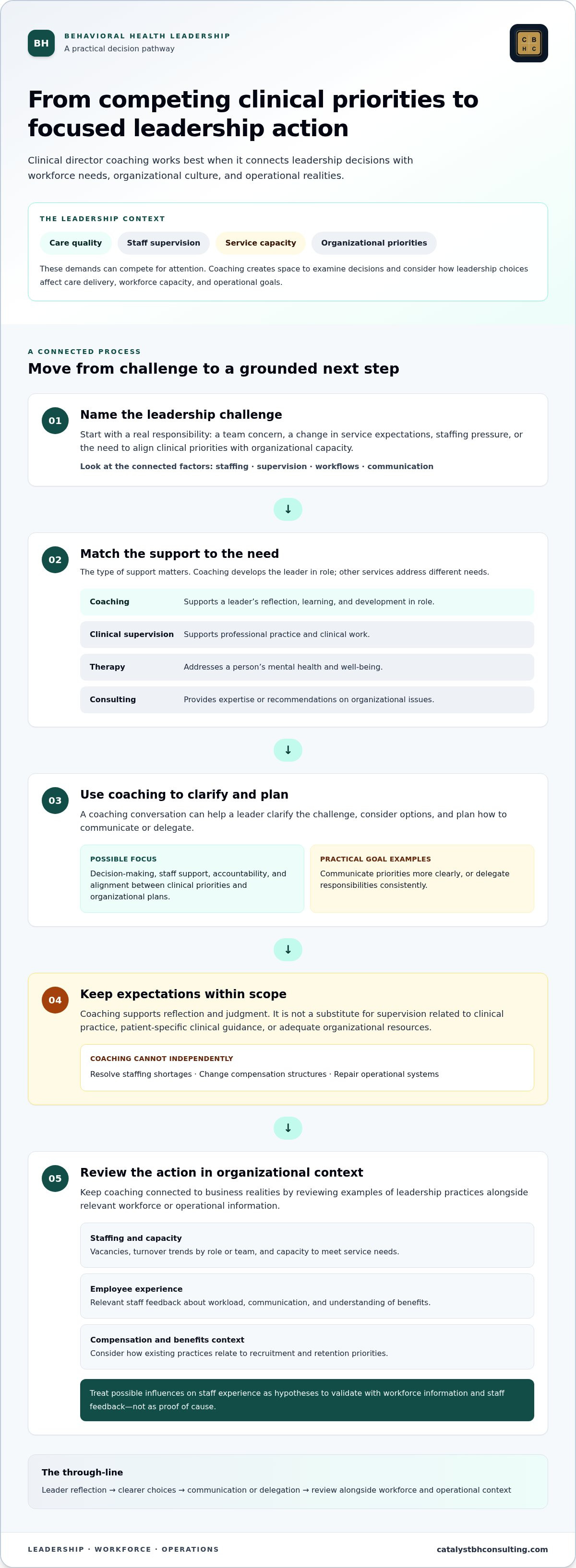
Clinical director coaching services can help a leader clarify a challenge, consider options, and plan how to communicate or delegate. Potential areas of focus include decision-making, staff support, accountability, and alignment between clinical priorities and organizational plans. The work should be tied to the leader’s actual responsibilities, rather than a preset solution for every behavioral health organization.
The distinctions matter:
- Clinical supervision supports professional practice and clinical work.
- Therapy addresses a person’s mental health and well-being.
- Consulting provides expertise or recommendations on organizational issues.
- Coaching supports a leader’s reflection, learning, and development in role.
Coaching can help a leader think through workforce pressures, but it cannot independently resolve staffing shortages, change compensation and benefits, or repair operational systems. Progress depends on the leader’s participation, organizational conditions, and whether decisions can be put into practice. A practical goal might be to communicate priorities more clearly or delegate responsibilities consistently. Reviewing examples of those practices alongside relevant workforce or operational information can keep coaching connected to business realities.
For a broader look at how leadership development relates to organizational challenges, read this behavioral health coaching discussion. Catalyst Behavioral Health Consulting offers executive coaching for behavioral health organizations, with conversations informed by clinical, workforce, and operational context.
How coaching can strengthen clinical leadership, culture, and workforce decisions
Leadership choices shape how priorities are communicated, responsibilities are understood, and staff concerns are addressed. Coaching can help a clinical director reflect on these practices and consider specific adjustments, such as clarifying who makes a decision or explaining how staffing decisions affect service delivery. These are areas to explore, not guaranteed outcomes. Whether a change improves staff experience depends on organizational conditions and how decisions are applied.
Connect leadership behavior with team experience
A clinical director might hear recurring concerns about workload or notice that teams interpret expectations differently. Coaching can help the leader identify what information is missing, decide what to ask, and plan a response. The NACHC Clinical Leadership Development Program is designed for clinical leaders in supervisory and administrative roles at health centers, illustrating how leadership development can address team and supervisory responsibilities.
Retention concerns call for careful analysis. A leader can explore whether role clarity, communication, or team culture may be influencing staff experience, then compare those possibilities with workforce information and staff feedback. These are hypotheses to validate, not proof of cause. Compensation and benefits also deserve attention: leaders can consider whether pay practices, benefit offerings, and communication about benefits align with workforce needs and organizational priorities. Coaching can help frame these questions, but it does not change compensation structures or establish why employees stay or leave.
Use workforce and compensation information to inform decisions
Workforce indicators can help leaders assess whether a concern is isolated or part of a broader pattern. Depending on the information available, useful context may include:
- Staffing: vacancies, turnover trends by role or team, and capacity to meet service needs.
- Employee experience: relevant staff feedback about workload, communication, and understanding of benefits.
- Compensation and benefits: how existing practices relate to recruitment and retention priorities, considered alongside other workforce factors.
Interpret each measure carefully. Check its definition and time period, and consider changes in workload, staffing, or organizational priorities before drawing conclusions. Comparing quantitative patterns with staff perspectives can help leaders ask more useful questions and identify where further organizational review may be needed.
Clinical director coaching services can give leaders space to examine these decisions in the context of behavioral health operations. Catalyst Behavioral Health Consulting offers executive coaching to behavioral health organizations, with support across clinical, human resources, and operational areas. You can discuss your leadership priorities in that organizational context.
How to compare clinical director coaching services and other leadership support
The right form of support depends on the problem to be addressed. A clinical director looking to strengthen judgment or communication may benefit from coaching. A leader addressing a clinical practice concern, a knowledge gap, or an organizational process issue may need a different approach. These options can complement one another, but they are not interchangeable. Compare their purpose, focus, participant role, and how progress could be reviewed.
| Support | Purpose and typical focus | Participant role | How progress could be reviewed |
|---|---|---|---|
| Coaching | Leadership reflection and development, such as examining decisions, communication, delegation, or alignment with organizational priorities. | The clinical director brings current leadership challenges, considers options, and identifies actions to apply. | Revisit agreed objectives and discuss examples of leadership practice, alongside relevant organizational indicators where appropriate. |
| Clinical supervision | Support for clinical work, professional practice, and related responsibilities. | The participant discusses clinical work within the supervision relationship and its defined scope. | Review relevant practice objectives and the supervision framework. |
| Consulting | Organizational advice or support with assessing and addressing a business or operational issue. | Leaders share context, consider recommendations, and determine how to use them. | Review agreed actions, decisions, or organizational measures connected to the issue. |
| Training | Development of knowledge or skills through instruction and learning activities. | Participants engage with content and practice or apply the material. | Review learning objectives and, where relevant, application of the skills or knowledge. |
Match the approach to the challenge
Start by describing the need precisely. “I need to handle competing priorities more clearly” points toward leadership development. A need for guidance on clinical practice suggests supervision, while a defined organizational problem may call for consulting. If leaders or staff need to learn a process or skill, training may be the more direct fit. Clinical curricula and training systems are distinct from coaching: curricula support structured learning, while coaching centers on the leader’s reflection and development.
Some challenges call for more than one form of support. A director might use training to build a specific skill and coaching to consider how to apply it amid competing team and operational priorities. Define each role so participants know whether they are developing judgment, receiving advice, or learning specific content.
Assess relevance and evidence
Clinical director coaching services are relevant when the goals connect to the leader’s responsibilities and the organization can make room to apply learning. Before selecting an approach, clarify what the director needs to do differently, what context could affect progress, and when objectives will be revisited. Choose indicators that fit the goals, such as staffing capacity or completion of agreed actions, without assuming that coaching caused a change. Research claims should match the population and setting studied; evidence from a different leadership or healthcare context may not transfer directly.
How to prepare for coaching and evaluate progress over time
Useful coaching goals start with an organizational need, not a general ambition to “be a better leader.” Turn the concern into a question the clinical director can work on and practices the organization can revisit. For example, if cross-team coordination is inconsistent, a focused question might be: “How can I clarify decision ownership and communicate changes so clinical and operational teams understand their roles?”
Set objectives grounded in organizational needs
Build a starting picture before choosing measures. Note the relevant clinical, workforce, and operational context, including current priorities, available feedback, and known constraints. Then define observable leadership practices, such as setting clear expectations or communicating decisions across teams. A useful evaluation lens comes from Avedis Donabedian’s 1988 JAMA paper on assessing health care quality, which distinguishes structure, process, and outcomes. Applied cautiously, this distinction can help separate organizational conditions, leadership actions, and results without implying that coaching itself produces a specific outcome.
Agree on what is within the leader’s influence and what depends on broader conditions. A clinical director may be able to clarify responsibilities or raise capacity concerns, but staffing resources, organizational policy, and competing initiatives can affect what changes are possible. If related needs extend beyond individual leadership development, clarify whether broader HR support is relevant too. The two forms of support may address different aspects of the challenge.
Review progress without overstating attribution
Select a small set of indicators that fit the goals and can be interpreted consistently. Depending on the challenge, these might include:
- Leadership practice: examples of clearer communication, delegation, or decision follow-through.
- Workforce context: vacancy patterns, turnover trends, staffing capacity, or relevant staff feedback.
- Operational priorities: progress on agreed coordination actions or a defined planning step.
Record how each indicator is defined, where the information comes from, and what conditions could influence it. Compare information over time, but treat changes as prompts for discussion, not proof that coaching caused them. A shift in turnover, for example, may coincide with changes in workload, staffing, leadership, or organizational priorities. Qualitative feedback can add context; agree in advance what information may be shared, with whom, and for what purpose.
Review goals at planned checkpoints and revise them if organizational needs change. Measures should support learning, not become guarantees or scorecards detached from context. Catalyst Behavioral Health Consulting offers executive coaching grounded in the clinical, workforce, and operational realities of behavioral health organizations. Discuss how coaching could align with your organization’s priorities.
Choosing a behavioral health coaching partner and taking the next step
Choosing a coaching partner starts with fit, not a promise of a particular result. Clinical directors work where care priorities, workforce decisions, and operational requirements intersect. A partner familiar with behavioral health organizations can understand that leadership questions often sit within this wider context, rather than treating them as isolated communication or management issues.
Assess organizational fit before committing attention
Before beginning clinical director coaching services, define the challenge in practical terms. Which leadership decision, communication pattern, or organizational priority needs attention? What change would matter to the organization, and who needs to support it? A clear starting point helps determine whether coaching fits the need or whether clinical supervision, training, consulting, or another organizational response is more appropriate.
Consider readiness as well as relevance. The clinical director needs space to reflect and apply learning, while organizational leaders should understand the purpose and boundaries of the work. Agree on realistic participation expectations and a way to revisit objectives. Progress discussions can consider relevant leadership practices and organizational indicators, while recognizing that staffing resources, competing priorities, and other conditions may affect what changes are possible.
Behavioral health experience matters because a leadership decision can have implications across clinical teams, service delivery, workforce capacity, and organizational operations. A useful coaching conversation keeps those connections in view without substituting for clinical guidance or assuming a particular solution. The partner should be able to discuss the organization’s context clearly and help the leader examine the challenge within the scope of executive coaching.
Connect coaching to the organization’s priorities
Catalyst Behavioral Health Consulting offers executive coaching to behavioral health organizations across the United States. Its work across clinical, human resources, regulatory, and operational areas provides relevant organizational context for conversations about leadership challenges. Coaching should stay grounded in the organization’s specific needs, without assuming that it alone can resolve workforce or operational constraints.
Before a conversation, prepare a concise summary of the leadership challenge, the organizational change you hope to support, and the people or teams affected. Bring relevant context, such as current priorities or existing indicators, while avoiding unnecessary personal or sensitive information. Identify what would make the discussion useful, whether that means clarifying the scope of coaching, exploring leadership priorities, or considering how the work connects with broader organizational needs.
If your organization is considering clinical director coaching, book a conversation about coaching needs and bring the leadership challenge you’re working through.
Make leadership development part of organizational progress
Clinical director coaching is most useful when it connects leadership reflection to the decisions and conditions shaping behavioral health operations. The right support depends on the challenge: coaching can develop leadership practice, while supervision, training, or consulting may better address other needs. Clear objectives and relevant workforce or operational indicators can help leaders review learning over time, without treating correlation as proof of impact.
Choosing clinical director coaching services is a strategic decision about fit, scope, and readiness. Start with the leadership challenge, identify the organizational context, and decide what progress would look like in practice. Catalyst BH Consulting offers executive coaching to behavioral health organizations across the United States.
Book a conversation about clinical director coaching to discuss your organization’s priorities. With a clear focus and realistic expectations, leaders can take a thoughtful next step toward connecting clinical leadership with sustainable organizational decisions.
Frequently Asked Questions
What do clinical director coaching services include?
Clinical director coaching services support leadership development by helping a director examine organizational challenges, consider options, and strengthen leadership practices. Focus areas may include decision-making, communication, delegation, or alignment between clinical priorities and organizational needs. Coaching differs from clinical supervision, which serves a distinct professional function, and consulting, which provides organizational advice or support. The focus should fit the director’s responsibilities and behavioral health context, rather than follow an assumed fixed process or set of deliverables.
How is coaching different from clinical supervision?
Coaching focuses on leadership goals and organizational practice, while clinical supervision serves a distinct professional function related to clinical work. A director might use coaching to reflect on how priorities are communicated across teams; supervision addresses matters within its own professional scope. Clarify the purpose, boundaries, and intended focus of each support so they are not confused or treated as substitutes. The appropriate arrangement depends on the organization’s needs and context.
Can coaching help a clinical director address staff retention?
Coaching may help a clinical director examine communication, team culture, and workforce information, but it cannot establish why employees leave or guarantee better retention. The U.S. Surgeon General’s Framework for Workplace Mental Health and Well-Being offers a broad lens for considering workplace conditions; it is not a behavioral-health-specific study proving that coaching changes retention. Leaders can use workforce trends and staff perspectives to develop questions, then consider workload, staffing capacity, compensation, and other organizational influences.
How can an organization measure whether leadership coaching is useful?
Set relevant objectives, identify leadership practices to revisit, and choose organizational indicators that fit the challenge. Donabedian’s 1988 JAMA paper, “The Quality of Care: How Can It Be Assessed?”, distinguishes structure, process, and outcomes as a framework for evaluating health care quality. It is not evidence that coaching causes organizational change. Document measure definitions and contextual factors, then review observed changes as information for learning, not proof of coaching’s impact.
Is executive coaching appropriate for behavioral health clinical directors?
Executive coaching may fit when a clinical director’s objectives involve leadership decisions, communication, or aligning clinical priorities with organizational needs. Fit depends on the director’s responsibilities, the organization’s context, and the goals being considered. Leadership development is distinct from patient care, clinical supervision, and technical training, which serve different purposes. No single approach suits every organization. Catalyst Behavioral Health Consulting offers executive coaching to behavioral health organizations across the United States.
What should a clinical director clarify before starting coaching?
Clarify the leadership challenge, the practices you want to strengthen, the stakeholders affected, and how progress will be reviewed. For example, a concern about coordination may call for clearer decision roles or communication expectations. Agree on confidentiality boundaries, including what information may be shared and with whom. Establish realistic expectations for participation and account for factors beyond the director’s control. These steps help determine whether coaching’s purpose and scope fit the need.
How does clinical director coaching relate to workforce strategy?
Coaching can help a clinical director consider how team experience, workforce indicators, compensation and benefits, and organizational priorities fit together. The U.S. Surgeon General’s Framework for Workplace Mental Health and Well-Being provides a broad workplace lens, not proof that coaching improves workforce outcomes. Leaders can review vacancy or turnover patterns alongside staff feedback and operating context, while checking how measures are defined. This analysis may inform questions and decisions, but it does not guarantee changes in staffing, retention, or performance.

Article by
James McCreary, MS, LPC-S
The Catalyst dispatch.
Frameworks and field lessons on running effective behavioral-health programs. One email a month, sometimes two. Never spam.