Insights
Clinical Training for Behavioral Health: 2026 Framework
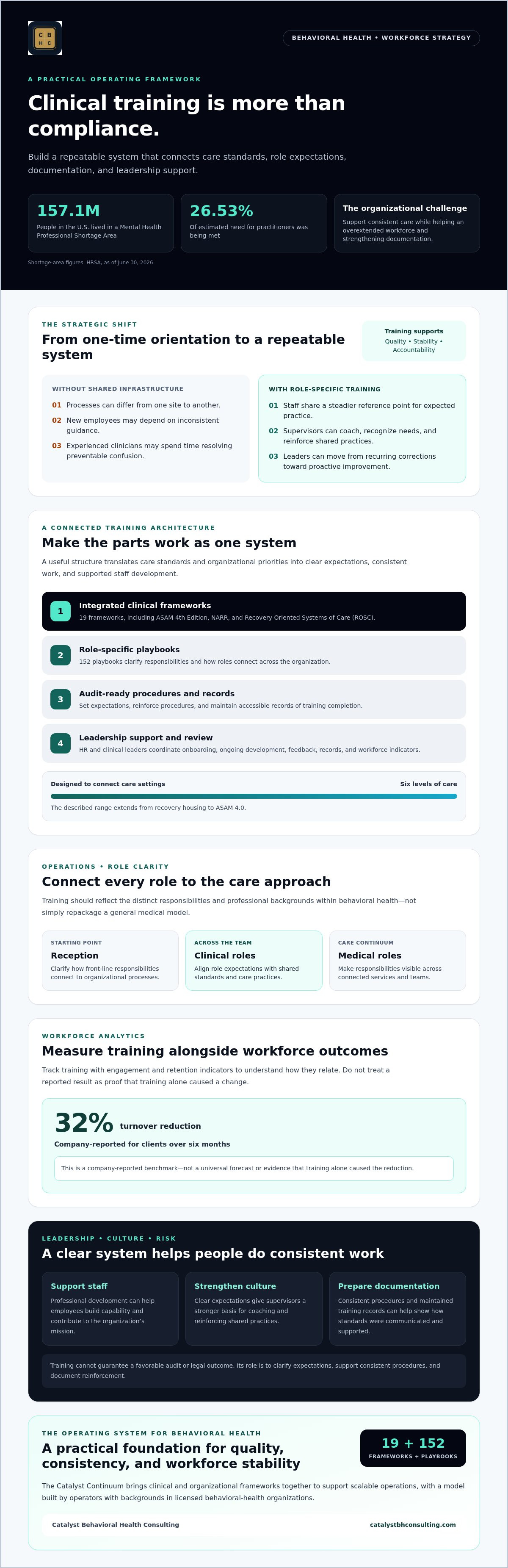
As of June 30, 2026, 157.1 million people in the United States lived in a Mental Health Professional Shortage Area, with only 26.53% of estimated need for practitioners being met, according to HRSA. In this environment, clinical training for behavioral health staff can’t remain a compliance checkbox. It must help organizations deliver consistent care, support an overextended workforce, and strengthen documentation before audit or litigation challenges arise.
Leaders already know that a one-time orientation can’t resolve uneven practice across sites or improve retention on its own. The answer is a repeatable system that connects role expectations, clinical standards, documentation, and leadership support. This framework shows how to build that infrastructure to reduce clinical errors, strengthen staff engagement, and align care with organizational priorities.
We’ll examine how to make training scalable and audit-ready in 2026, including the role of measurement-informed care and evolving accreditation expectations. We’ll also look at how the Catalyst Continuum’s 19 integrated frameworks and 152 role playbooks can support organizations seeking CCO-level leadership. Built by operators with backgrounds in licensed behavioral-health organizations, it positions training as The Operating System for Behavioral Health: a practical foundation for quality, consistency, and workforce stability.
Key Takeaways
- Position clinical training for behavioral health staff as an organizational system that supports consistent care, retention, and risk management, not just a compliance task.
- See how 19 integrated frameworks, including ASAM 4th Edition, NARR, and ROSC, can guide a more consistent approach to quality care.
- Use role-specific playbooks and audit-ready procedures to clarify how responsibilities connect across the organization, from reception through medical roles.
- Track training alongside workforce outcomes to understand its relationship to engagement and retention; Catalyst Behavioral Health Consulting reports a 32% turnover reduction in six months for clients.
- Explore how the Catalyst Continuum can help organizations build The Operating System for Behavioral Health, with clinical and organizational frameworks designed to support scalable operations.
Table of Contents
- The Strategic Case for Clinical Training: Beyond Basic Compliance
- Evidence-Based Frameworks: The 19 Pillars of Clinical Competency
- Operationalizing Training with 152 Role-Specific Playbooks
- Workforce Analytics: Measuring the ROI of Clinical Education
- Implementing the Catalyst Continuum: Your Clinical Operating System
The Strategic Case for Clinical Training: Beyond Basic Compliance
Clinical training is more than a collection of courses or an onboarding checklist. For a growing behavioral health organization, it’s infrastructure: a shared system for translating care standards, role expectations, and documentation practices into consistent work across teams and locations. That’s why it can serve as The Operating System for Behavioral Health, supporting quality, workforce stability, and accountable operations.
Behavioral health also calls for a model built around its own workforce and care context, not a surgical or general medical operating model repackaged for a different setting. Staff roles and professional backgrounds vary, from reception through clinical and medical positions. A useful training structure respects those distinctions while clarifying how each role contributes to the organization’s care approach. For a foundational overview of the profession, see Clinical mental health counseling.
Training as a Catalyst for Organizational Stability
Growth can expose gaps that informal knowledge once concealed. One site may handle a process differently from another; new employees may rely on inconsistent guidance; experienced clinicians may spend time resolving preventable confusion. Standardized, role-specific training gives staff a steadier reference point and helps leaders move from recurring corrections toward proactive improvement.
That consistency also shapes culture. When expectations are clear, supervisors can coach with greater confidence, recognize development needs, and reinforce shared practices without relying on crisis-driven reminders. Professional development can support recruitment and retention by showing employees how they can build capability and contribute to the organization’s mission. Catalyst Behavioral Health Consulting reports a 32% turnover reduction in six months for clients; that result is a company-reported benchmark, not a universal forecast or proof that training alone caused the change.
Mitigating Risk and Litigation Exposure
In multi-site organizations, clinical drift can create uneven practice and documentation. If staff aren’t trained to follow shared procedures, records may not clearly show what was done, by whom, or according to which organizational process. Training can reduce those gaps by setting expectations, preparing staff to use procedures consistently, and documenting completion and reinforcement. It can’t guarantee a favorable audit or legal outcome, but a maintained, accessible training record can help demonstrate how the organization communicated and supported its standards.
Senior HR leadership should help oversee the training lifecycle alongside clinical leaders: identify role-based needs, coordinate onboarding and ongoing development, maintain records, and review feedback and workforce indicators. This makes training part of workforce strategy rather than a standalone compliance task. Operators with backgrounds in licensed behavioral-health organizations can help keep that system grounded in the realities of behavioral health while supporting an approach that is consistent, adaptable, and defensible.
Evidence-Based Frameworks: The 19 Pillars of Clinical Competency
A framework becomes operational when an organization defines how it applies to its services, decisions, and quality review. Catalyst Behavioral Health Consulting’s clinical model integrates 19 frameworks, including ASAM 4th Edition, NARR, and Recovery Oriented Systems of Care (ROSC). The value lies not simply in adopting multiple standards, but in clarifying how they work together across six levels of care, from recovery housing to ASAM 4.0.
For leaders, this integration creates a way to examine whether policies and training reflect the organization’s actual care model. It also helps identify overlaps or gaps between frameworks, so teams can align procedures without assuming that one standard applies identically in every setting.
Standardizing Care with ASAM and NARR
As of 2026, the ASAM Criteria, 4th Edition, is the current comprehensive framework for adult addiction treatment. Its person-centered approach and updated organization of levels of care make it important for relevant teams to understand how the organization applies the criteria to assessment and placement. Staff training should reflect current source materials and local implementation, while preserving the role of qualified clinical judgment.
NARR Standard 3.0 provides guidance for recovery residences, describing four levels of support and standards across four domains. Organizations can use it to shape residence-specific practices and clarify how recovery housing fits within a broader service continuum. Leaders should confirm which standards and accreditation expectations apply to their programs, then document how those expectations inform local procedures.
Integrating ROSC and CHIME
ROSC frames recovery as a process supported across services and over time, rather than a concern limited to an acute episode. CHIME describes five recovery processes: Connection, Hope, Identity, Meaning, and Empowerment. Teams can use these concepts to reflect on whether interactions and service planning recognize a person’s goals and supports. CHIME should not be described as a formal audit tool unless the organization has established and validated that use.
Measurement-informed practice offers another link between frameworks and organizational learning. CARF’s 2026 Behavioral Health Standards Manual emphasizes Measurement-Informed Care, including the use of standardized assessments to track progress and inform decisions. Leaders can review whether chosen measures are applied consistently and whether the resulting information is useful to clinical teams. This supports evaluation and quality improvement, but doesn’t by itself guarantee better outcomes or reimbursement.
Organizations assessing how to connect frameworks with clinical curricula and operational guidance can explore integrated clinical training frameworks from Catalyst Behavioral Health Consulting, whose model is informed by operators with backgrounds in licensed behavioral-health organizations.
Operationalizing Training with 152 Role-Specific Playbooks
Frameworks only improve practice when employees can apply them in the moments that matter. Catalyst Behavioral Health Consulting’s model includes 152 role playbooks, covering positions from reception through medical roles. The purpose of this level of role-specific guidance is to clarify each employee’s responsibilities and how everyday work supports organizational quality standards.
A one-size-fits-all course can leave practical gaps. A receptionist may need guidance on routing a concern and protecting sensitive information, while clinical staff need training tied to their assigned responsibilities and documentation processes. Non-clinical roles aren’t substitutes for clinical judgment, but their work can affect how reliably an organization carries out its mission. Clinical training for behavioral health staff should make those role boundaries and handoffs clear.
Build Playbooks Around Real Work
Start with the tasks, decisions, and handoffs attached to each role. Then connect them to relevant policies, clinical standards, and escalation pathways. Editable, audit-ready standard operating procedures (SOPs) can support this work when they have clear ownership, version control, and a defined review process. Staff can learn from the same documented expectations, while leaders can identify where procedures need clarification or training needs reinforcement.
A Strategic Architect brings the system together: breaking complex expectations into focused learning segments, aligning playbooks with organizational standards, and checking that training reflects actual workflows. This modular approach makes learning more digestible without fragmenting the underlying clinical model.
Practice Skills and Track Readiness
Move beyond slides by giving staff structured opportunities to practice. Case-based ASAM exercises can help relevant team members work through how criteria inform assessment and placement decisions. SAFE-T can be incorporated into training for staff whose roles require suicide-risk assessment, with practice aligned to the organization’s protocols, role boundaries, and supervision structure. Neither a tool nor a training module replaces qualified clinical judgment.
Digital dashboards can help leaders monitor completion, overdue learning, and documented competency checks. Completion alone doesn’t establish fidelity, so pair tracking with appropriate observation, review, or coaching. That creates a more useful picture of whether training is being applied consistently, while helping leaders target support instead of relying on blanket reminders.
Training records and current procedures also support audit readiness by helping an organization show what expectations were communicated and when staff completed assigned learning. Catalyst Behavioral Health Consulting’s work is informed by operators with backgrounds in licensed behavioral-health organizations, connecting operational design with the realities of care delivery. Organizations assessing how to strengthen their procedures can explore behavioral health training support as part of building The Operating System for Behavioral Health.
Workforce Analytics: Measuring the ROI of Clinical Education
To evaluate clinical education, connect workforce measures to business priorities rather than treating course completion as the outcome. Establish a baseline, select indicators that match the training objective, and review results over time. For example, a manager-development initiative might be evaluated alongside employee feedback, internal promotion patterns, and retention trends. These measures can reveal useful associations, but they don’t prove that training alone caused a change.
The Data-Driven Approach to Retention
Use workforce data to locate pressure points before choosing a response. Compare turnover, engagement feedback, and training participation by role, team, and site, while protecting employee privacy. If teams report unclear expectations or limited manager support, investigate those conditions alongside workload and onboarding practices. The goal is to identify where leaders can act, then measure whether the experience improves, not to assign blame based on a single metric.
Leadership development is part of that analysis. Consistent manager practices can shape how employees receive feedback, understand performance expectations, and see opportunities to grow. During a leadership transition, organizations can assess whether managers understand decision rights and people processes, then target development to the gaps. This links training analytics to culture and organizational continuity without assuming that one course will solve a broader management challenge.
Compensation and Professional Growth
Training also belongs in a thoughtful total rewards strategy. Compensation and benefits remain important to recruitment and retention, while access to relevant learning can signal investment in an employee’s future. Review development opportunities alongside compensation practices, benefits feedback, and exit or engagement data. Use reliable, comparable market information where available, and avoid claiming a competitive advantage without evidence. The purpose is to make informed workforce decisions, not to treat training as a substitute for fair compensation.
For a practical review, leaders can map learning priorities against workforce needs and HR responsibilities, then identify gaps in ownership, process, and measurement. Review the indicators regularly with HR and clinical leadership, document decisions, and adjust the plan when evidence points to a different need. This turns clinical training for behavioral health staff into an integrated HR strategy that supports stronger management, workforce stability, and accountable operations.
Catalyst Behavioral Health Consulting provides fractional HR leadership and clinical curricula and training systems for organizations working to align workforce priorities with their clinical model. To discuss how to assess those priorities, book a conversation about workforce strategy and explore how training can support The Operating System for Behavioral Health.
Implementing the Catalyst Continuum: Your Clinical Operating System
A clinical training system only works if leaders can put it into practice, maintain it, and adapt it as the organization grows. The Catalyst Continuum is a productized clinical and organizational operating model designed to connect frameworks, care levels, and role expectations. Its 19 integrated frameworks and 152 role playbooks provide a structured foundation for organizations seeking consistency across teams and locations.
Think of a live, searchable portal as an operational design goal, not a substitute for accountable leadership. When staff can quickly find current procedures, training references, and documentation guidance in a central location, they have a clearer route from policy to practice. Leaders should establish ownership, review cycles, and version control so materials remain relevant and staff aren’t relying on outdated guidance.
Align Leadership and Implementation
Multi-site rollout requires clear executive ownership. Organizations that need CCO-level leadership can use a defined operating model to align clinical priorities, role responsibilities, and implementation decisions. Senior leaders should set the scope, clarify who owns each element, and create a feedback path for managers and staff. Fractional HR leadership can complement this work by connecting workforce strategy, leadership practices, and development priorities without implying a specific staffing arrangement or commitment length.
Operators with backgrounds in licensed behavioral-health organizations bring practical context to system design. That perspective helps leaders distinguish a framework that looks complete on paper from one staff can use in daily operations. The objective is to reduce dependence on individual heroics by building repeatable processes that support sound judgment, clear accountability, and a consistent staff experience.
Build an Audit-Ready Future
Accreditation readiness depends on an organization’s ability to implement its policies and maintain documentation that reflects its actual practices. Catalyst BH Consulting has expertise in CARF and JCAHO accreditation readiness. A productized clinical model can help leaders organize expectations, training records, and procedures into a more coherent system, but it doesn’t guarantee a survey outcome. Organizations should verify current standards and assess their own implementation regularly.
For clinical training for behavioral health staff, a steady system is more sustainable than repeated last-minute corrections. Leaders can set priorities, monitor adoption, and address gaps before they become routine sources of confusion. That’s the operational promise of The Operating System for Behavioral Health: a framework that helps connect people, procedures, and quality expectations as the organization grows.
To discuss how to strengthen your organization’s clinical training structure, book a discovery call to professionalize your clinical training.
Build a More Stable Future for Behavioral Health
Clinical training for behavioral health staff is most effective when it connects workforce strategy, role expectations, and quality standards in one practical system. The 19 integrated clinical frameworks and 152 role-specific playbooks in the Catalyst Continuum offer a structured foundation for organizations working to scale consistent practices across teams and care settings.
That structure matters for more than compliance. It can help leaders clarify expectations, support staff development, and build documentation practices that are organized and reviewable. Catalyst BH Consulting reports a 32% turnover reduction in six months for clients; this is a company-reported result, not a guarantee or proof that training alone produced the change.
Built by operators with backgrounds in licensed behavioral-health organizations, the Catalyst Continuum is designed as The Operating System for Behavioral Health. It reflects a broader principle: sustainable growth depends on systems that support people, not on individual heroics alone.
Take the next step toward more consistent clinical operations. Book a 20-minute discovery call to learn how the Catalyst Continuum can professionalize your clinical operations. With clear frameworks and steady leadership, your organization can build a stronger foundation for staff and the people they serve.
Frequently Asked Questions
What are the core clinical training requirements for behavioral health staff in 2026?
There isn’t one universal training checklist for every behavioral health organization. Training should reflect each person’s role, the services provided, organizational policies, and applicable accreditation, payer, and jurisdictional expectations. In 2026, leaders should verify current standards directly with relevant authorities. For example, CARF’s 2026 Behavioral Health Standards Manual emphasizes Measurement-Informed Care and written policies governing AI use. Map applicable expectations to staff responsibilities, then document training and competency review.
How can clinical training help reduce staff turnover in mental health facilities?
Well-structured training can make expectations clearer, strengthen onboarding, and give employees a defined path to develop in their roles. Those conditions may support engagement, but training alone can’t guarantee lower turnover. Leaders should compare retention and employee feedback across roles and locations, then examine workload, supervision, and management practices alongside training records. This gives decision-makers a more complete basis for improving the workforce experience.
What is the difference between a medical operating model and a behavioral health operating system?
A behavioral health operating system should be designed around behavioral health roles, care settings, recovery principles, and documentation needs, rather than adapting a surgical or general medical model. It connects clinical frameworks with workforce practices and operational procedures so teams can apply shared standards without treating every role or program as identical. The goal is a consistent, role-aware structure that supports sound judgment and clear accountability.
How do role-specific playbooks improve care quality in multi-site organizations?
Role-specific playbooks translate organizational expectations into practical guidance for different jobs and locations. For example, reception staff need clear procedures for routing information, while clinicians need role-appropriate guidance for clinical work and documentation. Shared, maintained playbooks can reduce confusion between sites and clarify handoffs. Leaders should pair them with training, version control, and periodic review so staff can find current procedures and apply them consistently.
Can fractional HR leadership help manage clinical training compliance?
Yes. Fractional HR leadership can help coordinate the people systems around training, such as role-based assignment processes, completion records, onboarding, and documentation practices. Clinical leaders should retain responsibility for clinical content and competency decisions, while HR leadership can support oversight, consistency, and an organized record trail. This partnership helps connect workforce strategy with training administration without treating HR as a substitute for clinical governance.
How often should clinical frameworks like ASAM or NARR be updated in staff training?
There isn’t a universal update schedule that applies to every organization. In 2026, the ASAM Criteria, 4th Edition, is the current adult framework, while NARR Standard 3.0 remains the identified current standard for recovery residences. Assign someone to monitor authoritative updates and review training when standards, applicable requirements, or organizational procedures change. Keep version dates and communicate revisions to the roles affected.
What tools are essential for documenting clinical training for CARF or Joint Commission audits?
Use a reliable system to record assigned training, completion dates, relevant curriculum versions, and competency checks where applicable. Maintain current procedures and a clear record of revisions, and make documentation accessible to the people responsible for oversight. A dashboard or searchable portal can help organize records, but no tool guarantees audit readiness. Confirm the documentation expectations for your program against the current standards that apply.
How does the Catalyst Continuum help startups establish a clinical training culture?
The Catalyst Continuum gives behavioral health startups a structured foundation through 19 integrated frameworks, 6 levels of care, and 152 role playbooks. Its model also includes a live searchable portal and interactive tools, which can help organize training references and procedures. Developed with input from operators with backgrounds in licensed behavioral-health organizations, it is designed as The Operating System for Behavioral Health, connecting clinical and organizational practices as a program develops.

Article by
James McCreary, MS, LPC-S
The Catalyst dispatch.
Frameworks and field lessons on running effective behavioral-health programs. One email a month, sometimes two. Never spam.