Insights
Improving Clinical Quality Systems in Behavioral Health: Trends and Practical Priorities
Clinical quality can be thoroughly documented and still fail to shape daily care. Improving clinical quality systems means connecting measurement with workforce capability, leadership decisions, and operational practice so data supports action rather than adding another layer of paperwork.
If quality processes feel separate from clinical work, or leaders struggle to turn dashboards into improvement decisions, the disconnect is an organizational challenge. Staff need systems that clarify priorities and support consistent practice, not simply ask them to record more information.
This article explores shifts shaping behavioral health quality, including outcome-focused measurement, workforce analytics, and technology oversight. It also outlines practical ways to align leadership, staff, operations, and clinical practice, then evaluate whether changes are producing useful results. The goal is a disciplined, measurable approach that makes quality improvement part of how the organization learns and works.
Key Takeaways
- Understand why improving clinical quality systems is a strategic priority connected to workforce capacity, care consistency, and organizational decisions.
- Assess emerging quality priorities against named sources and the needs of your organization, program, and care setting.
- Distinguish process, outcome, and balancing measures so activity counts aren’t mistaken for evidence of better care.
- Use a clear improvement sequence with defined ownership across clinical leadership, operations, and workforce functions.
- Build quality review into ongoing organizational practice, then use the evidence to refine priorities and processes.
Table of Contents
- Why improving clinical quality systems is a business priority in behavioral health
- Emerging trends reshaping clinical quality systems
- How to measure improvement without mistaking activity for quality
- A practical framework for strengthening a clinical quality system
- Making clinical quality improvement sustainable across the organization
Why improving clinical quality systems is a business priority in behavioral health
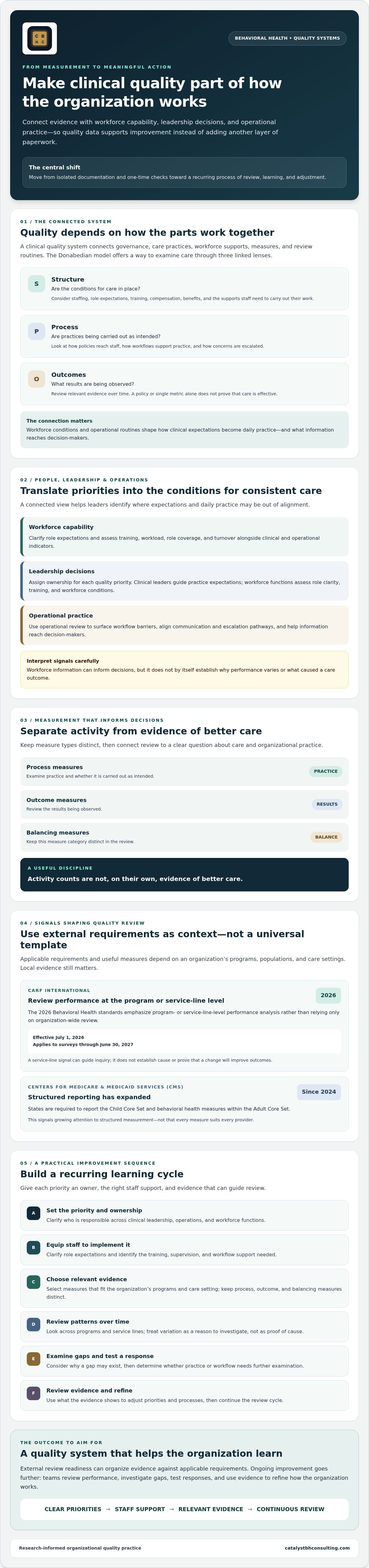
A clinical quality system is the connected set of governance, care practices, workforce supports, measures, and review routines an organization uses to guide, assess, and improve care. The Donabedian model offers one way to examine its components: it considers healthcare quality through structure, process, and outcomes. This framework for assessing health care quality helps leaders ask whether the conditions for care are in place, whether practices are being carried out as intended, and what results are being observed.
That connection makes quality a business priority, not just a documentation project. Decisions about staffing, role expectations, training, compensation, and benefits shape the conditions in which clinical work happens. Operational routines determine how policies are communicated, concerns are escalated, and information reaches decision-makers. Looking at these elements together helps an organization identify where expectations and daily practice may be out of alignment. A policy or single metric alone does not prove that care is effective.
What makes a clinical quality system more than a compliance file?
Policies define expectations, but they can’t show whether staff understand them, workflows support them, or implementation is consistent across programs. A connected system links governance to clinical practice, equips staff to carry out defined roles, and reviews relevant information to identify questions for improvement.
External review readiness and ongoing learning serve different purposes. Preparing for an accreditation or licensing review can help organize evidence against applicable requirements. Continuous quality improvement goes further: teams examine performance over time, consider why a gap exists, test an appropriate response, and review what the evidence shows. A one-time audit, isolated corrective action, or document revision may address a specific issue, but it doesn’t establish a recurring learning cycle.
Why behavioral health organizations need a connected view
Behavioral health organizations may work across distinct care models, roles, and operating routines. An expectation that is clear to one team may be interpreted differently by another if training, supervision, documentation, and escalation pathways aren’t aligned. Workforce information can help leaders examine workload, role coverage, and turnover alongside clinical and operational indicators. These signals inform decisions, but they don’t establish why performance varies or what caused a care outcome.
A practical starting point is to clarify who owns each quality priority, what staff need to implement it, and what evidence will inform review. Clinical leaders can guide practice expectations, operations can surface workflow barriers, and workforce functions can assess role clarity, training, and workforce conditions. For a deeper look at the training dimension, see Clinical Training for Behavioral Health: 2026 Framework. Improving clinical quality systems depends on bringing these responsibilities into a shared process of review and adjustment.
Emerging trends reshaping clinical quality systems
Quality expectations are moving toward more regular measurement and clearer links between evidence and decisions. These shifts aren’t a universal template: accreditation requirements, reporting responsibilities, and useful measures depend on an organization’s programs, populations, and care settings. For leaders improving clinical quality systems, the practical task is to identify which trends apply and what local evidence can support action.
From retrospective reporting to a learning system
Periodic audits can identify whether a requirement was met at a particular point in time. Recurring review adds another capability: it helps leaders notice patterns, ask what may explain them, and decide whether practice or workflow needs further examination.
CARF International’s 2026 Behavioral Health standards emphasize performance analysis at the program or service-line level, rather than relying only on organization-wide review. The standards took effect July 1, 2026, and apply to surveys through June 30, 2027. For behavioral health organizations, this raises a practical question: can leaders see variation across programs well enough to investigate it? A service-line signal can guide inquiry, but it doesn’t establish cause or prove that a change will improve outcomes.
CMS also reports that, since 2024, states are required to report the Child Core Set and behavioral health measures within the Adult Core Set. This signals growing attention to structured measurement, not that every measure suits every provider. Before using a measure to guide internal decisions, organizations should verify its relevance to their population and setting.
Workforce and organizational conditions as quality signals
Workforce analytics can provide context for quality review. Leaders might examine role coverage, vacancies, turnover, training completion, and workload alongside relevant service or care measures. These data can help identify where to investigate, but they can’t show by themselves that staffing conditions caused a clinical result. Changes in compensation and benefits strategy, role design, or leadership practice should also be assessed against organizational aims and monitored for unintended effects.
Implementation matters. Staff need clear expectations, relevant preparation, and a culture where raising a concern supports learning rather than blame. The Clinical Curricula for Treatment Centers: 2026 Buying Guide can help leaders think through how training resources align with workforce capability and program priorities. Any selected curriculum still needs to fit the organization’s roles and care context.
Technology oversight is another current consideration. CARF’s 2026 standards place stronger emphasis on technology governance, including organizations’ use of artificial intelligence and stakeholder input into technology planning. Leaders should first establish what tools are being used, who oversees them, and how their use will be reviewed. Appropriate controls depend on the application and setting.
To translate these trends into a locally grounded review plan, organizations may consider discussing quality-system priorities with a behavioral health consultant.
How to measure improvement without mistaking activity for quality
Start with a decision the organization needs to make, not with a dashboard. The Institute for Healthcare Improvement’s Model for Improvement describes outcome, process, and balancing measures as complementary ways to assess results, implementation, and potential unintended effects. For behavioral health organizations, measure definitions should fit the program, population, and care setting. A useful measurement plan also specifies who gathers the information, how data collection affects staff capacity, and how leaders will use the findings.
| Measure type | What it can indicate | What it cannot establish alone |
|---|---|---|
| Process | Whether a defined practice or workflow step is being carried out as intended. | Whether that step improved care or is appropriate for every setting. |
| Outcome | Whether a result relevant to the improvement aim is changing. | That a specific intervention caused the change. |
| Balancing | Whether a change may be creating a drawback elsewhere, such as added workload. | That the change is sustainable across teams or has no other unintended effects. |
Choose measures that match the improvement question
First, state the question in terms that connect organizational priorities to day-to-day work. For example: “Are staff able to complete the intended follow-up process, and what effect does it have on workload?” That question may call for a process measure, a relevant outcome measure, and a balancing measure. Define each measure’s data source, owner, review cadence, and limitations. Treat a proposed threshold as a local hypothesis until it has been validated for the setting, rather than presenting it as a universal benchmark.
Keep collection effort proportionate to the decision. HR and operations leaders can check whether responsibilities are clear, information is already captured, and reporting fits existing workflows. This helps prevent measurement from becoming an administrative task without a defined use.
Read workforce and clinical indicators in context
Workforce analytics can add context through indicators such as role coverage, turnover, training completion, and workload. Leadership practices, team culture, compensation and benefits decisions, and operational changes may also be relevant when interpreting patterns. For example, a change in staff coverage alongside a shift in a clinical indicator can prompt closer review, but the association doesn’t prove cause or clinical effectiveness.
Context matters. A signal can identify a question for investigation, while responsible interpretation requires considering how the measure was collected, which roles were affected, and what else changed during the review period.
Improving clinical quality systems means choosing measures that inform decisions, support accountable leadership, and remain workable for staff, not simply counting activity.
A practical framework for strengthening a clinical quality system
A workable improvement plan connects a defined care or organizational concern to clear ownership, relevant evidence, and a review routine. Use the sequence below as an adaptable framework, not a replacement for clinical judgment or requirements that apply to your specific setting.
- Define the problem. Describe the gap in observable terms. Identify the affected program, roles, workflow, and people served, then separate what’s known from what still needs investigation.
- Establish a baseline. Review available clinical, operational, and workforce information. Note data limitations, existing processes, staff capacity, and other constraints that may affect implementation.
- Select a focused priority. Choose a care need that can be addressed through a manageable operational response. State what the team intends to learn rather than assuming the cause or promising a particular result.
- Assign ownership. Clinical leadership should guide practice expectations and interpretation. Operations can map workflow and surface process barriers. Workforce functions can assess role clarity, training needs, staffing context, and relevant compensation or benefits considerations.
- Test a change with staff. Involve the people who carry out the work in identifying a practical adjustment. Clarify what will change, who needs preparation, and how the team will track implementation and workforce effects.
- Review and adjust. Set a review cadence that fits existing meetings and workflow. Compare findings with the baseline, discuss unintended effects, and decide whether to adapt, continue, or stop the change. Define how unresolved concerns move to the appropriate leader.
Establish a shared baseline and priority
Start with a shared account of how the process works in practice, not only how a policy describes it. For example, a team examining a handoff can map the roles involved, identify where information is recorded, and ask staff where delays or ambiguity arise. Then select measures that match the question and can be interpreted in the organization’s care context.
External review readiness may be one reason to clarify policies, evidence, and ownership, but preparation should remain connected to everyday practice. Organizations reviewing this dimension may also consult Behavioral Health Accreditation Support: A Strategic Path to Operational Excellence. Requirements vary, so verify which standards apply to the program and setting.
Test, learn, and sustain changes with staff
Staff feedback helps leaders understand whether a change is workable across roles and shifts. Review implementation alongside intended measures, workload, training completion, and relevant workforce signals. These observations can prompt further inquiry, but they don’t prove that a change caused a clinical result. Use findings to refine training, supervision, and operating routines, then document decisions and next steps.
For support aligning quality priorities with organizational processes, discuss your clinical quality system priorities.
Making clinical quality improvement sustainable across the organization
Quality improvement lasts when it becomes part of how the organization sets priorities, supports staff, and reviews performance. Leaders can reinforce that capability by assigning an accountable owner, involving teams closest to the work, and making review a regular part of existing governance and operational routines. The aim isn’t to create another reporting layer. It’s to ensure findings lead to considered decisions, follow-up, and learning.
Align governance, workforce capability, and operating routines
Clarify who approves a change, who implements it, and who reviews the evidence. Clinical leadership can maintain practice expectations, operations can identify workflow barriers, and workforce functions can address role clarity, training, and relevant staffing considerations. Staff need a way to raise concerns and understand how unresolved issues are escalated. These responsibilities should fit the organization’s structure and the requirements that apply to its programs.
Training and role-specific guidance can support more consistent implementation, but they don’t replace supervision, leadership attention, or ongoing review. A policy, dashboard, or technology platform can organize information without ensuring that people use it well. Sustainable improvement depends on connecting these resources to daily decisions and checking whether the process remains practical as staffing, programs, and organizational needs change.
When structured external support may help
External support may be worth considering when improvement work repeatedly stalls, ownership is unclear, processes vary across programs, or internal teams lack capacity to coordinate implementation. Catalyst Behavioral Health Consulting supports behavioral health organizations with clinical operations, quality, and organizational consulting. Its Catalyst Continuum is an audit-ready operating model delivered through documents, dashboards, and a live searchable portal. It includes 19 integrated frameworks, addresses 6 levels of care, and provides 152 role playbooks and 10+ interactive tools. These resources can help organize implementation, but they aren’t evidence that a particular quality outcome will follow or a substitute for evaluating what fits the organization.
For any external resource, assess alignment with your care settings, workforce roles, and applicable standards. Establish who will maintain the work, how staff feedback will inform decisions, and what evidence will be reviewed. That discipline helps keep quality improvement connected to organizational priorities rather than turning it into a one-time initiative.
Discuss your organization's quality priorities.
Make quality improvement part of how your organization works
Improving clinical quality systems takes more than adding measures or updating documents. It means connecting relevant evidence to leadership decisions, workforce capability, and everyday operating routines. Start with a focused question, choose measures that can inform a decision, and review findings with the people responsible for carrying out the work.
Keep interpretation disciplined: workforce and clinical indicators can point to issues worth investigating, but they don’t prove cause on their own. Clear ownership and regular review help teams learn, adjust practice, and keep improvement aligned with the needs of their programs and care settings.
Catalyst Behavioral Health Consulting’s Catalyst Continuum brings together 19 integrated frameworks, 6 levels of care, 152 role playbooks, and 10+ interactive tools in an audit-ready operating model delivered through documents, dashboards, and a live searchable portal. These structured resources may support implementation, while organizations remain responsible for evaluating what fits their needs.
If your quality priorities need clearer ownership or a more connected approach, book a 20-minute discovery call, with no obligation, to discuss your organization's priorities.
Frequently Asked Questions
What is a clinical quality system in behavioral health?
A clinical quality system is the connected structure an organization uses to guide care, measure performance, review findings, and improve practice. It brings together governance, clinical expectations, workforce preparation, operational processes, and relevant measures. In behavioral health, the system should reflect the organization’s programs and populations. Policies are one component, but leaders also need ways to understand how expectations are implemented and where teams may need support.
How can an organization improve its clinical quality system?
Improving clinical quality systems starts with a clearly defined care or organizational concern. Map the current process, identify affected roles, and review available evidence before selecting a focused improvement priority. Assign responsibility across clinical leadership, operations, and workforce functions. Choose measures that can inform a decision, involve staff in testing practical changes, and schedule regular reviews to assess implementation, unintended effects, and whether the approach needs adjustment.
What should behavioral health organizations measure to assess clinical quality?
Measure what relates directly to the improvement question. Process measures show whether a planned step is being carried out; outcome measures track a result relevant to the aim; balancing measures help identify possible unintended effects. For example, a team reviewing a follow-up process might monitor completion, a setting-appropriate outcome, and staff workload. Confirm that definitions and data sources fit the population and care setting, and avoid treating activity counts as proof of better care.
How can workforce analytics support clinical quality improvement?
Workforce analytics can help leaders interpret quality signals by examining information such as role coverage, turnover, training completion, and workload alongside relevant clinical measures. These indicators may show where further inquiry is useful, such as whether a workflow is difficult to carry out with current role expectations. They don’t prove that a workforce factor caused a clinical result. Consider leadership practices, team culture, and compensation or benefits decisions as context, not causal evidence.
Can quality improvement increase administrative burden for clinical staff?
It can, particularly when teams collect information without a clear decision in mind or duplicate documentation already captured elsewhere. Before adding a measure, specify what question it answers, who will use the information, and how findings could change practice. Where appropriate, use existing data sources and review whether each reporting step remains useful. Ask staff where collection creates friction, then simplify processes without removing information needed for care, oversight, or informed improvement.
How often should a behavioral health organization review its quality measures?
There isn’t one review schedule that fits every measure, program, or care setting. Set a cadence based on the purpose of the indicator, how often reliable data are available, and how quickly leaders need to respond to a concerning signal. Document the schedule and responsible reviewers. Reassess it when the process changes or information shows that the current cadence isn’t supporting timely, meaningful decisions.
What role does leadership play in sustaining clinical quality improvement?
Leadership sustains improvement by setting clear priorities, assigning ownership, and ensuring teams have the role clarity and training needed to implement changes. Leaders also establish a culture where staff can raise concerns and help interpret findings. Regularly reviewing progress with clinical, operations, and workforce representatives keeps decisions connected to daily practice. Compensation and benefits choices may affect workforce strategy, but should be evaluated carefully rather than assumed to produce clinical effects.

Article by
James McCreary, MS, LPC-S
The Catalyst dispatch.
Frameworks and field lessons on running effective behavioral-health programs. One email a month, sometimes two. Never spam.