Insights
Selecting the Best Nonprofit HR Consultant for Your Mission
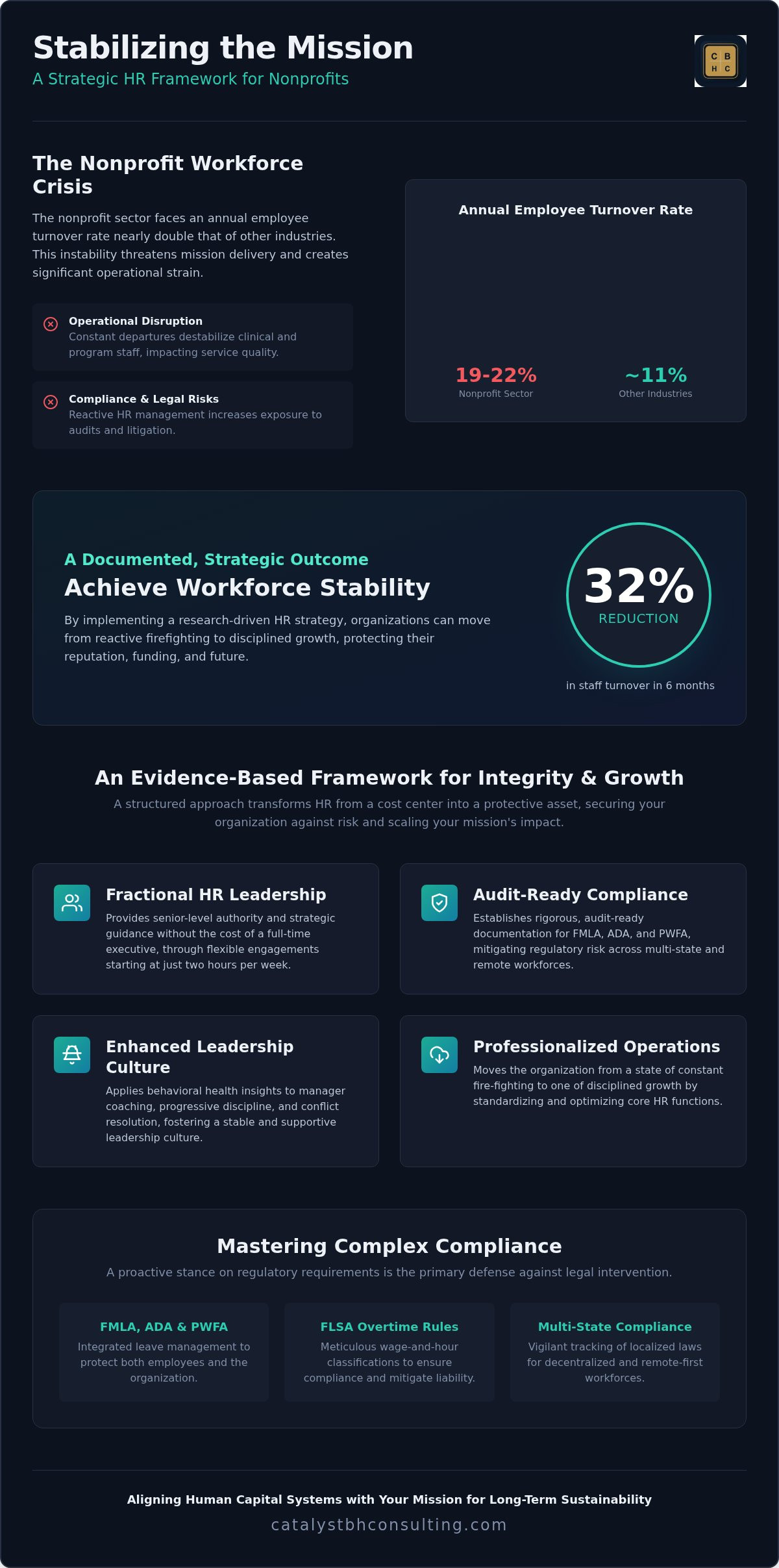
Did you know that the average annual employee turnover rate in the nonprofit sector currently sits between 19% and 22%, nearly double the rate of other industries? You've likely felt the weight of this instability through clinical staff departures, mounting board pressure to professionalize operations, and the constant fear of a multi-state compliance audit. It's difficult to focus on your mission when the structural integrity of your workforce feels fragile and reactive. Finding a specialized nonprofit HR consultant is no longer just an operational choice; it's a strategic necessity for long-term viability.
We understand that you must balance limited budgets with the urgent requirement to professionalize manager development, leadership, and staff retention. This article will show you how a research-driven HR strategy can stabilize your workforce, ensure audit-ready compliance trails, and reduce staff turnover by 32% in six months. We'll preview the essential criteria for selecting a partner who can integrate fractional leadership, workforce analytics, and behavioral health expertise to protect your organization's future. By the end of this guide, you'll have a clear framework to identify, evaluate, and secure the right expert to help your mission thrive.
Key Takeaways
- Resolve the inherent tension between mission and margin by aligning human capital systems with long-term strategic goals.
- Discover how a fractional nonprofit HR consultant delivers senior-level authority through flexible engagements starting at just two hours per week.
- Secure your organization against regulatory risks with audit-ready documentation and compliance trails for FMLA, ADA, and PWFA.
- Reduce staff turnover by a documented 32% through the integration of research-driven workforce analytics and professionalized people operations.
- Enhance leadership culture by applying behavioral health insights to manager coaching, progressive discipline, and organizational stability.
Table of Contents
- Navigating the Strategic Complexity of Nonprofit Human Resources
- Evidence-Based Frameworks for Compliance and Risk Management
- Evaluating the Fractional HR Model for Organizational Scalability
- Optimizing Culture and Leadership Through Behavioral Health Insights
- Securing the Future: Scaling Mission Impact with Catalyst
Navigating the Strategic Complexity of Nonprofit Human Resources
Effective leadership requires a deep understanding of nonprofit organizations and the specific structural pressures they face. A nonprofit HR consultant acts as a strategic architect, aligning human capital systems with mission-driven objectives to ensure long-term sustainability. Unlike traditional for-profit models, nonprofits operate within a delicate "Mission-Margin" tension. This dynamic often forces a choice between program funding and operational infrastructure, leading to a 19% to 22% average turnover rate that destabilizes service delivery.
Organizations face unique hurdles such as intricate board governance, rigid grant-funded role requirements, and the complexities of multi-state compliance. When these elements are managed reactively, the result is often operational chaos. Fractional HR leadership offers a solution by providing senior-level expertise without the burden of a full-time executive salary. This model allows mid-sized nonprofits to professionalize their operations through engagements that scale from two to twenty hours per week.
The Business Case for Strategic HR Intervention
Reactive HR is a liability. It creates litigation exposure, increases workforce strain, and erodes donor trust. For founder-led or family-owned nonprofits, the transition to a professionalized system is often fraught with emotional and operational friction. A consultant provides a steady hand; they implement objective systems that move the organization from a state of constant fire-fighting to one of disciplined growth. By audit-proofing documentation and standardizing employee relations, organizations can achieve a 32% turnover reduction in six months. This professionalization protects the reputation, the funding, and the future of the entity.
Beyond Administrative Tasks: The Strategic Architect
Strategic HR moves beyond the mechanics of payroll and benefits. It focuses on organizational development, executive coaching, and leadership scalability. At Catalyst, our senior HR partners are named individuals who provide a direct line of communication to founders and boards. This ensures that high-level strategy translates into daily operational reality. The Strategic Architect serves as the essential bridge between the visionary mission of the board and the tangible reality of workforce management. To determine your organization's current standing, you can book a consultation for a Business Health Assessment.
Evidence-Based Frameworks for Compliance and Risk Management
Structural integrity in a mission-driven organization relies on a rigorous, evidence-based approach to risk management. A specialized nonprofit HR consultant implements a framework built on four essential pillars: Fractional HR Leadership, Compliance & Policy, Employee Relations, and People Operations. This structured approach ensures that every facet of the workforce is integrated, monitored, and defended against external scrutiny, transforming HR from a cost center into a protective asset.
Audit-ready documentation is the primary defense against regulatory intervention. With the 2026 FLSA overtime exemption salary threshold maintained at $684 per week, organizations must meticulously review wage-and-hour classifications to mitigate legal liability. Beyond payroll, the intersection of FMLA, ADA, and the Pregnant Workers Fairness Act (PWFA) creates a complex web of requirements. Maintaining contemporaneous, accurate records is a strategic safeguard rather than a mere administrative burden. Our expertise, born in high-compliance behavioral health environments, creates a high-water mark for compliance that provides stability for nonprofits across all sectors.
Multi-State Compliance in a Remote-First World
Decentralized workforces introduce localized risks that require constant vigilance. From state-level requirements to store demographic pay data separately to updated annual "Know Your Rights" notices, staying current is a significant operational challenge. Effective leave program administration serves as both a retention tool and a legal shield in this landscape. For organizations seeking deeper regulatory context, our Behavioral Health Accreditation Support framework provides a proven roadmap for maintaining operational excellence across diverse jurisdictions.
Workforce Analytics: Measuring What Matters
We utilize a proprietary HR capability index that evaluates twelve essential functions to provide a baseline for organizational health. This data-driven insight identifies compliance gaps before they become litigation triggers or cause internal culture shifts. A critical component of this analysis involves nonprofit employee compensation benchmarking. By aligning pay scales with 2026 market data and ensuring internal equity, nonprofits can reduce turnover while remaining fiscally responsible. Organizations ready to transition from reactive fixes to proactive, organized systems can schedule a Business Health Assessment to identify their most urgent priorities.
Evaluating the Fractional HR Model for Organizational Scalability
Scaling a mission-driven organization requires a precise balance of executive foresight, operational discipline, and structural integrity. Many leaders face a common dilemma: hiring a full-time, mid-level HR generalist or engaging a high-level nonprofit HR consultant. While a generalist manages day-to-day administration, they often lack the strategic depth required for complex board governance and long-term workforce planning. The fractional model bridges this gap by providing senior-level leadership on a flexible, as-needed basis.
Engagements are designed to be agile, starting at just two hours per week and scaling up to twenty as organizational needs evolve. This modular approach allows nonprofits to access specialized expertise during critical growth phases, such as clinical expansions or technology implementations, without the financial commitment of a full-time executive salary. To understand the mechanics of this arrangement, review our guide on What is Fractional HR?
One frequent concern is "culture fit." Unlike traditional consultants who observe from the sidelines, a fractional partner functions as an integrated team member. They participate in internal meetings, manage staff relations, and represent the organization’s values with the same commitment as a direct hire. This integration ensures that HR strategies aren't just theoretical but are deeply rooted in the organization's daily reality.
Fractional Leadership vs. Traditional Outsourcing
It's vital to distinguish fractional leadership from generic HR outsourcing. Traditional outsourcing often relies on anonymous call centers or ticket-based support systems that lack organizational context. In contrast, fractional leadership provides a named senior partner who understands your specific mission, donor expectations, and clinical requirements. These experts offer high-level strategy for board briefings and succession planning, ensuring that human capital decisions align with the organization's broader vision. This level of partnership provides the stability and relief that comes from professional, steady-hand intervention.
The ROI of Professionalized People Operations
The financial impact of professionalized HR is measurable and significant. Research indicates that organizations can achieve a 32% turnover reduction within six months by rebuilding performance frameworks and stabilizing people operations. In mission-driven sectors, the cost of losing a single employee extends beyond recruitment fees; it includes lost clinical fidelity, decreased service quality, and administrative strain. Implementing a research-driven onboarding framework ensures that new hires are integrated quickly and effectively, protecting the organization's core clinical mission and long-term viability.
Optimizing Culture and Leadership Through Behavioral Health Insights
High-compliance environments, particularly those within behavioral health, require a specialized level of human resources discipline that few other sectors demand. A nonprofit HR consultant with deep roots in these regulated spaces brings a "clean-traveling" expertise that translates effectively to any mission-driven organization. This background ensures that manager coaching, progressive discipline, and performance frameworks aren't just administrative tasks. Instead, they serve as essential tools to stabilize, secure, and scale the workforce. By applying these high-water-mark standards, organizations can move from reactive personnel management to a state of disciplined operational health.
Leadership must prioritize the creation of documentation that is defensible in both litigation and audits. This requires a shift in how managers approach employee relations. When leadership provides a steady hand and clear expectations, the organization builds a culture of accountability. This approach protects the mission by ensuring that every human capital decision is backed by a clear, audit-ready trail of evidence. To explore how these systems function in high-stakes environments, review our Staffing Solutions for Behavioral Health framework.
Building a Culture of Clinical and Operational Fidelity
There is an undeniable synergy between service quality and HR systems. Standardized operating procedures (SOPs) act as the connective tissue that aligns daily tasks with long-term strategic goals. When these systems are predictable and transparent, they improve employee engagement, patient outcomes, and organizational stability. Research indicates that organizations investing in structured manager training programs see a 25% increase in staff retention because these programs reduce role ambiguity and increase perceived organizational support. This level of fidelity ensures that the mission remains the primary focus, rather than the distraction of operational chaos.
Executive Coaching for Mission-Driven Leaders
Many nonprofit founders operate in a state of perpetual urgency, functioning more as daily operators than strategic architects. Executive coaching facilitates the transition from hands-on management to high-level leadership, which is critical for succession planning and long-term viability. This professionalization is especially vital for family-owned or founder-led entities that must navigate complex board governance and funding requirements. Through targeted coaching, leaders learn to identify, document, and defend the systems that protect their organizations. For additional insights into leadership training, see our strategies for Store Manager Development. If your organization is ready to move toward a more professionalized leadership model, book a Business Health Assessment today.
Securing the Future: Scaling Mission Impact with Catalyst
Scaling mission-driven impact requires a transition from fragmented administration to a unified operational framework. Catalyst functions as the operating system for high-compliance nonprofits, providing the structural integrity necessary to navigate complex regulatory landscapes. By partnering with a specialized nonprofit HR consultant, your organization secures senior-level strategic authority without the prohibitive cost of a full-time executive hire. This model ensures that your leadership remains focused on clinical excellence, community engagement, and mission delivery. It provides the relief that comes from professional intervention, allowing you to move forward with quiet confidence.
Our commitment to audit-ready documentation and defensible people operations provides a steady hand in an era of increasing scrutiny. Whether managing FMLA intricacies or navigating the 2026 state-level pay data requirements, we offer a nationwide reach that ensures multi-state compliance. This comprehensive support allows founders and boards to operate with the security of a seasoned partner. As your nonprofit HR consultant, we prioritize structural integrity, long-term viability, and operational excellence to protect the health of your organization.
The Catalyst Approach to People Operations
We utilize the Catalyst Continuum™, a proprietary framework centered on a twelve-function HR capability index. This systematic approach evaluates, optimizes, and integrates every facet of your workforce. Our fractional partners don't act as distant advisors; they become active participants in your journey, merging seamlessly into your existing organizational structure. This integration facilitates a critical shift from reactive crisis management to proactive strategic architecture. By rebuilding performance frameworks and stabilizing people operations, we help your team move with intention, clarity, and discipline.
Next Steps for Organizational Excellence
Professionalizing your HR infrastructure is the most effective way to protect your mission and ensure long-term viability. By building robust systems today, you insulate your organization against future workforce instability and regulatory shifts. We invite you to book a discovery call to assess your organizational health and explore how our senior partners can support your growth. Build, grow, and thrive with a partner who understands the complexity of your mission.
Professionalizing Your Mission for Long-Term Viability
Mission-driven impact is the byproduct of structural integrity and compliant human capital systems. By engaging a specialized nonprofit HR consultant, your organization gains immediate access to SHRM-CP certified leadership and nationwide multi-state compliance expertise. This strategic partnership allows you to implement audit-ready documentation, professionalize manager development, and stabilize your workforce without the financial burden of a full-time executive salary. It provides the steady hand necessary to navigate evolving labor laws while maintaining a focus on your core purpose.
The results of this evidence-based approach are measurable and significant. Organizations that transition to proactive, organized people operations can achieve a 32% turnover reduction in six months. This shift protects your funding sources, secures your clinical fidelity, and ensures your team remains focused on their essential community work. You don't have to navigate these complex regulatory and operational hurdles alone. Secure your mission’s future. Book a strategic HR consultation today. We're ready to help your organization build a sustainable, resilient foundation for the future.
Frequently Asked Questions
What exactly does a nonprofit HR consultant do compared to a regular HR manager?
A nonprofit HR consultant functions as a strategic architect rather than a tactical administrator. While a traditional HR manager focuses on day-to-day payroll and benefits, a consultant aligns your human capital systems with long-term mission objectives. They provide executive-level foresight for board governance and implement high-level structural changes that an internal generalist may not have the capacity or specialized expertise to execute effectively.
How can a fractional HR model save my nonprofit money while improving compliance?
The fractional model eliminates the high overhead of a full-time executive salary while delivering senior-level authority. By engaging an expert for only the hours required, organizations can allocate more resources toward their clinical or community programs. This targeted approach ensures that complex compliance tasks, such as leave program administration and handbook design, are handled correctly the first time, preventing costly legal errors and regulatory penalties.
Is a nonprofit HR consultant necessary if we already have an office manager handling payroll?
Payroll processing is only one small component of a professionalized people operation. A nonprofit HR consultant addresses high-stakes areas that typically fall outside an office manager’s scope, such as defensible documentation for investigations and federal wage-and-hour classifications. Moving beyond basic administration to strategic HR reduces litigation exposure and ensures your organization is prepared for rigorous audits by grantors, state agencies, or accreditation bodies.
Can an HR consultant help with board governance and executive succession planning?
Strategic HR partners are essential for maintaining organizational continuity during leadership transitions. They provide objective frameworks for executive coaching and help professionalize founder-led organizations to prepare for future succession. By developing comprehensive board briefing decks and leadership development tracks, a consultant ensures that the board of directors has a clear, data-driven view of the organization’s human capital health and future stability.
What are the most common compliance gaps for nonprofits in 2026?
Many organizations currently struggle with the 2026 federal salary threshold of $684 per week for overtime exemptions and new state-level pay transparency requirements. Other frequent gaps include outdated I-9 audit procedures and insufficient documentation for the Pregnant Workers Fairness Act (PWFA). Consultants identify these vulnerabilities across twelve essential HR functions, ensuring that your policies and procedures remain compliant with the latest federal tax law changes and labor regulations.
How do you measure the ROI of hiring an HR consultant for a mission-driven organization?
The most direct measure of ROI is the significant reduction in workforce instability and recruitment costs. For example, Catalyst has demonstrated a 32% turnover reduction within six months by rebuilding performance frameworks and manager training systems. Beyond retention, ROI is measured through the preservation of clinical fidelity, the mitigation of legal risks, and the increased efficiency of your people operations, all of which protect your organization’s long-term viability.
Does Catalyst provide support for multi-state compliance and remote workforces?
Catalyst offers a nationwide multi-state compliance footprint designed for decentralized and remote workforces. We manage the complexities of jurisdictional leave laws, annual notice requirements, and state-specific data storage mandates. This comprehensive support allows your organization to hire talent across the country without the administrative burden of tracking localized regulatory changes. We ensure your remote-first policies are robust, consistent, and fully compliant with all applicable federal and state statutes.
What is the minimum commitment required for a fractional HR engagement?
Engagements are highly flexible and can start with as little as two hours per week. This modular approach allows small to mid-sized nonprofits to access senior HR leadership that scales as the organization grows. For those requiring more intensive support, such as a Fractional Chief Clinical Officer through the Catalyst Continuum™, we offer 90-day or 6-month engagement options, with a minimum commitment of six months for ongoing implementation partnerships.

Article by
James McCreary, MS, LPC-S
The Catalyst dispatch.
Frameworks and field lessons on running effective behavioral-health programs. One email a month, sometimes two. Never spam.