Insights
Standard Operating Procedures for Mental Health: 2026 Guide
What if the biggest risk in a mental health SOP isn’t a missing document, but a different response from each team, shift, or location? Standard operating procedures for mental health should make critical steps clear and accessible while giving leaders a way to monitor ownership, training, and follow-through. When instructions are hard to find or out of date, even experienced staff can be left without a consistent operational reference.
The challenge is to create procedures that guide real work without becoming generic documents staff don’t use. Effective SOPs connect frontline decisions with accountable organizational controls. They support reliable operations while reflecting the needs of each program.
This guide explains how to prioritize SOPs, assess existing procedures, and assign ownership for each step. It also covers staff training, document access, and review processes that support quality improvement. Use these practices to connect day-to-day workflows with leadership oversight as teams, services, and organizational needs change.
Key Takeaways
- Define each SOP around a recurring process, clear roles, and practical steps, while preserving individualized clinical judgment.
- Use a consistent document structure and version control so staff can find and follow the current procedure.
- Evaluate templates for operational fit, ownership, and maintenance needs. A template is a starting point, not proof that a procedure works for your organization.
- Put standard operating procedures for mental health into practice by prioritizing workflows, validating drafts with staff, and reinforcing procedures through training and feedback.
- Set review triggers and track relevant quality findings so procedures can adapt as services, roles, and organizational needs change.
Table of Contents
- What standard operating procedures for mental health organizations should accomplish
- How to structure standard operating procedures for mental health teams
- SOP templates versus tailored procedures: what fits a mental health organization?
- How to implement, train, and measure mental health SOPs
- How to maintain a mental health SOP system as services evolve
What standard operating procedures for mental health organizations should accomplish
A useful SOP creates consistency around care, not a script for treating every person the same way. It describes how a recurring organizational process is performed, who owns each step, and how completion is recorded or handed off. This reflects the foundational purpose of a Standard operating procedure (SOP): helping an organization carry out work in a repeatable, clearly understood way.
In a behavioral health organization, repeatable processes can support reliable handoffs, staff orientation, and managerial accountability. A new employee should be able to identify where a process begins, which role takes the next step, and where to find current instructions. Managers can use the procedure to spot unclear ownership or recurring breakdowns instead of relying on informal knowledge held by a few experienced staff members.
Consistency has limits. Standard operating procedures for mental health should clarify routine operational steps while preserving appropriate professional judgment and individualized care. A process can specify how information is routed or a task is documented. It shouldn’t imply that every client or clinical situation calls for an identical response.
How SOPs differ from policies, protocols, and work instructions
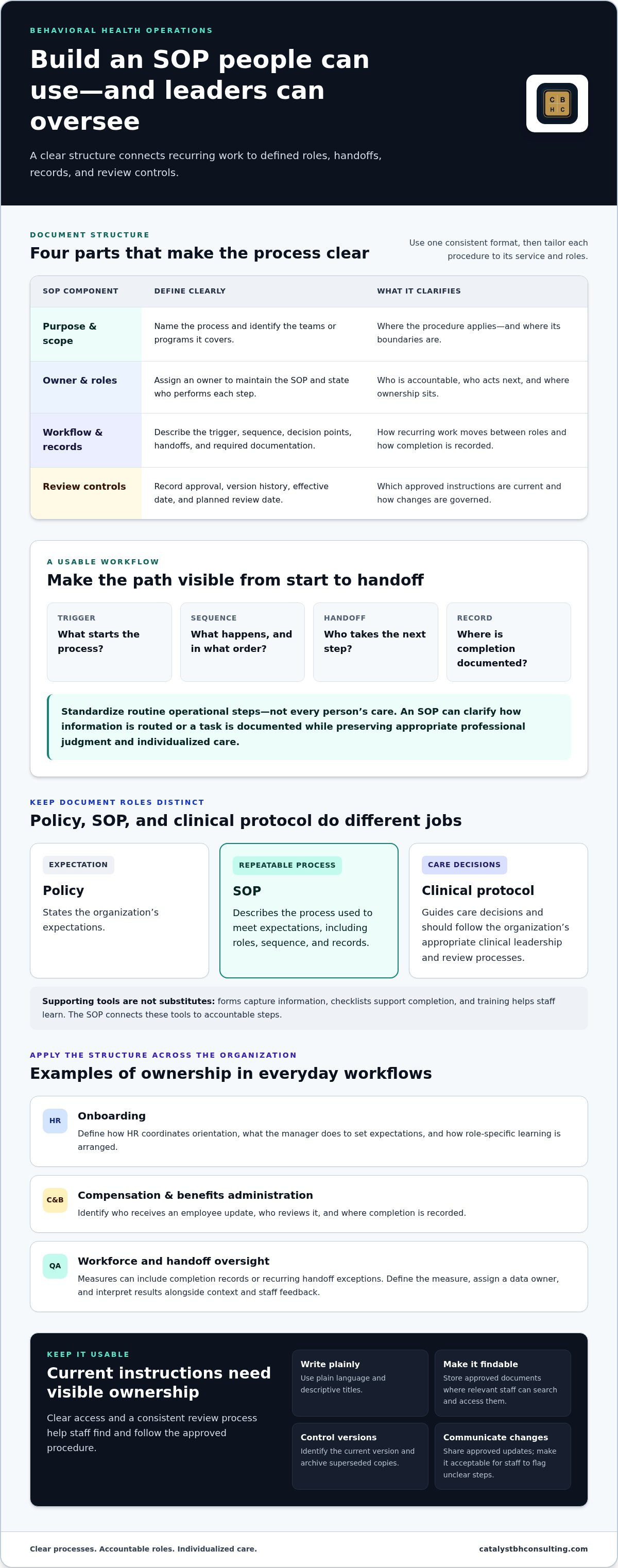
These documents have related but distinct purposes. A policy states an organization’s expectations. An SOP describes the repeatable process used to meet them, including roles, sequence, and records. A clinical protocol guides care decisions and should be developed and governed through the organization’s appropriate clinical leadership and review processes.
Forms, checklists, and training materials can help staff apply an SOP, but they don’t replace the procedure. A form captures information; a checklist supports completion; training helps staff learn. The SOP connects these tools to accountable steps and clarifies who maintains them when the process changes.
Why mental health operations need procedures tailored to their setting
Workflows vary by service model. An outpatient organization may need clear coordination around appointments, referrals, and transitions between staff. A residential program may have different shift-based handoffs, role boundaries, and escalation ownership. These are operational design considerations, not universal clinical instructions.
Before documenting a process, map who performs each step, what information moves between roles, and who is accountable when the usual path cannot be followed. Clinical content should be reviewed under the organization’s governance structure and grounded in applicable, authoritative sources for its setting. This approach gives leaders a practical way to clarify operations without treating a general template as a substitute for local decision-making.
How to structure standard operating procedures for mental health teams
A consistent structure helps staff locate instructions and leaders identify process ownership. For standard operating procedures for mental health, include the purpose, scope, document owner, roles, workflow, records, approval path, version, and review date. Use the same format across documents, then tailor the steps to the service and roles involved.
- Purpose and scope: Name the process and identify the teams or programs it covers.
- Owner and roles: Assign responsibility for maintaining the SOP and clarify who performs each step.
- Workflow and records: Explain the trigger, sequence, decision points, handoffs, and required documentation.
- Review controls: Record approval, version history, effective date, and planned review date.
This structure works for workforce processes as well as service operations. An onboarding SOP, for example, can define how HR coordinates orientation, what the manager does to set expectations, and how role-specific learning is arranged. A compensation and benefits workflow can identify who receives an employee update, who reviews it, and where completion is recorded. Clear steps reduce ambiguity without creating requirements beyond the organization’s applicable policies and guidance.
Make instructions usable and controlled
Write in plain language, use descriptive titles, and store approved documents where relevant staff can search for and access them. Clearly identify the current version, archive superseded copies, and communicate approved changes. Leaders should model the process and make it acceptable for staff to flag unclear steps. Questions can uncover training needs, gaps in role clarity, or friction in the workflow.
Workforce reporting can help managers assess whether a process is working as intended. Define measures such as completion records or recurring handoff exceptions, assign a data owner, and interpret results alongside context and staff feedback. Without a clear definition and review owner, a measure can create noise instead of useful oversight.
Organize around roles and workflows
Group SOPs by operational function and staff role rather than placing every document in one undifferentiated library. Connect related processes such as onboarding, supervision, performance management, and compensation and benefits administration, while keeping each procedure’s owner and purpose clear. Clinical training for behavioral health staff can reinforce role expectations, but training materials should complement, not replace, controlled procedures. Clinical guidance needs appropriate review; the APA Clinical Practice Guidelines are one reference for clinical content.
Catalyst Behavioral Health Consulting’s Catalyst Continuum provides a structured, document-based operating model with 19 integrated frameworks and 152 role playbooks. These materials are exclusive intellectual property of Catalyst Behavioral Health Consulting, LLC, with all rights reserved. They must not be reproduced, distributed, or adapted without written permission. Organizations still need to align procedures with their own services and governance. For help clarifying document ownership and workflow design, explore support for your SOP structure.
SOP templates versus tailored procedures: what fits a mental health organization?
A template can provide structure, but it can’t establish whether a procedure reflects how your organization works. Effective standard operating procedures for mental health account for the service setting, staffing model, role boundaries, leadership oversight, and existing workflows. An organization may combine a shared template, internally developed content, and a supported document management system. The key question isn’t which format to choose. It’s whether each procedure has a clear owner and a reliable path from draft to use.
When a template is a useful starting point
Templates help teams organize information, map likely topics, and get past the blank page. They can standardize headings and prompt writers to consider scope, roles, workflow, and review. But a completed template doesn’t show that a procedure fits the operation. Staff need to validate the steps against actual responsibilities, handoffs, and exceptions, and an accountable owner needs to maintain the approved procedure.
Consider a generic onboarding template. It may list orientation tasks, but your organization must decide which manager initiates them, how role-specific training is assigned, and where completion is recorded. The same principle applies to supervision, performance management, and compensation and benefits workflows. The template supplies a frame; organizational decisions supply the content.
How to evaluate a tailored SOP system
Compare approaches based on role coverage, searchability, revision control, training integration, and quality review. Internally developed SOPs can reflect established workflows, but responsibility for consistency and upkeep must be explicit. A supported operating system can provide a coordinated document structure, but it still needs to align with the organization’s services and governance.
Test the system with practical questions: Can staff locate the current procedure? Can leaders identify its owner and last review date? Does training reinforce the documented process, and can staff feedback reach the owner? The answers show whether the documents work as an operational resource or sit unused in a static library.
- Fit: Does the procedure reflect the organization’s setting, staffing structure, and actual workflow?
- Ownership: Is responsibility for approval, communication, and maintenance assigned?
- Learning: Can quality findings and staff feedback inform a controlled review?
More documentation isn’t automatically better. Avoid repeating the same instruction in multiple policies and SOPs, where updates can create conflicting versions. Define each document’s purpose and link related materials so staff can follow the process without duplicating its source of authority. Connect review findings with clinical quality systems and operational learning. Use feedback to identify unclear steps and recurring gaps. This alignment supports reliable governance; it doesn’t, by itself, guarantee compliance.
How to implement, train, and measure mental health SOPs
Implementation is a managed process, not a document launch. For standard operating procedures for mental health, connect each procedure to an accountable owner, staff learning, and measures that show whether the workflow is understood and usable.
- Prioritize workflows: Select processes where unclear handoffs, role boundaries, or recurring exceptions create operational friction.
- Assign an owner: Identify who coordinates drafting, review, communication, and maintenance.
- Validate the draft: Walk through each step with the staff who perform it and the leaders accountable for the process.
- Train and reinforce: Integrate role-specific learning into onboarding and supervision, then reinforce expectations through managers.
- Schedule review: Set a regular review date and triggers for earlier review, such as service or workflow changes.
Build staff adoption through leadership
Training should connect instructions to the decisions and handoffs staff encounter in their roles. Managers can use onboarding and supervision to clarify responsibilities, invite questions, and reinforce consistent operational practice. Make it safe for employees to report steps that are unclear or impractical. Their feedback can identify where guidance or training needs refinement.
Leadership reinforcement doesn’t mean turning clinical work into a script. SOPs should clarify operational expectations while preserving appropriate clinical judgment and established governance. HR processes also benefit from clear ownership. A compensation and benefits workflow, for example, can define who receives an employee update, who reviews it, and where completion is recorded.
Measure what the procedure is designed to improve
Choose measures that reflect the workflow’s purpose, such as completion records, handoff exceptions, staff readiness, or recurring questions. Define each measure, assign a data owner, and set a review cadence before interpreting results. Consider the context behind a change: more recorded exceptions could reflect a process issue, improved reporting, or a different understanding of the procedure.
This program-level approach is consistent with CARF International’s 2026 Behavioral Health Standards Manual, which emphasizes analyzing performance data for individual programs or service lines rather than relying only on organization-wide results. Apply that principle by reviewing relevant process measures where the work occurs, then considering them alongside staff feedback, audits, and documented improvement actions. Don’t treat a single measure as proof of quality or apply unsupported benchmarks. Use findings to decide whether the SOP, training, or role clarity needs adjustment.
For support aligning procedure rollout with workforce responsibilities and leadership oversight, review your SOP implementation approach.
How to maintain a mental health SOP system as services evolve
Standard operating procedures for mental health remain dependable only when organizations treat them as controlled documents, not finished projects. A new service, a change in staff responsibilities, or a quality finding can make a previously accurate workflow incomplete. A defined governance cycle helps leaders identify what changed, assess which procedures are affected, and communicate approved updates before outdated guidance becomes the default.
A practical governance cycle for keeping SOPs current
Assign each procedure a responsible owner and identify who can approve revisions. The owner coordinates review, while subject-matter and leadership input may be needed when changes affect multiple roles or programs. Maintain version history, approval status, effective date, and review date so staff can distinguish current instructions from archived copies.
Set routine review dates and triggers for earlier review. Changes to services or role responsibilities may affect a workflow’s scope, handoffs, or escalation path. Audit findings, staff questions, and feedback can also reveal unclear or impractical steps. After approval, communicate what changed, who is affected, and where to find the current version. These controls support readiness and documented systems, but they don’t guarantee compliance or replace organization-specific governance.
For organizations preparing for accreditation review, connect document control with broader behavioral health accreditation support. The value lies in maintaining a clear relationship between written procedures, actual practice, and the organization’s review process.
When structured operational support can help
Catalyst Behavioral Health Consulting supports behavioral health organizations across operational, clinical, regulatory, and human resources systems. Its operating-system perspective connects role clarity, document ownership, and ongoing review. The Catalyst Continuum is one example of a structured, document-based operating model. It includes 19 integrated frameworks, 6 levels of care, 152 role playbooks, and 10+ interactive tools. These materials offer a structured reference, but they don’t replace an organization’s own governance or approval process.
The Catalyst Continuum materials are the exclusive intellectual property of Catalyst Behavioral Health Consulting, LLC, with all rights reserved. They may not be reproduced, distributed, or adapted without written permission. Leaders assessing how document ownership, workflows, and review practices fit together can discuss their organization’s operational needs.
Make your SOP system part of how the organization operates
Strong standard operating procedures for mental health do more than document tasks. They clarify ownership, help teams coordinate work, and give leaders a practical basis for training and review. The most effective system fits the organization’s services, is accessible to staff, and stays current as roles and workflows change.
Start with processes that need greater clarity. Assign owners, validate instructions with the people who use them, and connect staff feedback and quality findings to ongoing updates. This creates a working link between frontline practice and leadership oversight without turning procedures into rigid scripts or static files.
Catalyst Behavioral Health Consulting supports behavioral health organizations with operational, clinical, regulatory, and human resources expertise. The Catalyst Continuum includes 19 integrated frameworks and 152 role playbooks, providing an example of a structured operating model that organizations can align with their own governance.
To strengthen document ownership, role clarity, and ongoing review, book a consultation about your behavioral health operating systems.
Frequently Asked Questions
What should a mental health standard operating procedure include?
A mental health SOP should identify its purpose and scope, owner, roles, workflow, records, approvals, and review date. It should explain what triggers the process, the sequence of steps, decision points, required handoffs, and how exceptions are escalated. Reference supporting forms and training materials, but keep the procedure itself clear and authoritative. Separate operational instructions from clinical guidance that requires appropriate clinical governance and review.
How is an SOP different from a policy or clinical protocol?
A policy states an organization’s expectations; an SOP describes the repeatable process and responsibilities used to carry them out. A clinical protocol guides care-related decisions and should be developed and reviewed through appropriate clinical governance. Forms, checklists, and training resources help staff use procedures, but they don’t replace the SOP. Keeping these document types distinct helps teams understand which expectations apply and who maintains each resource.
How do you write SOPs for a mental health clinic?
Start by mapping a recurring workflow. Identify where it begins, which roles perform each step, and what handoffs or records are involved. Draft instructions in plain language, then validate them with staff who do the work and leaders accountable for the process. Clarify exceptions and ownership before approval. For standard operating procedures for mental health, review clinical content through appropriate governance and align operational instructions with the clinic’s actual services.
Who should be responsible for reviewing mental health SOPs?
Assign a named owner to coordinate each SOP’s review, track revisions, and communicate approved changes. The owner should involve people with relevant operational, managerial, or clinical expertise based on the procedure’s content. A staff onboarding process may need HR and manager input, while a procedure containing clinical guidance needs appropriate clinical review. Make approval authority clear so responsibility doesn’t depend on informal assumptions.
How often should mental health standard operating procedures be updated?
Set a planned review date for each procedure and define events that can prompt an earlier review. A new service, a change in staff roles, audit findings, or repeated questions about a workflow may indicate that instructions need attention. The appropriate cadence depends on the document and organizational governance. Record revisions and effective dates, and communicate changes so staff can distinguish current procedures from archived versions.
Can one SOP template work for inpatient and outpatient behavioral health settings?
A shared template can provide consistent formatting and document fields, but it can’t establish whether a workflow fits both settings. Inpatient and outpatient services may differ in staffing patterns, handoffs, responsibilities, and escalation paths. Use a common structure where useful, then tailor the procedure to the service, roles, and governance involved. Validate the steps with staff who perform the process instead of assuming one template fits every program.
How can leaders make sure staff follow mental health SOPs?
Integrate role-specific SOP training into onboarding and supervision, and make current instructions easy for relevant staff to find. Managers should reinforce expectations, model the documented process, and invite staff to flag unclear or impractical steps. Review completion records, workflow exceptions, recurring questions, and quality findings to identify where clarification or retraining may help. Treat feedback as a practical input for improvement while preserving appropriate clinical judgment and accountability.

Article by
James McCreary, MS, LPC-S
The Catalyst dispatch.
Frameworks and field lessons on running effective behavioral-health programs. One email a month, sometimes two. Never spam.