Insights
Starting a Behavioral Health Business: A Strategic Operating Framework for 2026
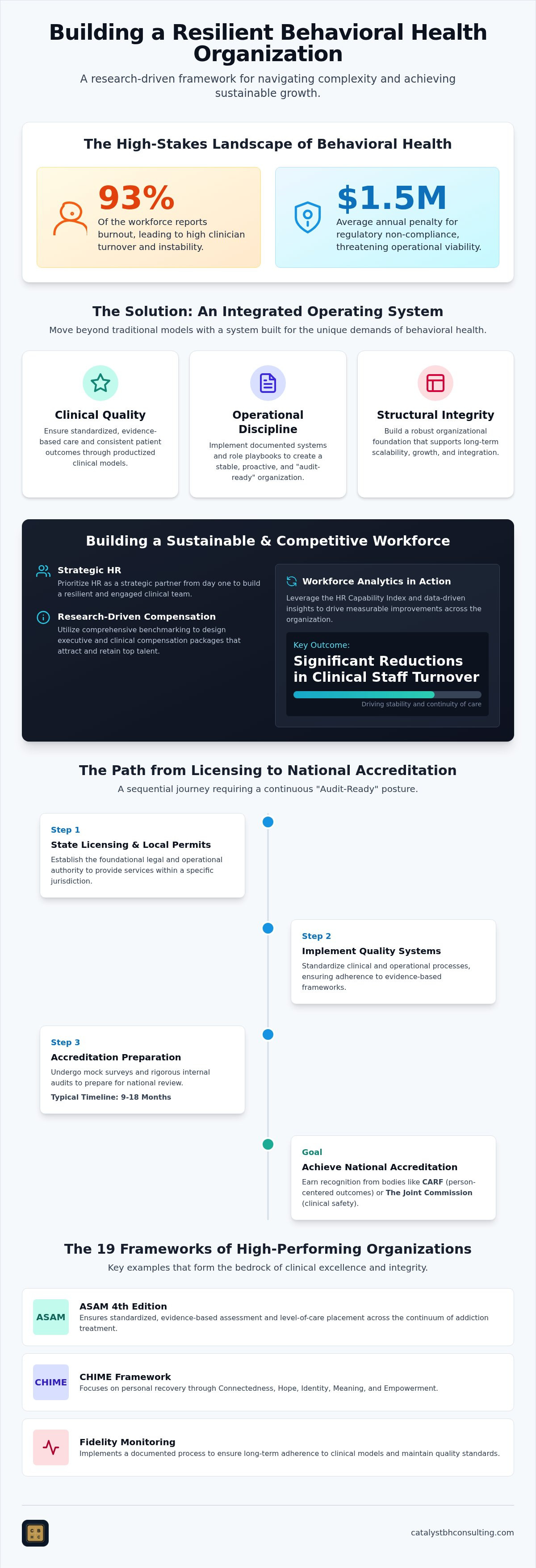
With 93% of the workforce reporting burnout and regulatory penalties for non-compliance averaging $1.5 million annually, the margin for operational error has vanished. Starting a behavioral health business in 2026 requires more than clinical passion; it demands a productized operating system that integrates HR strategy, workforce analytics, and rigorous compliance. You likely recognize that the traditional medical model fails to address the unique complexities of behavioral health, leaving many founders struggling with high clinician turnover and shifting multi-state regulations. It's a landscape where stability is won through systems, not just individual effort.
This guide provides a research-driven framework to help you master clinical operations, navigate licensing hurdles, and build a sustainable workforce strategy. We'll examine the essential playbooks for creating an audit-ready facility, optimizing executive compensation, and implementing the structural integrity needed for long-term scalability. By the end, you'll have a clear roadmap to transform your vision into a disciplined, high-performing organization that prioritizes growth, integration, and clinical excellence.
Key Takeaways
- Implement a specialized organizational operating system that integrates clinical quality, operational discipline, and structural integrity.
- Maintain a continuous "Audit-Ready" posture to navigate the sequential path from state licensing to national accreditation with quiet confidence.
- Prioritize strategic HR and research-driven compensation benchmarking when starting a behavioral health business to ensure a sustainable and competitive workforce.
- Leverage workforce analytics and the HR Capability Index to drive measurable improvements, including significant reductions in clinical staff turnover.
- Adopt the Catalyst Continuum to access 152 role playbooks and documented systems that transform vision into a scalable, mission-driven reality.
Table of Contents
Defining the Behavioral Health Clinical and Organizational Operating Model
Starting a behavioral health business requires a departure from traditional healthcare frameworks that prioritize acute intervention over longitudinal care. While a general medical practice focuses on episodic treatment, a behavioral health organization must manage chronic conditions, social determinants, and complex human behaviors. This distinction is critical; applying a rigid medical framework to a substance use disorder program often leads to operational friction, clinical misalignment, and systemic failure. Successful founders recognize that behavioral health is a unique discipline requiring its own specialized operating system to achieve growth, scalability, and optimization.
Why Behavioral Health is Operationally Unique
The behavioral health sector faces pressures including high litigation exposure, intense workforce strain, and complex multi-state regulatory environments. Unlike standard healthcare, providers must navigate the nuanced intersection of behavior management principles and strict privacy laws like the updated 42 CFR Part 2. Borrowing medical models fails because it ignores the necessity of relational care and the high emotional labor that drives 93% of workers toward burnout. The Strategic Architect is a disciplined leader who designs the organization’s big picture while simultaneously managing the smallest technical details of clinical and operational systems.
The 19 Frameworks of High-Performing Organizations
A robust organization is built on 19 integrated frameworks that provide the bedrock for clinical quality and structural integrity. When starting a behavioral health business, these standards include the ASAM 4th edition for addiction treatment, the National Alliance for Recovery Residences (NARR) standards, and the Recovery-Oriented Systems of Care (ROSC) model. These frameworks don't operate in isolation; they interact to create a holistic health profile for the organization. Key components include:
- ASAM 4th Edition: Ensures standardized, evidence-based assessment and level-of-care placement across the continuum.
- CHIME: Focuses on personal recovery through connectedness, hope, identity, meaning, and empowerment.
- Fidelity Monitoring: Implements a documented process to ensure long-term adherence to these models and maintain clinical quality.
By productizing the clinical model, founders ensure consistent patient outcomes and operational scalability. This systems-first approach transitions the organization from a reactive posture to a proactive, audit-ready state. It provides the stability, relief, and professional intervention needed to survive in a landscape where non-compliance costs can average $1.5 million annually. Documenting these processes early creates a culture of excellence that supports both patient recovery and organizational health.
Navigating Licensing and Accreditation Readiness
Starting a behavioral health business requires a methodical approach to regulatory hurdles that extends far beyond simple paperwork. Founders must first align their organizational foundation with the SBA guide to writing a business plan to ensure their infrastructure can support the weight of state and federal mandates. Licensing isn't a one-time event; it's a sequential journey that moves from regional operational permits to national accreditation. Rigorous benchmarks for national standards now require organizations to demonstrate thorough financial disclosures, enhanced background checks, and specific clinical supervision ratios. Managing these complexities requires a steady hand to ensure growth, scalability, and long-term viability.
The Path to National Accreditation
Facilities typically choose between CARF and The Joint Commission for national recognition. While CARF focuses on consultative standards and person-centered outcomes, The Joint Commission emphasizes clinical safety, medical integration, and risk management. Achieving these credentials often requires a 9 to 18-month timeline, depending on the maturity of your existing quality systems. Adopting a behavioral health accreditation support framework ensures the organization remains audit-ready from day one. This master playbook approach reduces the timeline for mock surveys by standardizing, integrating, and sustaining quality measures across all levels of care.
Building Defensible Documentation Systems
Defensible documentation is the backbone of a compliant facility and a primary defense against the $1.5 million average annual cost of non-compliance. It requires shifting from fragmented, paper-heavy processes to a live, searchable digital portal that provides total organizational transparency. This transition ensures that every staff member, from medical directors to front-office personnel, follows standardized protocols. Utilizing 152 integrated role playbooks allows an organization to:
- Standardize Operations: Ensure every function is documented and repeatable across multi-site platforms.
- Integrate Quality Assurance: Use automated QA rubrics to monitor clinical fidelity and identify emerging documentation risks.
- Sustain Clinical Accuracy: Leverage interactive tools like the SAFE-T for suicide assessment and the ASAM scorer for precise level-of-care placement.
These systems allow leadership to maintain an audit-ready state with current staff credentials and safety certifications readily available for unannounced site visits. By moving from reactive preparation to a proactive posture, you protect the health and success of your organization. To ensure your facility meets these rigorous standards, you may wish to schedule a business health assessment to identify existing operational gaps.
Strategic HR and Compensation Benchmarking for Startups
HR strategy constitutes 25% of the foundational operating model for any high-performing behavioral health organization. While many founders focus heavily on clinical curricula, the success of starting a behavioral health business depends on the ability to recruit, develop, and retain a stable workforce. This requires a shift from reactive hiring to a disciplined human capital strategy that prioritizes structural integrity and long-term viability. By treating HR as a core business problem rather than an administrative task, leadership can address the systemic causes of the 93% worker burnout rate that plagues the industry. Professional intervention in human resources provides the relief and stability necessary for an organization to thrive.
Designing a Competitive Compensation Strategy
Effective compensation benchmarking is a research-driven process that ensures competitive hiring in a strained labor market. In 2026, the national hourly rate for Licensed Professional Clinical Counselors (LPCCs) reached $40.57, reflecting a 2.48% increase from the previous year. To maintain equity and prevent costly wage-and-hour classification errors, organizations must implement a structured pay philosophy. Every tier is a range. Where you land depends on scope – not on negotiation. This approach provides the transparency, equity, and stability needed for robust benefits governance. When evaluating executive leadership options, it's helpful to consult the Fractional HR Buying Guide to understand how to scale your C-suite expertise.
Multi-State Compliance and Policy Design
Scaling across state lines introduces complex multi-state compliance footprints that require expert-level oversight. Organizations must navigate the nuanced requirements of the Family and Medical Leave Act (FMLA), the Americans with Disabilities Act (ADA), and the Pregnant Workers Fairness Act (PWFA) within a healthcare environment. A well-designed employee handbook serves as a tool for both compliance and cultural alignment, ensuring that policies are applied consistently across all sites. This creates a sense of security and professional standards for the entire team.
For those starting a behavioral health business who require senior-level expertise without the cost of a full-time executive, fractional HR leadership provides a steady hand. These fractional CCO engagements involve a 6-month minimum to ensure the successful integration of systems and processes. This model allows for direct board-level reporting through a named senior HR partner who understands the movement and optimization of human capital. It's a fundamental rule of this strategic partnership that to reduce price, we subtract deliverables, ensuring that every engagement is tailored to the specific organizational scope and clinical mission.
Leveraging Workforce Analytics and Leadership Development
Workforce analytics transform human capital from a variable expense into a predictable asset. For those starting a behavioral health business, the ability to interpret labor data is the difference between a revolving door of clinicians and a stable, high-performing team. Data-informed decisions allow leadership to identify turnover precursors, optimize staffing ratios, and implement retention programs that actually work. By utilizing the HR Capability Index, an organization can evaluate twelve essential HR functions—including talent acquisition, performance management, and workforce planning—to ensure total organizational support and structural integrity.
The Impact of Data-Driven Retention
Stability in a clinical setting is achieved through the integration of rigorous onboarding, manager training, and performance frameworks. Research indicates that Catalyst clients have realized a 32% turnover reduction within six months by applying these systemic improvements. This reduction is not accidental; it is the result of moving from reactive problem-solving to a proactive, systems-first approach. Documented compliance trails and clear performance rubrics do more than improve morale; they protect the organization against litigation and audit risk by providing a defensible record of professional conduct and operational excellence. A disciplined focus on these twelve HR functions ensures that the business remains audit-ready while fostering a culture of accountability.
Executive Coaching for Clinical Leaders
The Clinical Director serves as a dual leader, bridging the gap between high-quality patient care and disciplined clinical operations. Many directors are promoted for their clinical expertise but lack the formal training required to manage complex human systems or organizational budgets. Executive coaching provides these leaders with a "steady hand" approach to workplace conflict, employee relations, and strategic decision-making. This professional intervention is vital because the manager's behavior directly influences the frontline Behavioral Health Technician (BHT) experience. When a Clinical Director is equipped with the tools of a Strategic Architect, they can lead with quiet confidence and visionary clarity.
Investing in leadership development ensures that your mission-driven goals are supported by grounded, practical reliability. This creates a narrative of organizational health that resonates with both staff and stakeholders. To evaluate your current leadership capacity and identify opportunities for optimization, you should book a business health assessment with our team of seasoned operators.
Scaling with the Catalyst Continuum Operating System
The Catalyst Continuum is the definitive "Operating System" for those starting a behavioral health business, designed to replace fragmented processes with a productized infrastructure. This system moves beyond the theoretical frameworks discussed earlier, delivering the tangible tools required for day-to-day excellence and structural integrity. The core deliverables include 152 role playbooks, spanning every organizational function from reception to medical, and documented protocols for 6 levels of care. These resources are integrated into a live searchable portal at catalystcontinuum.pplx.app, providing staff with immediate access to the organization's Master Playbook. Engaging with this system begins with a 20-minute discovery call to align organizational needs with the appropriate service tier and a targeted 90-day mock survey timeline.
It's important to note that our engagement model is built on strict operational discipline and professional transparency. Every tier is a range. Where you land depends on scope – not on negotiation. This approach ensures that the professional intervention provided is exactly calibrated to the complexity and mission of your organization. Furthermore, our commitment to organizational health is absolute; to reduce price, we subtract deliverables. This ensures that the systems remaining in your deployment are never diluted or compromised, maintaining a "no-nonsense" commitment to excellence.
Turnkey Deployment for Multi-Site Platforms
For private equity-backed platforms and hospital systems expanding into behavioral health, Catalyst Behavioral Health Consulting offers a Tier 3 turnkey deployment. This level of support is essential for maintaining clinical fidelity across diverse geographic footprints. A key differentiator in this tier is the inclusion of 6 months of fidelity monitoring, which provides the "steady hand" oversight needed to ensure that new service lines achieve long-term viability and optimization. Organizations at this scale also benefit from fractional CCO leadership, which carries a 6-month minimum commitment to ensure deep-seated organizational change and workforce stability.
Self-Serve Licenses for Small Operators
Small-scale operators, such as NARR homes and startup substance use disorder (SUD) facilities, can access these systems through a Tier 1 self-serve license. This tier provides the foundational policies, procedures, and training systems necessary to launch with quiet confidence. A significant benefit of this model is the annual renewal at 60%, which ensures that operators maintain access to updated compliance materials and the latest clinical curricula. This structure allows founders to professionalize their operations without the overhead of a full-time compliance department. To begin the process of identifying the right tier for your organization, we encourage founders to Book a Discovery Call to conduct an initial business health assessment with Catalyst Behavioral Health Consulting.
Building for Long-Term Organizational Health
Starting a behavioral health business in 2026 demands a shift from clinical theory to operational discipline. Success is found in the integration of specialized operating systems, research-driven HR strategies, and a continuous audit-ready posture. By implementing 152 integrated role playbooks and leveraging SHRM-CP certified leadership partners, you can transition from a reactive startup to a scalable, mission-driven organization. The data is clear. Organizations that prioritize these structural frameworks have seen a 32% turnover reduction in just six months. This stability provides the relief, security, and clarity needed to focus on patient outcomes while ensuring long-term viability.
You don't have to navigate these complexities alone. Our team of seasoned operators is ready to help you implement the systems that solve human and organizational problems. Schedule a 20-minute discovery call to build your audit-ready operating model. Your vision deserves a foundation that is as visionary, practical, and grounded as the care you provide.
Frequently Asked Questions
What is the first step in starting a behavioral health business?
The first step in starting a behavioral health business is establishing a specialized organizational operating model that distinguishes your clinical mission from traditional medical frameworks. This involves defining your big-picture strategy while simultaneously documenting the technical details of your clinical and operational systems. By adopting a "Strategic Architect" mindset early, you ensure that your organization is built on structural integrity and practical reliability. This foundation allows for future scalability and optimization across all service divisions.
How long does it typically take to achieve CARF or Joint Commission accreditation?
Achieving national accreditation through CARF or The Joint Commission typically requires a timeline of 9 to 18 months. The duration depends heavily on the maturity of your existing quality systems and documentation fidelity. To streamline this process, our framework targets a 90-day mock survey and board briefing timeline. This methodical approach ensures that your facility remains audit-ready and compliant while reducing the administrative burden on your clinical leadership and staff.
What is fractional HR and how does it benefit a healthcare startup?
Fractional HR provides your organization with senior-level leadership and executive strategy without the cost of a full-time hire. These engagements typically range from two to twenty hours per week and offer a direct line to founders and boards. It's a fundamental rule of our engagement that every tier is a range. Where you land depends on scope; not on negotiation. This model allows leadership to focus on clinical growth while a seasoned partner manages the complexities of human capital.
Why is a specialized operating model necessary for behavioral health?
A specialized operating model is necessary because behavioral health involves unique litigation risks, intense workforce strain, and complex behavior management principles. Traditional medical or surgical models lack the relational and longitudinal frameworks required for sustainable behavioral health delivery. Our system integrates 19 frameworks, including ASAM 4th and ROSC, to ensure clinical quality. This approach provides the stability and relief necessary for long-term organizational success in a highly regulated and compliance-heavy industry.
How can a new facility reduce clinical staff turnover from day one?
Reducing clinical staff turnover when starting a behavioral health business requires a research-driven human capital strategy that prioritizes onboarding, manager coaching, and performance frameworks. By implementing these structured systems, Catalyst clients have realized a 32% turnover reduction within six months. This data-informed approach addresses the root causes of burnout and professional dissatisfaction. Creating a culture of excellence and documented accountability ensures that your workforce feels supported, integrated, and valued from their first shift.
What are the common compliance gaps found during initial licensing audits?
Common compliance gaps often involve inadequate credentialing, inconsistent documentation fidelity, and outdated policy manuals. During unannounced site visits, auditors frequently identify risks related to staff training records and safety certifications. Maintaining an "audit-ready" state through a live searchable portal and 152 role playbooks mitigates these risks. This continuous compliance posture protects your organization from financial penalties, which can average $1.5 million annually for non-compliant entities. It also provides the structural integrity needed for growth.
What is the Catalyst Continuum and how does it support startups?
The Catalyst Continuum is the comprehensive "Operating System for Behavioral Health" designed to standardize and scale clinical operations. It provides 152 role playbooks, 6 levels of care, and 10+ interactive tools to ensure total organizational support. This master playbook allows startups to deploy documented systems with quiet confidence and visionary clarity. It transforms complex regulatory requirements into a manageable, productized reality that supports both patient outcomes and business growth through disciplined, organized systems.
Does Catalyst provide direct medical billing or legal services?
No, Catalyst does not provide direct patient care, medical billing services, or legal representation. Our focus is strictly on the operational, clinical, regulatory, and human resources infrastructure of your organization. We function as a strategic partner that delivers the playbooks, leadership, and compliance oversight needed to build, grow, and thrive. For billing or legal needs, we recommend consulting with specialized professionals who focus exclusively on those distinct areas of healthcare administration and law.

Article by
James McCreary, MS, LPC-S
The Catalyst dispatch.
Frameworks and field lessons on running effective behavioral-health programs. One email a month, sometimes two. Never spam.