
Insights
5 ways to scale a private therapy practice through referrals
Scaling a private therapy practice takes more than adding clinicians. Five connected steps can make growth manageable: streamline daily operations, focus marketing on effective referral sources, shift from clinician to business leader, set clear revenue and lifestyle goals, and decide whether a group practice fits your vision. The aim is to build capacity while protecting care quality and the kind of work life you want.
Referrals can support growth, but a full calendar alone doesn’t make a practice scalable. Consistent processes, a clear picture of where inquiries come from, and thoughtful decisions about team structure help turn demand into a more sustainable operation.
This article covers five steps, from organizing intake and follow-up to preparing for a team. You’ll learn how to identify useful referral patterns, set goals that guide decisions, and assess whether expanding into a group practice makes sense for your practice.
Key Takeaways
- Streamline intake, reminders, billing, and follow-ups so routine work doesn’t depend on the practice owner’s constant attention.
- Review where your last five referrals came from, then focus marketing effort on the sources that are generating relevant inquiries.
- Shift time from delivering every service yourself to setting priorities, strengthening processes, and leading the business.
- Track cash flow and revenue sources, then set growth goals that account for team capacity and the lifestyle you want.
- Before building a group practice, consider the added responsibilities around hiring, onboarding, oversight, and operating procedures.
Table of Contents
- 1. Automating intake, reminders, billing, and follow-ups
- 2. Focusing marketing on sources that generate referrals
- 3. Moving from solo practitioner to business leader
- 4. Setting clear revenue, team-size, and lifestyle goals
- 5. Scaling a solo therapy practice into a group practice
- Catalyst Behavioral Health Consulting: Licensing and accreditation support
1. Automating intake, reminders, billing, and follow-ups
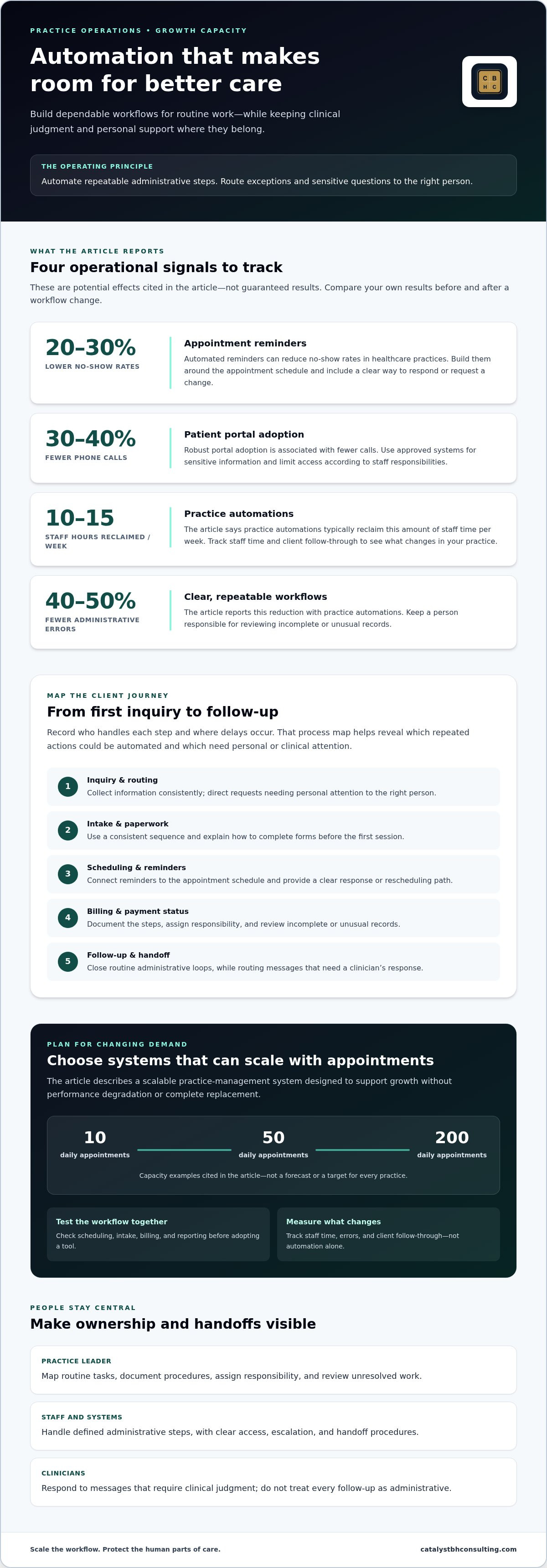
Start by mapping each step from the first inquiry through post-appointment follow-up. A prospective client may complete an intake form, schedule an appointment, receive reminders, and submit required paperwork. Record who handles each task and where delays occur. This process map reveals which repeated actions could be automated and which require clinical judgment. The goal is dependable workflows, not technology for its own sake.
For intake, establish a consistent sequence for collecting information, confirming appointments, and routing inquiries. An automated confirmation, for example, can explain how to complete forms before a first session. Set clear handoffs for requests that need personal attention, such as questions about services or scheduling. Standardized processes reduce reliance on the owner’s memory and make the client experience more consistent as inquiries grow.
Appointment reminders can support attendance while reducing manual outreach. Automated reminder systems can reduce no-show rates by 20-30% in healthcare practices. Build reminders around the appointment schedule, and include a clear way to respond or request a change. Track missed appointments before and after introducing reminders. That comparison helps determine whether the workflow is working for your practice, rather than assuming an automation has improved results.
Billing also benefits from defined steps. Set a sequence for preparing claims or invoices, notifying clients about outstanding balances, and recording payment status. Assign each task to a role or system, then document how staff should handle exceptions. Automation can reduce repetitive data entry, but someone still needs to review incomplete or unusual records. Clear responsibility supports follow-through and gives the owner better visibility into unresolved billing tasks.
Use follow-up messages to close routine loops, such as confirming receipt of forms or reminding clients about unfinished administrative steps. A patient portal can centralize messages and documents; robust portal adoption is associated with 30-40% fewer phone calls. Protect security by limiting access according to staff responsibilities and using approved systems for sensitive information. Define which messages require a clinician’s response, rather than treating every follow-up as administrative.
Choose systems that can accommodate a changing appointment load. A scalable practice-management system should support growth from 10 to 50 to 200 daily appointments without performance degradation or complete replacement. Before adopting a tool, test its scheduling, intake, billing, and reporting workflows together. Monitor staff time, errors, and client follow-through. Practice automations typically reclaim 10-15 hours of staff time per week and reduce administrative errors by 40-50%.
Automation can also reveal when it’s time to delegate. If the owner is still the only person coordinating virtual intake, billing support, and reminders, document those tasks before assigning them to employees or contractors. Write procedures for common scenarios, such as rescheduling or incomplete paperwork. Train each role on access, escalation, and handoffs. These processes give a growing team a consistent structure, while allowing clinicians to focus on care and the practice leader to focus on long-term success.
2. Focusing marketing on sources that generate referrals
Review your most recent referrals. Record how each person found the practice, who referred them, and whether the inquiry matched your services. This quick review replaces assumptions with actual patterns. If several inquiries came through clinicians and another came through a directory, you have a clearer basis for deciding where to focus. Repeat the review regularly so marketing reflects current sources, not outdated impressions.
Assess referral quality as well as volume. A source is useful when it connects you with people whose needs fit your clinicians’ expertise, availability, and approach to care. For example, a relationship with a school counselor may generate inquiries that suit a clinician’s specialty, while another source may bring frequent requests outside the practice’s scope. Track the source, fit, and follow-through in one administrative record.
Choose a focused plan instead of spreading your effort across many strategies. Nicole McCance recommends concentrating marketing rather than trying ten strategies at once. Select channels that have produced appropriate referrals, then define a manageable action for each. You might arrange a professional introduction, update a referral information sheet, or share a short practice overview with an organization. Consistent actions make it easier to learn what supports sustainable growth.
Networking works best when it builds professional understanding, not just visibility. Identify clinicians and organizations that serve related needs, then introduce your practice and explain its referral process. Share which services your clinicians provide, how prospective clients can inquire, and what information helps the practice respond appropriately. Follow up with a concise update after a meaningful change, such as adding a clinician or adjusting availability.
A referral program can be a clear, repeatable process rather than a reward or incentive. Give referral partners a concise description of services, the right intake contact, and an easy way to share practice information. Keep materials accurate as clinicians’ specialties and availability change. For clients, make it easy to share general information about the practice without asking them to disclose private details about their care.
Measure the full path from referral to scheduled appointment. Record the source, inquiry date, response status, and whether the person scheduled. Review results by source to identify administrative delays or unclear information that may be limiting follow-through. If a source generates inquiries but few suitable appointments, refine the audience or explanation before investing more time there.
Set a recurring review on your calendar and make one adjustment at a time. A brief monthly check can help you compare sources, identify relationship gaps, and decide which outreach deserves continued attention. For structured support aligning referral growth with practice operations, consider referral-growth planning.
3. Moving from solo practitioner to business leader
A solo clinician often fills several roles: therapist, scheduler, decision-maker, and financial administrator. To lead the business, identify which tasks need your clinical expertise and which can follow documented processes. For example, reserve time to review performance, improve workflows, and plan capacity. This shift means working on the practice, not only in it. It gives decisions about staffing, scheduling, and growth a place alongside client care.
Choose one primary business goal before adding new strategies. The goal might be improving referral follow-through, creating time for leadership, or preparing to hire. Write down the outcome, the process that supports it, and the signal you’ll use to review progress. Steve Jobs described innovation as saying no to 1,000 things. The practical lesson is focus: pause initiatives that compete with the priority, then direct time and attention toward the work that moves it forward.
Separate business and personal finances to better understand practice performance. Use distinct accounts and consistently record business transactions, including expenses tied to scheduling, professional development, and operations. Then review cash flow and identify revenue sources. Keeping household purchases separate from practice expenses, for example, makes records easier to interpret and business performance easier to discuss with an accountant. If you don’t already work with one, consult an accountant about your records and financial planning.
Don’t add complexity before the practice has a clear operational need. A new software platform, service line, or administrative role can each create work. Before adopting one, define the problem it solves and the process it will change. If missed follow-ups are the issue, document the current handoff and test a focused improvement first. This approach streamlines operations without layering systems onto a workflow that needs clarification.
Choosing a business structure is a consequential decision, not just a registration task. Consider how ownership, decision-making, financial reporting, and future hiring fit together. The right considerations depend on your goals and circumstances, so review the business and tax implications with qualified professionals. Connect the decision to your operating model: a solo clinician planning to remain solo may need a different structure from an owner preparing to bring on clinicians.
Use a simple leadership rhythm to make the transition tangible. Schedule recurring reviews of cash flow, scheduling patterns, referral activity, and unresolved operational decisions. Use the same agenda each time, then record the decision, owner, and next action. If the practice needs a structured review of its business health, a Business Health Assessment can help organize priorities. This cadence makes leadership a defined part of running the practice, rather than an occasional interruption.
4. Setting clear revenue, team-size, and lifestyle goals
Set goals across three areas: revenue, team capacity, and personal workload. Decide what growth should change in your week, such as reducing clinical hours or protecting time for leadership. Then translate that outcome into an operating target. For example, add provider capacity only when referral demand and administrative support can sustain it. This keeps expansion aligned with your care model and desired work life.
To set fees and assess profitability, review clinician compensation, operating expenses, payer mix, and revenue by service line. Compare collected revenue with the resources required to deliver care, then use that analysis to inform fee decisions. Healthy private practices maintain profit margins of 20-35%. Treat that range as a planning reference, not a substitute for understanding your own practice’s financial structure.
Track a focused set of measures linking client access, workforce capacity, and financial performance. Useful measures include client acquisition and retention, no-show and cancellation trends, provider caseload balance and utilization, revenue per provider or service line, and client feedback. A practice-management platform can help bring these measures together. Review them as a connected picture: rising inquiries matter less if appointment access or provider capacity remains constrained.
Use the data to identify where operations need attention. If no-shows rise, examine appointment patterns and follow-up processes. If one provider’s caseload is full while another has capacity, assess how inquiries are routed. Client feedback may also reveal friction in scheduling or communication. These signals help leaders adjust staffing and operations before growth creates uneven workloads or a less consistent client experience.
AI-assisted coding is another revenue-optimization tool to evaluate. AI-assisted coding can recover 10-15% in lost revenue for healthcare practices. Treat the result as a prompt to examine coding accuracy and documentation workflows, not as a guaranteed outcome. Define who reviews coding suggestions, how errors are corrected, and which measures will show whether the process improves revenue capture.
Set team-size goals according to workload and service needs, not headcount alone. Identify which responsibilities require clinical providers and which need administrative support. Compare projected capacity with referral demand, caseload utilization, and the leadership time you want to protect. A hiring decision, for example, should account for onboarding and oversight, not just additional appointment capacity.
Connect revenue targets to lifestyle boundaries and community needs. Decide which clinical work you want to retain, what leadership duties you can take on, and what service capacity your community needs. Review these choices alongside cash flow and revenue sources. Clear measures help you adjust goals as the practice evolves, without treating growth as an end in itself.
5. Scaling a solo therapy practice into a group practice
Choose a growth model by identifying the constraint you need to solve. More individual clients use available appointment capacity; group therapy creates a different service structure; hiring clinicians adds provider capacity but also leadership and operational responsibilities. Compare each option with referral demand, clinical strengths, and your desired role as owner. The best fit addresses a real constraint without adding unnecessary complexity.
Solo practices generally tie growth to the owner’s clinical availability. Group practices can increase capacity through additional clinicians and shared administrative functions. Telehealth changes the delivery format, but you still need to assess demand, provider capacity, and the practice’s ability to support care. These models don’t guarantee different revenue outcomes; potential depends on service mix, utilization, and the operating structure behind each appointment.
For a contractor-based group practice, clinicians may operate independently while the practice retains a portion of their revenue. The research guidance also emphasizes choosing between 1099 contractors and W2 employees based on the level of oversight the practice needs. Treat that distinction as an operating-model decision, and evaluate classification with qualified HR and tax professionals rather than assuming one arrangement fits every practice.
Plan compensation and benefits around the role and relationship you intend to establish. Define responsibilities, expected availability, administrative contributions, and how the practice will communicate its compensation approach. For employees, clarify the benefits and support the organization provides; for contractors, document the independent operating arrangement and revenue-sharing terms. Assess how each structure affects recruiting, retention, supervision, and the practice’s ability to maintain consistent care. Don’t choose a model solely for immediate administrative convenience.
Growth also changes the organization’s resource needs. Group practices should prepare for higher operating costs and account for the work of coordinating clinicians and maintaining consistent standards. Before committing to expansion, compare projected caseload demand with your capacity to support the chosen model. Conversations with experienced group practice owners can also surface practical considerations that may not appear in a spreadsheet, such as how leadership responsibilities change as the team develops.
Set a deliberate review point after each expansion decision. Look at whether the model is meeting its purpose, whether responsibilities remain clear, and whether the owner’s role is moving toward the leadership work they intended. Adjust the structure when actual demand or team needs differ from expectations. To plan a behavioral health organization’s next stage, book a group-practice planning discussion.
Catalyst Behavioral Health Consulting: Licensing and accreditation support
Catalyst Behavioral Health Consulting helps behavioral health organizations prepare for growth and strengthen their operational foundations. When expansion brings new licensing or accreditation requirements, its licensing and accreditation support can help organize the work. For practices developing team structures, fractional HR leadership can address workforce needs. Catalyst Continuum startup packages and Catalyst Academy digital downloads offer additional resources for organizations planning their next stage.
A Business Health Assessment can help practice leaders examine organizational priorities and identify areas needing attention. These supports are relevant when growth introduces new responsibilities, processes, or staffing decisions that require a more structured approach. To discuss your practice’s needs, contact Catalyst Behavioral Health Consulting.
Build the Next Stage with Intention
The next stage of growth is an opportunity to define what you want the practice to make possible, for clients and for you as its leader. Treat scaling a private therapy practice as an organizational decision, not simply a response to a busy calendar. Build a structure that supports the care your community needs and remains workable for the people delivering it.
Choose a practical next step: identify the decision slowing progress, clarify who needs to own it, and decide what information would help move it forward. That might mean planning a new team structure, strengthening internal leadership, or preparing for a more complex operating model. Clear priorities make growth more deliberate and keep the mission at the center of business decisions.
If you’re ready to discuss your organization’s next stage, connect with Catalyst Behavioral Health Consulting. With a thoughtful plan and the right support, you can build a practice designed for lasting progress.
Frequently Asked Questions
What are the main steps to scale a private therapy practice?
Scale in stages: define the growth objective, identify the constraint, and test the next capacity change before expanding further. If inquiries exceed available appointment slots, for example, assess schedule utilization and administrative bottlenecks first. Adding clinicians won’t solve a slow response process on its own. Set a review point using access, workload, and care-quality indicators, then proceed when the operating model can support added demand.
What does it cost to hire and onboard a therapist for a private practice?
Build a hiring budget around the full employment lifecycle, not compensation alone. Include recruiting time, onboarding, supervision, benefits or payroll administration where applicable, credentialing, workspace or technology, and the capacity lost while a new clinician ramps up. Credentialing for a therapy practice can take 60 to 120 days, so account for that period in workforce planning. Compare these commitments with expected caseload and collections.
What HIPAA, licensing, and business rules apply when expanding a therapy practice across states?
Review each state separately before serving clients there. Create a compliance map covering clinician authorization, telehealth practice, business registration, records and privacy processes, payer credentialing, and applicable state behavioral-health rules. A therapy practice should comply with regulations in every state where it operates. Include HIPAA-related privacy and security workflows, and have a qualified compliance professional assess how obligations apply to the practice’s services and structure.
How can a private therapy practice attract clients while maintaining ethical marketing standards?
Describe clinician qualifications, specialties, availability, and services accurately, and avoid promising specific clinical outcomes. A referral sheet, for example, can explain whom a clinician serves and how to submit an inquiry without including identifiable client stories. Establish a review process for website copy, social posts, and referral materials. Keep every channel consistent with the practice’s actual scope and current capacity.
What systems and software help manage scheduling, billing, documentation, and referrals at scale?
Choose tools based on workflows and accountability, not feature lists. Group-practice software can centralize scheduling across providers and locations, insurance and self-pay billing, secure internal messaging, and care coordination. Before rollout, test a sample journey from referral receipt through appointment completion and documentation. Assign responsibility for correcting failed handoffs, and use reporting that separates activity by clinician, service line, and referral source.
What are the risks of scaling a therapy practice too quickly, and how can they be reduced?
Rapid expansion can outpace cash flow, onboarding, clinical oversight, and referral demand, leaving providers underused or leaders unable to monitor consistency. Reduce that risk with hiring gates: confirm demand, supervision capacity, documented workflows, and administrative support before adding roles. Expand in reviewable stages and compare caseload, cancellations, collections, and workload with the plan. If performance weakens, pause further expansion and address the underlying process.

Article by
James McCreary, MS, LPC-S
The Catalyst dispatch.
Frameworks and field lessons on running effective behavioral-health programs. One email a month, sometimes two. Never spam.