Insights
Behavioral Health Clinical Operations Roles and Responsibilities
A behavioral health program depends on the systems supporting its care. Behavioral health clinical operations coordinate resource planning, staffing, licensure, leadership, supervision, incident response, and client rights. Reviewing these functions alongside workforce and service data can help organizations assess whether clinical teams have the support to deliver care.
That coordination involves more than a set of administrative tasks. Workforce capacity is one factor to assess when examining service delivery; leadership and supervision shape how teams work, while clear procedures provide a basis for consistent responses to concerns. Tracking these elements together can help organizations identify gaps that may place pressure on staff or operations.
This article outlines the core responsibilities, how they connect to organizational priorities, and when specialized support may help. It covers resource and workforce planning, clinical licensure, leadership, oversight, and client protections, offering a practical framework for assessing behavioral health clinical operations.
Key Takeaways
- Compare workforce plans with service-demand data and organizational priorities to assess staffing resilience.
- Review role-specific education, experience, supervision, and active credentials when assessing clinical leadership requirements.
- Define leadership accountabilities across facilities and Local Mental Health Authorities to support consistent, measurable decision-making.
- Evaluate supervision and operational workflows using staff-support, incident-response, and client-rights measures.
- Assess clinical curricula and training systems against organizational expectations and staff-development needs.
Table of Contents
- Budgeting and workforce planning
- Clinical licensure requirements
- Clinical operations leadership in facilities and Local Mental Health Authorities
- Clinical staff supervision
- What are the core workflows in behavioral health clinical operations?
- Catalyst Behavioral Health Consulting: Clinical curricula & training systems
Budgeting and workforce planning
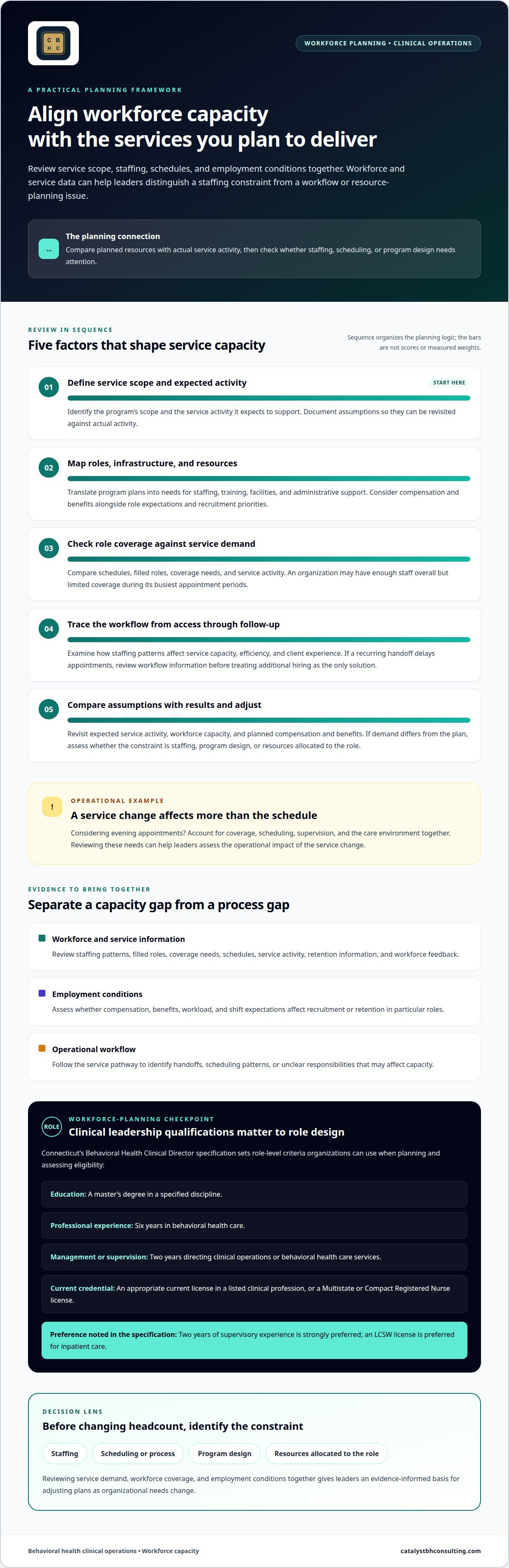
Budgeting and workforce planning connect an organization’s resources with the services it intends to deliver. Behavioral health clinical operations depend on aligning staffing, compensation, benefits, and program priorities. Using service, staffing, and retention data can help leaders test whether these plans address organizational needs.
Operational Budgeting
Operational budgeting plans resources for an organization’s services and responsibilities. It translates program plans into decisions about staffing, training, facilities, and administrative support. Comparing planned resources with actual service activity can help identify gaps.
Start by defining the program’s scope, then identify the roles and infrastructure it requires. For example, a clinic considering evening appointments should account for coverage, scheduling, supervision, and the care environment. Reviewing these needs together helps leaders assess the operational impact of a service change and use capacity data to inform decisions.
Compensation and benefits are part of the resource plan. Leaders can assess how pay structures, benefit offerings, and role expectations support recruitment and retention priorities. If a program struggles to fill a specialized role, reviewing compensation alongside workload, scheduling demands, and recruitment data may clarify the workforce challenge.
Documented assumptions make budget decisions easier to revisit. Leaders can outline expected service activity, workforce capacity, and planned compensation and benefits, then compare these assumptions with results. If demand differs from the plan, they can assess whether the constraint lies in staffing, program design, or resources allocated to the role.
A behavioral health operations consultant can examine how budgets, workforce plans, and service design interact. This can help leaders identify planning gaps and connect resource decisions to organizational priorities when growth or competing program needs strain existing processes. Reviewing relevant workforce and service data can support more informed adjustments.
Workforce Planning and Service Capacity
Workforce planning matches staff availability and role coverage to the services an organization intends to provide. It supports workable schedules, coordinated processes, and a consistent client experience. Tracking coverage and service activity can help leaders assess whether capacity aligns with demand.
A consultant can review how staffing patterns affect capacity, efficiency, and client experience by tracing a service pathway from appointment access through follow-up. For example, if a recurring handoff delays appointments, leaders can examine workflow information before treating additional hiring as the only solution.
Workforce information can guide targeted decisions. Leaders can compare schedules with filled roles, coverage needs, and service activity. They can also assess whether compensation, benefits, or shift expectations affect recruitment and retention in particular roles by reviewing relevant workforce patterns. Together, these factors help distinguish a staffing constraint from a scheduling or process issue.
A program may have enough staff overall but limited coverage during its busiest appointment periods. Adjusting shift patterns or clarifying responsibilities may better align capacity with demand. Leaders should also consider workload and the overall employment offering, using workforce feedback and retention information to ensure operational changes support staff stability.
Consultants can help organizations connect capacity reviews with compensation and benefits planning, then identify practical workforce options. Reviewing service demand, coverage, and employment conditions together gives leaders a stronger, evidence-informed basis for adjusting plans as needs change.
Clinical licensure requirements
Clinical licensure requirements define the education, experience, and credentials needed for a clinical role. Connecticut’s Behavioral Health Clinical Director specification provides role-level evidence that organizations can use to inform workforce planning.
Education and experience
The specification states that Connecticut’s Behavioral Health Clinical Director position requires a master’s degree in a specified discipline and six years of professional experience in behavioral health care. These are documented qualifications; their workforce-planning implications are an organizational analysis.
The position also requires two years of managerial or supervisory experience directing clinical operations or behavioral health care services. Separating this requirement from professional experience can help planners define the role, structure recruitment, and identify potential development needs among internal candidates. The specification sets the criteria; it does not establish how many candidates meet them.
The role profile distinguishes hands-on practice from leadership experience, helping clarify expectations. It also strongly prefers two years of supervisory experience. Keeping required and preferred criteria distinct can support clearer screening and more consistent role expectations.
Current clinical credentials
The specification requires Behavioral Health Clinical Directors to maintain an appropriate current license in a listed clinical profession or hold a Multistate or Compact Registered Nurse license. This requirement gives workforce planners a defined credential criterion to use when assessing role eligibility.
For inpatient care, an LCSW license is preferred. This is a stated preference, not a universal requirement. Separating preferred credentials from required ones can help hiring teams assess candidates consistently and align leadership qualifications with program settings.
The position requires American Heart Association CPR certification within 30 days of hire, with recertification every two years. It also requires Nonviolent Crisis Intervention training within 60 days of hire or transfer, with annual recertification. These specified timelines can inform onboarding plans and training records.
Specification and workforce alignment
A job specification documents the qualifications and expectations attached to a role. Connecticut’s current Behavioral Health Clinical Director specification replaced an existing specification approved October 22, 2024. This documented change makes version control relevant to workforce planning: role profiles and recruitment materials need to reflect the applicable specification.
For example, a candidate review can list degree, experience, license, and training criteria separately. This is an approach for organizing decisions, not an additional requirement in the specification. It can help leaders distinguish eligibility gaps from preferred experience or onboarding needs and support consistent workforce decisions across facilities and care settings.
Clinical curricula and training systems can help organizations align role expectations with staff development. A focused licensure and training planning conversation can help connect credential requirements, onboarding, and ongoing workforce needs.
Clinical operations leadership in facilities and Local Mental Health Authorities
Clinical operations leadership coordinates service delivery, accountability, and performance review across programs. Leaders can base decisions on operational records, consistently defined measures, and documented follow-up, making the evidence behind decisions easier to review.
Operations Across Care Settings
Care-setting operations are the processes and responsibilities shaped by how services are delivered. Mapping these processes can help identify differences between settings.
Outpatient leaders coordinate appointment access, clinician schedules, and follow-up between visits. Inpatient and residential leaders organize staff handoffs and daily coordination within the care setting. Telehealth leaders manage virtual appointment workflows, technical access, and communication across remote interactions. Reviewing each setting’s workflow and records helps determine whether a process fits its program.
Facilities and Local Mental Health Authorities can map each program’s service pathway and assign an owner to every transition. For example, referral records can show where requests wait between receipt and assignment. Reviewing timestamps across those records helps leaders locate process delays rather than rely on anecdotes.
Behavioral Health Clinical Workflows
A clinical workflow is a defined sequence of operational tasks that supports care and information exchange.
Leaders can trace referral review, scheduling, assessment, care planning, and follow-up using documented processes and available records. A consultant can compare the written process with staff accounts and workflow records. If referrals remain unassigned, the review can examine routing rules, queue ownership, and handoff documentation to identify where the process breaks down.
Consultants can help organizations assess technology and electronic health record systems against documented user needs. They can map essential tasks, test representative workflows, and record where systems support or obstruct those tasks. Documented test results give leaders a structured basis for evaluating fit, rather than relying on a feature list alone.
Documentation, Billing, and Compliance
Documentation, billing, and compliance workflows connect clinical records with administrative review and organizational oversight.
Leaders can examine a sample of completed records for recurring omissions, late entries, or unclear review ownership. Recording each finding, assigning follow-up, and comparing later reviews can show whether the process has changed. Billing procedures should follow applicable requirements and established review controls.
For facilities and Local Mental Health Authorities, a documented responsibility map can show who addresses record exceptions and monitors corrective actions. Consultants can review these operational handoffs and organize findings for leadership review, supporting process oversight without substituting for legal advice.
Access, Wait Times, and Clinical Outcomes
Access and outcome measurement uses defined indicators to assess service entry, continuity, and results.
Leaders can define how the organization records referral receipt, first appointment, missed visits, and follow-up. Comparing these records by program or service pathway can reveal differences in access. Clear definitions and consistent collection practices help ensure outcome comparisons are based on the same underlying information.
A consultant can help select measures, assess data quality, and organize reports around leadership decisions. For example, a rise in recorded waiting intervals alongside stable referral volume may prompt a review of scheduling capacity or handoff processes. Discuss operational performance priorities to connect the available evidence with practical next steps.
Clinical staff supervision
Clinical staff supervision is a structured process for supporting practice, reviewing clinical work, and clarifying accountability. In behavioral health organizations, it connects staff development with service quality and operational consistency.
Effective supervision starts with clear role expectations. Supervisors and clinicians should understand the role’s scope, which decisions require consultation, and how to escalate concerns. For example, a new clinician may need guidance on documenting a complex case or coordinating a referral. Clear boundaries show staff when to act independently and when to seek support.
Case review makes supervision concrete. A supervisor can examine a clinical scenario with a staff member, explore the reasoning behind decisions, and discuss possible next steps. A consistent structure might cover the client’s goals, progress, barriers, documentation, and unresolved concerns. This keeps the discussion focused on practice rather than general impressions.
Supervision also supports workforce stability. Individual discussions can surface workload pressures, unclear responsibilities, or training needs affecting a team. If several clinicians report confusion about a referral handoff, for instance, the issue may call for workflow clarification, not just individual coaching. Supervisors can share recurring themes with operational leaders while protecting appropriate confidentiality.
- Set expectations: Clarify role boundaries, consultation pathways, and documentation responsibilities.
- Review practice: Use relevant cases to discuss clinical reasoning and follow-up.
- Record actions: Document agreed development steps and who owns each follow-up.
- Escalate patterns: Share recurring workflow barriers with the leaders responsible for resolving them.
Written follow-up turns supervision into an operational tool. A supervisor might document that a clinician needs help with a specific documentation process, then agree on a training resource and a later review. The record should identify the action and its owner, not merely note that a conversation took place.
Consistency matters across facilities and teams. If one supervisor addresses a recurring practice concern while another overlooks it, staff receive uneven guidance. Shared supervision frameworks can set common expectations while allowing discussions to reflect each clinician’s responsibilities and setting. Clinical curricula and training systems can reinforce those expectations with structured learning materials.
Leaders can assess supervision quality by checking whether agreed actions are completed, recurring questions decline, and staff understand escalation routes. These indicators help distinguish a one-time coaching need from a broader organizational gap. When supervision reveals unclear policies or repeated workflow barriers, leaders can address the system as well as individual development.
Clinical staff supervision works best as a defined management practice, not an isolated conversation. Connecting case discussion, staff development, and operational follow-through helps behavioral health organizations strengthen accountability and give teams a clearer structure for delivering care.
What are the core workflows in behavioral health clinical operations?
Core workflows are repeatable processes that move clients and information through a behavioral health organization. Clear ownership at each step helps teams coordinate access, care, follow-up, and operational decisions.
Referral and intake
Referral management covers receiving, reviewing, and routing requests for services. A defined workflow specifies who records the referral, who reviews fit, and who communicates next steps. For example, an intake coordinator can route a referral to the appropriate program and record its status for follow-up. If essential information is missing, staff need a clear way to resolve the gap rather than let the referral stall.
Organizations can map every handoff from first contact through scheduled intake. The map makes delays and unclear responsibilities visible to leaders. It also helps staff explain what happens next, so prospective clients receive consistent information rather than different instructions from each team.
Care coordination and transitions
Care coordination is the organized exchange of information and responsibilities across staff, programs, and service transitions. A workflow can specify who communicates a change in care, updates the relevant record, and coordinates follow-up. When a client moves between programs, for example, the sending and receiving teams need a defined handoff to preserve continuity.
Leaders can document where tasks change ownership, then clarify who confirms receipt, addresses unresolved questions, and records the outcome. This reduces reliance on informal messages and helps teams identify unfinished work before it affects a client’s next step.
Incident response and client rights
Incident response involves documenting concerns, assigning follow-up, and reviewing organizational learning. A written workflow should define how staff report an event, who receives the report, and how leaders track resulting actions. For example, an incident review can identify a communication breakdown and assign a policy or training follow-up.
Client-rights processes also need clear routing. Staff should know how a concern is received, documented, and sent for review. Leaders can monitor whether it reaches the appropriate decision-maker and whether the next action is recorded. Connecting these processes helps organizations respond consistently and maintain accountability.
Record completion and operational review
Record completion ensures clinical information reaches the appropriate record and review stage. Organizations can define who enters, reviews, and corrects documentation. A clear exception path helps staff resolve incomplete records rather than leave discrepancies unassigned.
Operational review turns workflow information into decisions. Leaders can consider referral status, handoff delays, incident follow-up, and record exceptions together. A repeated delay at one transition may signal unclear ownership; recurring record corrections may point to a training need. This distinction helps target improvement to the actual process.
To align these workflows with your organization’s priorities, schedule an operational workflow discussion.
Catalyst Behavioral Health Consulting: Clinical curricula & training systems
Catalyst Behavioral Health Consulting helps behavioral health organizations strengthen operations through clinical curricula and training systems. Organizations can assess these resources by tracking staff expectations, role development, and learning against defined workforce and operational needs.
Consider this support when teams need a shared training framework or growth makes informal onboarding difficult to sustain. Licensing and accreditation support can address related readiness needs, while fractional HR leadership supports workforce planning and leadership priorities. Define the operational gap and use relevant workforce measures to guide the starting point.
For a conversation about strengthening your clinical training approach, contact Catalyst Behavioral Health Consulting.
Build the Next Phase With Clear Priorities
Operational improvement is easier to assess when leaders translate priorities into clear ownership, review rhythms, and decision criteria. Rather than treating every pressure as a separate fix, identify an organizational constraint affecting multiple teams. Establish a baseline, select indicators linked to that constraint, and review them regularly to guide adjustments. This helps behavioral health clinical operations distinguish measurable progress from activity.
Choose support that fits your organization’s needs. Catalyst Behavioral Health Consulting offers licensing and accreditation support, fractional HR leadership, and Catalyst Continuum startup packages. These offerings address different priorities, including readiness, leadership capacity, and startup structure. Match support to the decision ahead, define accountability, and use relevant indicators to assess progress for those carrying the work forward.
With a defined priority and appropriate support, your organization can move from operational uncertainty toward a more deliberate plan. Contact Catalyst Behavioral Health Consulting to discuss the next step for your organization. A focused conversation can help clarify the evidence and decisions needed to move forward with purpose.
Frequently Asked Questions
What are behavioral health clinical operations?
Behavioral health clinical operations are the organizational systems that support care delivery. They connect program design, workforce coordination, clinical oversight, documentation, and quality review. When a provider adds a service, for example, leaders need to align its staffing model, intake process, clinical supervision, and performance monitoring. These functions translate organizational priorities into consistent team practices while keeping operational decisions connected to the services clients receive.
What staffing roles and staffing ratios are needed for behavioral health services?
Staffing roles depend on the service model, client needs, hours of operation, and applicable licensing or funding requirements. A program may need clinical leadership, licensed clinicians, support staff, and administrative coordination, with responsibilities shaped by its services. No single ratio suits every program. Leaders should define coverage needs by shift and service activity, then compare required competencies with workforce capacity and organizational obligations.
What regulations govern behavioral health clinical operations in the United States?
Behavioral health operations are shaped by applicable federal and state requirements, state program rules, funding conditions, and any accreditation standards an organization adopts. Requirements vary with the services offered, setting, funding arrangements, and professional roles. A provider operating distinct programs, for example, may need separate procedures and records for each. Leaders should assign regulatory oversight and incorporate applicable changes into policies and staff guidance.
Which operational factors should behavioral health organizations consider when planning a clinic or program?
Clinic planning should align the service model with community demand, referral pathways, workforce availability, facility needs, and operational oversight. A program offering onsite and virtual appointments, for example, needs suitable space, scheduling processes, technology, and staff responsibilities for each channel. Leaders should also plan intake, continuity of care, records, and performance review. These elements determine whether the design can operate consistently after launch.
What are common operational risks and safety protocols in behavioral health settings?
Common operational risks include unclear escalation responsibilities, communication breakdowns, incomplete records, and staff-coverage gaps. Safety protocols should explain how staff report incidents, respond to urgent concerns, communicate across shifts, and document follow-up. A written escalation pathway, for example, can identify who receives a report and how unresolved concerns reach leadership. Organizations can use incident reports, coverage records, and staff feedback to identify recurring process weaknesses, assess safety protocols, and target training and operational oversight.

Article by
James McCreary, MS, LPC-S
The Catalyst dispatch.
Frameworks and field lessons on running effective behavioral-health programs. One email a month, sometimes two. Never spam.