Insights
Behavioral health HR consulting for provider organizations
In behavioral health, workforce systems are part of organizational capacity. Behavioral health HR consulting helps provider organizations align staffing, leadership, and people processes with operational needs, including credential and license tracking.
Workforce challenges rarely sit within a single HR process. Staffing needs affect operations, compensation and benefits influence recruitment and retention, and leadership practices shape workplace culture. A coordinated approach helps organizations identify gaps, strengthen processes, and support sustainable growth.
This article explains how HR consulting can address organizational priorities, workforce planning, and credential and license tracking. It also explores how workforce information can guide decisions, how leadership and culture fit, and where Catalyst Behavioral Health Consulting’s fractional HR leadership and licensing and accreditation support can help organizations put practical, integrated guidance into action.
Key Takeaways
- Connect HR planning to organizational priorities so staffing, leadership, and operations support the provider’s direction.
- Use workforce information to identify capacity gaps and guide recruitment, retention, and role planning.
- Build consistent processes for tracking professional credentials and licenses to support workforce readiness.
- According to the U.S. Department of Health and Human Services, HIPAA requires covered entities to follow rules protecting patients’ protected health information and data.
- Account for state-specific labor requirements when shaping HR policies, and consider fractional HR leadership or licensing and accreditation support when additional expertise is needed.
Table of Contents
Behavioral health organizational consulting
Organizational consulting connects workforce decisions with program design, clinical priorities, and day-to-day operations. For a behavioral health provider, the aim is to identify process gaps, clarify ownership, and help leaders build a culture that supports staff and quality care.
Outsourced and In-House HR Support
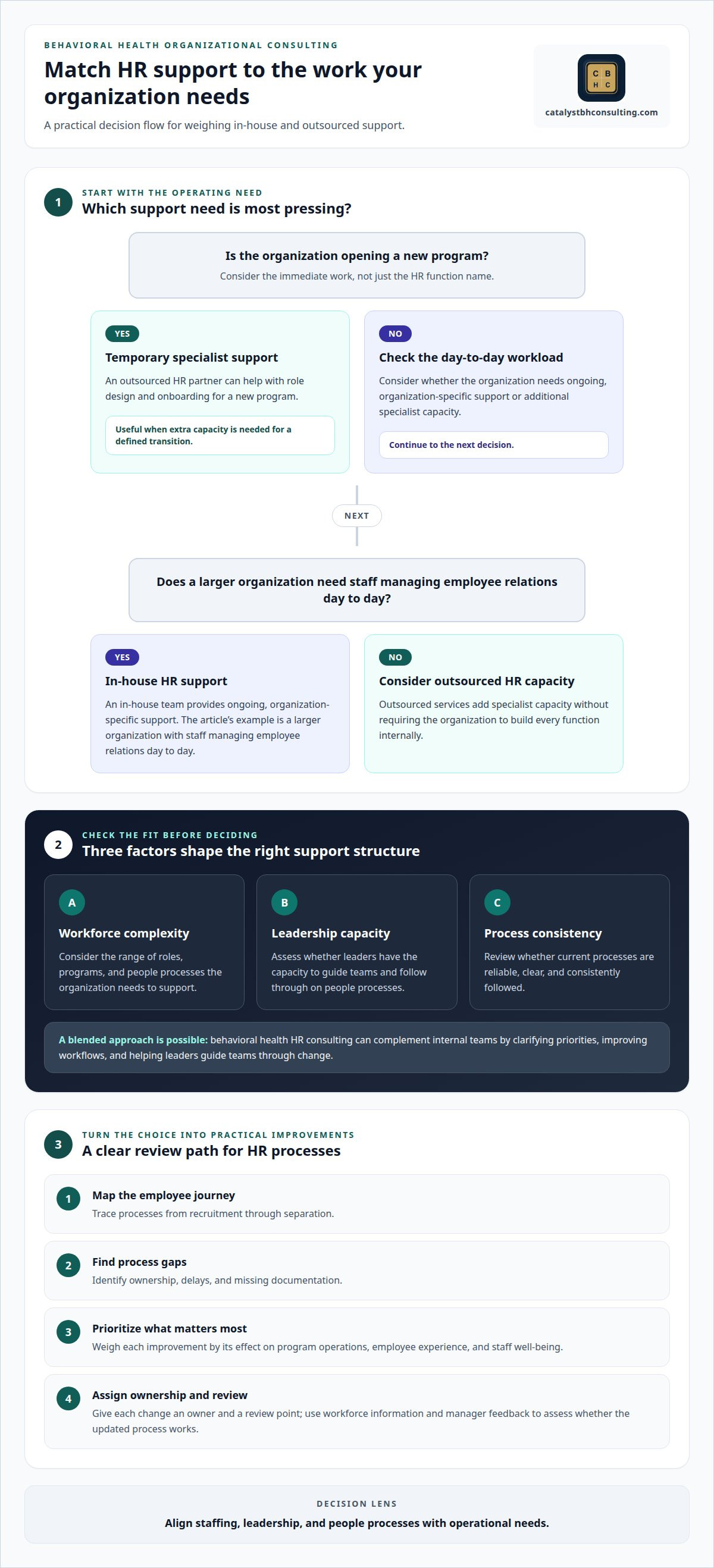
Outsourced HR services add specialist capacity without requiring an organization to build every function internally; an in-house team provides ongoing, organization-specific support. The right structure depends on workforce complexity, leadership capacity, and the consistency of existing processes. A provider opening a new program, for example, may need temporary support with role design and onboarding, while a larger organization may need staff managing employee relations day to day. Behavioral health HR consulting can complement internal teams by clarifying priorities, improving workflows, and helping leaders guide teams through change.
Leadership and Team Culture
Leadership practices shape how employees communicate, raise concerns, and respond to demanding work. Behavioral health organizations can assess whether supervisors set clear role expectations, invite feedback, and follow up consistently. A policy review should also consider how leaders communicate changes and support trust across clinical and nonclinical teams. These signals can help identify cultural barriers that affect collaboration and staff experience.
Clinic and Treatment Center HR Policies
Clinics and treatment centers need policies covering hiring, onboarding, role expectations, supervision, conduct, leave, performance management, and complaint handling. Policies should reflect the organization’s programs and distinguish responsibilities for clinical and nonclinical roles. For example, onboarding procedures can specify orientation steps, training records, and the manager responsible for completion. The U.S. Department of Health and Human Services states that HIPAA requires covered entities to follow rules protecting patients’ protected health information and data. Clear guidance can help employees handle that information while reinforcing a culture of responsibility.
Employment Risks and Claims
Potential employment risks include inconsistent discipline, unclear job expectations, inadequate documentation, and mishandled complaints. In behavioral health, staffing changes, emotional strain, or crisis response can also expose gaps in role clarity and manager support. Review how supervisors document performance concerns, respond to employee reports, and explain decisions. Regularly examining these patterns can help leaders identify workplace stressors and improve communication before problems become more difficult to address.
To assess HR needs, map processes from recruitment through separation, then identify ownership, delays, and missing documentation. Prioritize improvements by their effect on program operations, employee experience, and staff well-being. Assign an owner and review point to each change, then use workforce information and manager feedback to assess whether the updated process works and supports a healthier team culture.
Behavioral health workforce solutions
Workforce decisions shape service capacity, employee experience, and organizational resilience. Providers can connect staffing information with compensation, benefits, and employee development priorities.
Reducing Turnover and Burnout
Review turnover alongside workload, vacancies, schedule changes, and employee feedback. These indicators can help leaders distinguish retention concerns from staffing gaps or uneven coverage. Repeated vacancies in one role, for example, may prompt a review of job expectations, manager support, and the benefits employees value. Choose a focused response based on the findings, then track workforce indicators over time.
Clinician Recruitment and Retention
Recruitment starts with role clarity: describe responsibilities, supervision, schedule expectations, and development opportunities accurately. Compare compensation structures and benefits across comparable internal roles to identify inconsistencies that could complicate hiring or advancement. Retention planning can include manager check-ins, professional development, and clear paths to increased responsibility. Pair each effort with an indicator, such as applicant flow, acceptance patterns, or employee feedback.
The behavioral health sector faces an undersupply of mental health professionals. The National Council for Mental Wellbeing launched its Center for Workforce Solutions in 2023, in partnership with The College for Behavioral Health Leadership and HMA. This workforce context makes planning more useful than treating each vacancy as a separate event. Leaders can identify roles essential to each program and understand where recruitment pressure affects service capacity.
Workforce analytics can help explain these pressures. Review vacancies, turnover patterns, internal transfers, recruitment progress, and training completion together. Compare results by role or program when records support a meaningful analysis. Persistent openings paired with extended onboarding, for instance, may point to different constraints than turnover concentrated among experienced staff. Data helps leaders frame questions and prioritize investigation; it does not replace context from employees and managers.
Structured analysis can also improve compensation and benefits decisions. Consider role expectations, compensation practices, benefits use, and employee feedback as connected signals. Low participation in a benefit may call for clearer communication, while repeated concerns about advancement may point to a need for better-defined career paths. Avoid interpreting a single indicator in isolation. Compare patterns across teams and pair quantitative measures with employee input before changing workforce practices.
Translate findings into a short workforce plan with an owner, an action, and a measure for each priority. A workforce planning conversation can help connect staffing analysis with compensation, benefits, and program needs.
When employees raise concerns about advancement, leaders can compare role expectations, development options, and manager support before choosing a response. Workforce planning should also reflect how services are organized. Integrated behavioral health combines mental health and substance use disorder treatment in coordination with primary care. Organizations using this model can map staffing responsibilities across those areas, clarify how teams coordinate, and identify recruitment or training needs. Clear role boundaries and communication expectations help employees understand how their work fits into care.
Review these decisions alongside employee feedback and service needs, then revisit them as circumstances change. A consistent process connects workforce priorities with the services an organization aims to provide, without assuming one staffing response suits every program.
Behavioral health consulting
Behavioral health consulting can help providers connect workforce decisions with patient and organizational outcomes. A focused assessment can clarify program needs, leadership responsibilities, and how teams measure progress. For a provider planning a new service, reviewing staffing, training, and employee support alongside patient needs can help identify readiness gaps before launch. This connects workforce capacity with the patient experience.
Consulting can begin with a review of existing programs, reporting lines, workforce data, and employee feedback. Leaders can use these inputs to distinguish immediate barriers from longer-term priorities. A clinic facing delayed onboarding, for instance, can examine the process from an accepted offer through orientation and role-specific training, while considering whether compensation and benefits support recruitment and retention goals. An action plan can assign owners and define progress measures.
Behavioral health strategy also responds to changes in health services. U.S. policy responses include the Mental Health Parity and Addiction Equity Act and the integration of Medicaid funding streams. Organizations can assess how financing, service design, and workforce capacity interact, including how staff experience changes in care delivery. A provider considering integrated care can define how mental health and substance use treatment coordinate with primary care. Clear roles, supportive leadership, and effective handoffs help translate the model into daily practice.
Funding models also shape organizational decisions. Behavioral health organizations are facing a shift from fee-for-service care toward value-based care arrangements. Leaders can assess whether staffing, care coordination, and performance information support their chosen model. Workforce analytics can help teams examine access, follow-up, and workload patterns, while employee feedback can highlight barriers to delivering coordinated care. These perspectives support informed choices without assuming that one model fits every organization.
Regulatory and program requirements can also shape consulting priorities. The U.S. Government Publishing Office identifies 42 CFR Part as a treatment-center compliance guide topic. Organizations can review relevant requirements alongside staff roles, training, and documentation, considering whether expectations are clear and manageable for employees. Distinguishing organization-wide processes from program-specific ones helps leaders assign ownership and support consistent implementation.
A practical consulting engagement can assess current conditions, prioritize consequential gaps, and implement assigned improvements. A provider expanding services across the nation, for example, might review program capacity, decision-making authority, and workforce readiness. Leaders can consider how culture, employee well-being, and benefits support the changes, then use regular reviews of workforce and patient-service measures to assess progress. This approach connects organizational priorities with clear responsibilities and evidence-informed decisions.
What HR compliance requirements apply to behavioral health providers in the U.S?
Behavioral health providers need clear processes for translating applicable requirements into staff practices. The U.S. Department of Health and Human Services says HIPAA requires covered entities to follow rules protecting patients’ protected health information and data. For HR, that means aligning staff access, training, and workplace procedures with each employee’s role.
Start by mapping compliance responsibilities across hiring, onboarding, supervision, and employee records. Identify, for example, who assigns role-based training, records completion, and follows up when staff responsibilities change. A written process helps managers apply consistent steps across programs. It also reveals where policies, training materials, or recordkeeping practices need review.
Behavioral health treatment centers should also account for 42 CFR Part, which the U.S. Government Publishing Office identifies as a treatment-center compliance guide topic. HR leaders can connect relevant organizational guidance with job responsibilities and staff training. A practical review asks which roles need guidance, who provides it, and how the organization documents completion. This keeps compliance planning connected to actual work rather than a standalone policy file.
Separate organization-wide procedures from program-specific processes. A clinic and a residential treatment program may have different workflows, supervision arrangements, and staff access needs. Document these differences in role descriptions, onboarding steps, and training plans. When a program changes, assign someone to review affected procedures and communicate updates to relevant teams.
Employee documentation also benefits from a consistent structure. Define where the organization records hiring decisions, role changes, performance discussions, completed training, and policy acknowledgments. Assign access and recordkeeping responsibilities according to organizational procedures. A manager documenting a role change, for example, can follow the same approved process as other managers, helping keep personnel records aligned with current duties.
A useful review can follow three steps: identify applicable requirements, map them to current policies, and assign owners to address gaps. Then set a schedule for reviewing procedures when programs or roles change. Record the decision, responsible lead, and implementation status for each action. This creates a working compliance system that leadership can monitor, rather than a collection of disconnected documents.
Behavioral health HR consulting can coordinate these efforts by connecting people processes with program operations. A structured assessment can examine policy coverage, training workflows, role documentation, and accountability. Leaders can prioritize updates based on operational relevance and assign clear responsibility. The result is a more coherent way to maintain staff readiness and support the organization’s compliance work.
How do state labor laws affect behavioral health organizations?
State labor laws are one factor in how behavioral health organizations plan staffing and manage operations across locations. A provider operating in multiple states can start by listing where employees work, which policies apply, and who maintains each policy. This inventory gives leaders a basis for connecting workforce planning with local requirements and organizational priorities.
Hiring and onboarding processes should reflect the organization’s operating locations and workforce needs. Review job documents, employee communications, and onboarding steps together, then assign responsibility for updates. If a provider opens a clinic in another state, its expansion plan can include a review of employment policies and staffing processes for that workforce. This connects growth decisions with HR readiness before managers apply existing procedures in a new setting.
Scheduling decisions can be reviewed alongside program coverage and employee workload. Behavioral health providers may use different coverage patterns across outpatient, inpatient, and crisis programs. Map how scheduling decisions are made, where employees work, and how managers document changes. Then compare those practices with requirements applicable to each location. This review can help leaders identify where a distinct procedure may be needed to support both service operations and workforce planning.
Compensation and benefits administration also calls for location-aware planning. Document how the organization establishes pay practices, communicates benefits, and handles employee questions across its workforce. A multistate provider can use a policy matrix to show which procedures apply organization-wide and which need location-specific handling. Assign a policy owner and review trigger, such as a new location or revised program structure, to connect updates with operational changes.
Employee relations procedures should give managers a consistent framework while allowing for state-specific policy differences. A supervisor handling a complaint, for example, should know where to record it, who receives it, and which internal process applies. Review manager guidance, escalation routes, and documentation practices together. Clear ownership and consistent documentation can support leadership oversight and help managers address concerns through established processes.
A practical review can follow three steps: map employee locations, compare policies and workflows, and assign owners for updates. Track completion and unresolved issues in a central register. Workforce information, including employee work locations and role assignments, gives leaders a basis for reviewing staffing patterns and operational needs. Revisit the register when the organization adds a site, changes staffing models, or updates a program’s coverage approach.
A Business Health Assessment can help leadership connect policy review with wider organizational priorities. Use the assessment process to clarify ownership, surface operational gaps, and organize next steps for state-specific HR practices and workforce planning.
Include relevant policy developments in leadership reviews, and assign responsibility for evaluating their potential implications. Leaders can consider whether a development calls for changes to workforce planning, benefits administration, or program operations, without assuming that a proposed change has altered applicable rules. This approach keeps policy monitoring connected to organizational decisions and the needs of behavioral health programs.
Catalyst Behavioral Health Consulting
Catalyst Behavioral Health Consulting helps behavioral health organizations address workforce, licensing, and accreditation priorities. Turn to its support when internal teams need additional HR leadership, clearer startup planning, or practical resources to strengthen organizational processes. Fractional HR leadership supports workforce decisions, while Catalyst Continuum startup packages and Catalyst Academy digital downloads address distinct organizational needs. Licensing and accreditation support helps providers organize requirements as programs develop.
Choose the support that aligns with your organization’s current priorities, whether you’re building a program or improving existing systems. Contact Catalyst Behavioral Health Consulting to discuss your organization’s needs.
Make Your Next Workforce Decision Deliberate
Choose one organizational priority to address first. It might be clarifying decision ownership, strengthening workforce planning, or aligning HR processes with a developing program. A defined priority gives leadership a practical starting point and keeps implementation connected to the organization’s broader direction.
Behavioral health HR consulting can turn that priority into coordinated action, with responsibilities and next steps suited to your organization. The goal is not to add process for its own sake, but to create structure that helps teams focus on their work and leaders make informed decisions.
If you’re ready to plan the next step, start a conversation with Catalyst Behavioral Health Consulting. A clear starting point can help your organization build momentum with purpose.
Frequently Asked Questions
What services do behavioral health HR consultants provide?
Behavioral health HR consultants can support workforce planning, HR policies, employee relations, recruiting, and retention. The scope depends on an organization’s needs, such as adding senior HR capacity or strengthening people operations. Catalyst Behavioral Health Consulting offers fractional HR leadership, compliance audits and handbooks, employee relations and investigations, recruiting, culture, and retention services. A growing provider, for example, may need help aligning hiring processes and manager practices as teams expand.
How do I choose a behavioral health HR consulting firm?
Choose a firm whose capabilities match your immediate workforce challenge and operational context. Define the work you need, such as policy development, employee relations, or fractional HR leadership, then assess whether the firm’s stated services address those needs. Consider how recommendations will be implemented and communicated to managers. Catalyst Behavioral Health Consulting provides HR consulting and operational, clinical, and regulatory support for behavioral health organizations.
How should behavioral health organizations handle credentialing, licensing, and background checks?
Use a documented, role-based process with clear ownership at each stage. Identify which credentials and licenses apply to each position, record their status, and establish a process for reviewing required renewals. Organize background-check procedures and records according to applicable requirements. For example, an onboarding workflow can assign responsibility for collecting documents, recording completion, and escalating outstanding items before a staff member begins assigned duties.

Article by
James McCreary, MS, LPC-S
The Catalyst dispatch.
Frameworks and field lessons on running effective behavioral-health programs. One email a month, sometimes two. Never spam.