
Insights
Behavioral Health Pro Forma Template 2026: Strategic Financial and Workforce Modeling
Theoretical bed census doesn't govern clinical financial viability; staffing ratios, onboarding velocity, and clinician retention do. When mapping out organizational growth, standard accounting spreadsheets fall short because they treat healthcare human capital as a static line item. Designing an operational model around a dedicated behavioral health pro forma template 2026 framework ensures your organization accounts for credentialing lead times and workforce friction before those systemic bottlenecks drain early operational reserves.
You already understand that generic financial projections fail to translate complex supervisory ratios, high clinician turnover, and multi-state compliance mandates into defensible figures. By following this guide, you'll master behavioral health financial modeling for 2026 with a pro forma structure that integrates clinical staffing, regulatory compliance, and workforce analytics directly into clear revenue generation targets.
Ahead, we explore the data-driven labor benchmarks, operational systems, and compensation models required to establish an audit-ready forecast that satisfies executive boards, lending institutions, and clinical leaders alike.
Key Takeaways
- Structure an institutional-grade behavioral health pro forma template 2026 that links verified levels of care and length-of-stay assumptions directly to dynamic revenue performance.
- Align client-to-staff ratios with accreditation standards while factoring documentation overhead into realistic, sustainable clinician billable productivity targets.
- Calculate the true cost of care delivery by modeling fully burdened labor tiers, mandatory benefit loads, and credentialing lead times across multidisciplinary teams.
- Integrate regulatory supervision requirements, clinical governance protocols, and structured retention systems to stabilize capacity without inflating permanent executive overhead.
- Stress-test multi-year forecasts against census volatility and payer lag to establish audit-ready monthly operational scorecards for board members and lending institutions.
Table of Contents
- Core Architecture of a Modern Behavioral Health Pro Forma Template
- Workforce Analytics: Modeling Clinical Ratios and Productivity Baselines
- Compensation, Benefits, and True Labor Cost Projections
- Leadership Structure, Regulatory Compliance, and Cultural Overhead
- Operationalizing Pro Forma: Spreadsheet to Facility
Core Architecture of a Modern Behavioral Health Pro Forma Template
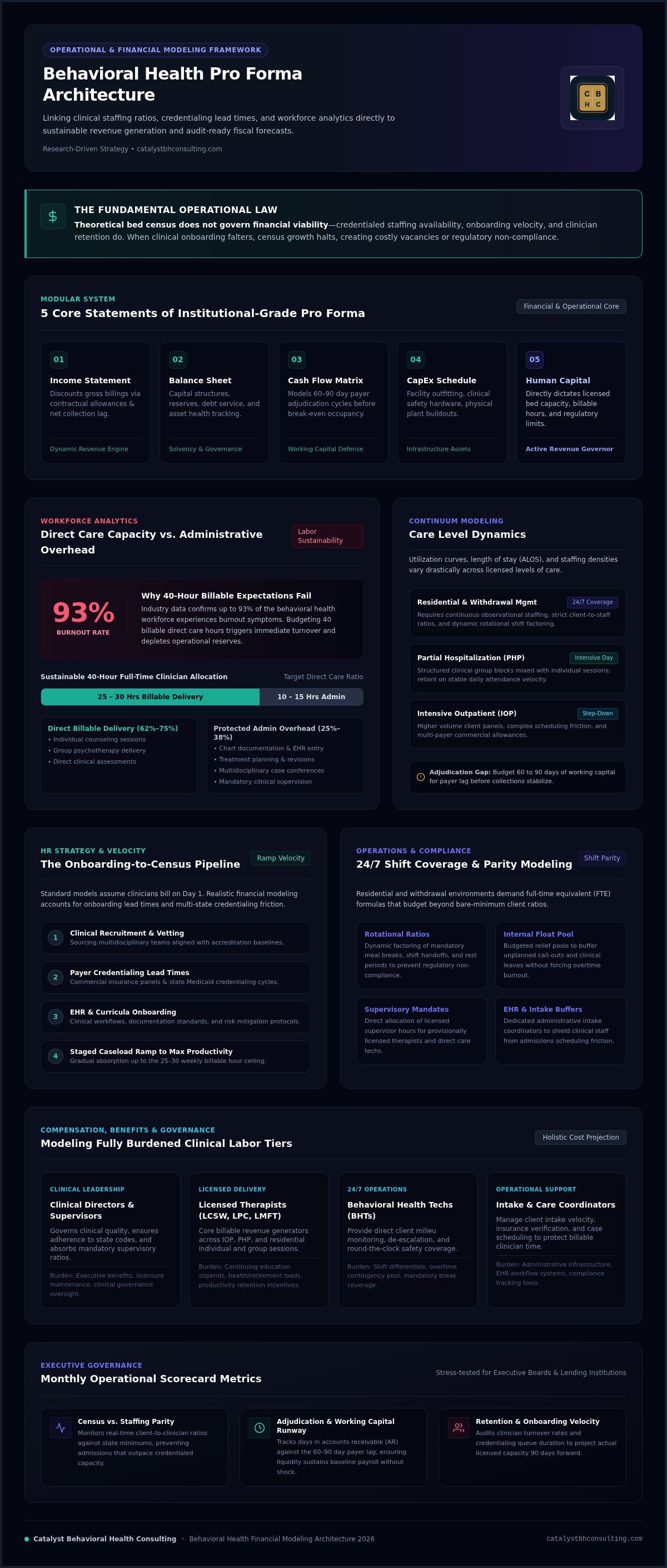
Institutional-grade healthcare forecasting demands modular integration across five foundational statements: the income statement, balance sheet, cash flow projection, capital expenditure schedule, and human capital staffing matrix. General commercial spreadsheets consistently fail because they treat clinical labor as a static entry rather than an active revenue governor. Building defensible pro forma financial statements requires linking licensed facility capacity directly to credentialed workforce availability. In an operational behavioral health pro forma template 2026, working capital reserves don't just cover facility overhead; they provide liquidity to absorb 60-to-90-day payer adjudication cycles and upfront clinician onboarding delays before facilities reach break-even occupancy.
Revenue Recognition and Census Modeling Across Care Levels
Topline projections depend on realistic patient intake velocity, average length of stay (ALOS), and payer mix realities rather than theoretical bed capacity. Residential settings, partial hospitalization programs (PHP), and intensive outpatient programs (IOP) operate under markedly different utilization curves and reimbursement mechanics. An accurate behavioral health pro forma template 2026 discounts gross billings through contractual commercial allowances, anticipated denial percentages, and net collection lag. Most importantly, client acquisition schedules must synchronize directly with clinical talent acquisition. If clinician onboarding falters, census growth halts, creating costly bed vacancies or forcing facilities into regulatory non-compliance.
Operational Expense Categorization and Facility Baselines
Disciplined financial governance isolates unyielding physical plant commitments from volume-sensitive delivery expenses. Facility leases, specialized electronic health record (EHR) platforms, enterprise security, and recurring accreditation fees define the fixed operational baseline. Variable expenditures, such as catering services, client toxicology screens, and therapeutic supplies, scale alongside daily attendance. Strategic operators also budget for executive risk mitigation, clinical curricula systems, and ongoing compliance oversight from day one, ensuring administrative infrastructure scales cleanly alongside clinical census expansion.
Workforce Analytics: Modeling Clinical Ratios and Productivity Baselines
Workforce analytics form the operational bridge between clinical licensing requirements and sustainable fiscal viability. With industry research showing up to 93% of the behavioral health workforce experiencing symptoms of burnout, building an aggressive 40-hour billable expectation into your pro forma spells financial disaster. A robust behavioral health pro forma template 2026 isolates direct care productivity from administrative overhead, aligning staff-to-client ratios with state administrative codes and accrediting standards while protecting clinicians from administrative fatigue.
Clinical Caseload Capacity and Direct Care Productivity
Defensible staffing projections balance direct clinical delivery against mandatory non-billable responsibilities. Full-time licensed therapists rarely sustain more than 25 to 30 billable hours per week once chart documentation, treatment planning, multidisciplinary case conferences, and clinical supervision are accounted for. When outpatient models mix individual counseling with group therapy sessions, productivity baselines must adjust to reflect distinct reimbursement schedules. Implementing structured operational workflows and dedicated intake coordination shields clinicians from scheduling friction, preserving billable hours and stabilizing staff retention.
Direct Care Shift Coverage and Parity Modeling
Residential facilities and withdrawal management environments require around-the-clock observational coverage governed by strict state staff-to-client minimums. Modeling full-time equivalents (FTEs) for Behavioral Health Technicians (BHTs) across 24/7 matrices requires distinct coverage calculations:
- Baseline Rotational Ratios: Standard shifts demand dynamic factoring of mandatory meal breaks, shift handoffs, and rest periods to remain compliant.
- Float Pool Allocations: Budgeting an internal relief pool mitigates unplanned absenteeism, holiday premiums, and expensive emergency overtime.
- Agency Dependency Reductions: Proactive FTE modeling directly reduces dependence on third-party contract staffing agencies, which often inflate direct labor expenses.
Aligning clinical capacity with predictable labor structures preserves working capital while maintaining licensing compliance across every shift. Organizations seeking to pressure-test their operational assumptions can schedule a strategic consultation to review their clinical staffing architecture before launch.
Compensation, Benefits, and True Labor Cost Projections
Labor represents the single largest expenditure in mental health and addiction recovery operations. Yet, standard financial spreadsheets routinely underestimate wage inflation and human capital friction. With an estimated 122 million Americans living in areas experiencing mental health professional shortages, competing for licensed clinicians requires precise financial modeling. A modern behavioral health pro forma template 2026 must delineate compensation across multidisciplinary roles, applying realistic labor burdens rather than broad corporate assumptions to establish true delivery costs.
Total Rewards Architecture and Fringe Benefit Modeling
Talent acquisition strategies require competitive total rewards packages that balance base payroll with organizational viability. In addition to statutory payroll taxes, workers' compensation, and unemployment insurance, providers must factor comprehensive medical, dental, and retirement benefits into their labor multipliers. For licensed clinical personnel, including a competitive annual salary alongside structured fringe benefits, such as dedicated continuing education stipends and licensure renewal allowances, directly strengthens workplace retention. Pairing base compensation with objective bonus structures tied to documentation timeliness and clinical quality metrics reinforces compliance without compromising care standards.
Turnover Friction and Workforce Replacement Financials
Frontline clinician turnover inflicts measurable financial damage on early-stage and scaling treatment facilities. When an independently licensed therapist resigns, the organization absorbs immediate recruitment advertising expenses, credentialing lead times, and lost billable capacity. Implementing structured workforce frameworks addresses these organizational vulnerabilities directly. For example, deploying systemic onboarding and retention initiatives has delivered a demonstrated turnover reduction of 32 percent in six months, preserving critical cash reserves.
Failing to model workforce turnover leaves balance sheets vulnerable to sudden staffing gaps. Reviewing the core principles of starting a behavioral health business highlights how strategic workforce planning stabilizes early-stage facility operations. A reliable behavioral health pro forma template 2026 integrates the full cost of talent acquisition, orientation ramps, and credentialing lag directly into its working capital calculations, ensuring that cash reserves remain intact while new clinicians achieve full billing productivity.
Leadership Structure, Regulatory Compliance, and Cultural Overhead
Generic accounting spreadsheets treat regulatory compliance as a flat, miscellaneous contingency. In reality, clinical governance is an active operational discipline requiring dedicated supervisory capacity, continuous chart auditing, and rigorous utilization review systems. When designing an institutional-grade organizational chart, your behavioral health pro forma template 2026 must balance executive oversight with frontline clinical productivity, ensuring that administrative leadership protects the facility's license without draining capital reserves.
Clinical Governance and Supervisory Infrastructure
Deploying provisionally licensed or associate-level clinicians offers an effective talent pipeline, but it introduces non-negotiable supervisory overhead. Clinical directors and fully licensed supervisors must dedicate multiple non-billable hours each week to individual case review, group supervision, and chart signing. These oversight hours must be explicitly modeled in labor schedules because every hour spent supervising directly reduces a senior clinician's billable patient capacity. Establishing this governance structure guarantees that client documentation satisfies the rigorous requirements detailed in behavioral health accreditation support, preventing technical denials and post-payment audit clawbacks.
Culture, Professional Development, and Leadership Development
Building high-retention clinical environments requires structured investments in organizational culture, trauma-informed leadership training, and supervisor coaching. Without deliberate professional development frameworks, frontline managers quickly burn out under operational pressures, accelerating facility turnover. Early-stage facilities and scaling operators, however, often struggle to support full-time executive salaries across HR, compliance, and clinical operations.
Deploying fractional executive leadership solves this structural challenge. As explored in our analysis of fractional HR for healthcare, engaging seasoned advisory talent allows providers to establish policy and procedures, execute performance management systems, and manage human resources functions across twelve essential operational domains without taking on permanent C-suite overhead. To build a compliant leadership and supervisory model for your facility, book an executive advisory session to evaluate your staffing strategy.
Operationalizing Pro Forma: Spreadsheet to Facility
Financial models remain mere theoretical exercises until leadership translates them into operational execution. Transitioning an architectural model into an active treatment facility requires stress-testing core assumptions against real-world friction. Within an institutional behavioral health pro forma template 2026, dynamic modeling must convert annual line items into monthly operational scorecards, establishing clear accountability across clinical productivity, labor expenditures, and regulatory compliance benchmarks.
Sensitivity Analysis and Cash Flow Stress Testing
Pro forma viability hinges on preparing balance sheets for operational volatility. Commercial payer credentialing delays frequently push initial cash collections back by several months, requiring dedicated liquidity reserves to sustain payroll during licensing ramps. Operators must stress-test their models against several critical operational scenarios:
- Credentialing Lag Curves: Simulating cash flow deficits when commercial payer enrollment takes ninety to one hundred twenty days longer than projected.
- Length of Stay Variations: Calculating shifts in break-even occupancy levels when average length of stay fluctuates due to utilization review decisions.
- Regulatory Remediation Buffers: Setting aside capital reserves to fund rapid corrective action plans, policy updates, or mandated staffing adjustments following initial licensing surveys.
Strategic Advisory and Implementation Validation
Validating financial projections against state-specific administrative standards prevents catastrophic launch errors. Before admitting clients, facilities benefit from comprehensive readiness reviews that audit clinical workflows, verify staffing ratios, and establish defensible human resources systems. Management operating systems must convert high-level targets into daily key performance indicators, tracking provider caseloads, documentation completion speed, and shift attendance in real time.
Building an audit-ready, clinically sound organization requires strategic alignment between financial modeling and day-to-day operations. When clinical leadership and operational governance operate in silos, early-stage facilities experience severe cash burn and licensing vulnerabilities. Integrating structured systems, compliance readiness, and fractional leadership bridges this divide, establishing sustainable clinical care without inflating fixed overhead. To pressure-test your financial model and align operational systems with regulatory mandates, take time to book a strategic consultation with our advisory team.
Translating Financial Models Into Sustainable Clinical Operations
Defensible healthcare forecasting requires moving past static balance sheets to integrate clinical staffing ratios, fully burdened labor costs, and mandatory supervision overhead directly into revenue targets. Utilizing an operational behavioral health pro forma template 2026 unites clinical capacity planning with fiscal discipline, safeguarding working capital against credentialing delays and operational friction.
Turning financial projections into a thriving, compliant facility demands proven execution systems. Catalyst Behavioral Health Consulting provides the strategic architecture necessary for sustainable growth, leveraging structured frameworks spanning twelve critical HR functions alongside nationwide expertise in state licensing, Joint Commission, and CARF accreditation readiness. With structured workforce systems proven to reduce clinical turnover by 32 percent in six months, you don't have to risk early reserves while scaling top-of-license care.
When you align disciplined human capital strategy with operational governance, clinical excellence and fiscal sustainability naturally reinforce each other. Schedule a strategic discovery session to pressure-test your staffing models and turn your financial roadmap into an enduring clinical reality.
Frequently Asked Questions
What makes a behavioral health pro forma different from a standard medical practice budget?
Unlike medical practices that scale revenue around diagnostic equipment or physician visit volume, behavioral health economics depend on clinical staffing ratios, variable care levels, and documentation requirements. An operational behavioral health pro forma template 2026 must link facility capacity directly to credentialed clinical full-time equivalents. It accounts for intensive supervisory structures, therapeutic group limitations, and unique payer reimbursement mechanics across inpatient and outpatient care levels.
How many months of operating capital should a new behavioral health facility forecast?
Facilities should forecast at least six to nine months of fully burdened operational working capital. Commercial payer contracting, provider credentialing, and initial Medicaid enrollment frequently introduce revenue delays spanning ninety to one hundred twenty days post-launch. Modeling adequate liquidity ensures continuous payroll, facility lease coverage, and administrative support while patient census builds toward sustainable break-even occupancy thresholds.
How do clinical supervision ratios impact the operational labor budget in outpatient clinics?
Deploying associate-level or provisionally licensed clinicians optimizes direct clinical payroll, but it introduces non-billable supervisory overhead. Fully licensed clinical supervisors must dedicate weekly hours to individual case oversight, group supervision, and chart co-signatures. In your pro forma, this commitment directly lowers senior clinician billable productivity targets, requiring careful schedule modeling to maintain regulatory fidelity alongside fee-for-service revenue generation.
What is the benchmark ratio for Behavioral Health Technicians to residential beds?
Technician ratios vary based on state administrative codes, client acuity tiers, and facility licensure categories. Common residential benchmarks range from 1:8 to 1:12 during daytime programming, shifting to 1:15 during overnight observation. Accurate labor modeling must calculate 24/7 rotational coverage matrices, mandatory meal break coverages, weekend differentials, and internal relief float pools to avoid chronic overtime expenses.
Why do standard pro forma templates fail to capture behavioral health turnover costs?
Standard accounting models treat staff vacancies as passive payroll savings rather than operational disruptions. In behavioral health, clinician turnover results in immediate lost billing capacity, extensive recruiting expenses, and delayed ramp periods. A specialized behavioral health pro forma template 2026 models the financial drag of credentialing lag and orientation periods, demonstrating the fiscal value of structured workforce retention programs.
How should credentialing lag times be reflected in early cash flow projections?
Credentialing lead times should be built into monthly cash flow forecasts as a delayed revenue ramp rather than immediate billing collections. Organizations should project a ninety-to-one-hundred-twenty-day lag per clinician between hiring and active in-network reimbursement. The pro forma must fund base compensation and complete benefit loads during this lead time before commercial payers process and pay clean claims.
Can fractional leadership be factored into an early-stage behavioral health pro forma?
Yes, modeling fractional leadership provides strategic governance without the long-term overhead of permanent C-suite hires. Startups and expanding facilities regularly incorporate fractional human resources leadership, clinical advisory, and compliance oversight into their operating expenses. This approach preserves critical working capital while establishing compliant human resources frameworks, audit-ready documentation systems, and sustainable clinical operations from day one.

Article by
James McCreary, MS, LPC-S
The Catalyst dispatch.
Frameworks and field lessons on running effective behavioral-health programs. One email a month, sometimes two. Never spam.