Insights
Behavioral health risk management for reporting, coverage, and safety
A report alone doesn’t manage risk. Effective behavioral health risk management connects incident response with leadership accountability, workforce planning, and operational review. In New York, the Office of Mental Health identifies Part 524 as the regulation for incident management programs.
Clear procedures matter, but so do the people responsible for carrying them out. Leaders can use workforce trends, role clarity, and benefits strategy to assess whether teams have the capacity and support to follow established processes.
This article outlines practical ways to approach incident reporting, adverse-event follow-up, records, insurance, and safety. It also explains how leadership, workforce data, and operational decisions work together to support consistent practice.
Key Takeaways
- Build incident-reporting procedures that capture what happened, staff responses, and the follow-up needed to turn reports into organizational learning.
- Use a consistent process to identify adverse events, examine contributing factors, and plan steps to reduce the chance of recurrence.
- Make consultation and recordkeeping part of the response, with clear documentation of decisions, referrals, and relevant communications.
- Review insurance policies for role-specific protection, abuse and molestation coverage, and telehealth services before coverage gaps become a concern.
- Connect screening, staff training, crisis response, and physical security in a safety plan suited to the organization’s programs and services.
Table of Contents
- 1. Incident reporting and reportability guidance
- 2. Adverse-event identification and follow-up
- 3. Consultation, referral, documentation, and records
- 4. Insurance coverage and risk transfer
- 5. Behavioral health safety and security
- Catalyst Behavioral Health Consulting: Licensing and accreditation support
1. Incident reporting and reportability guidance
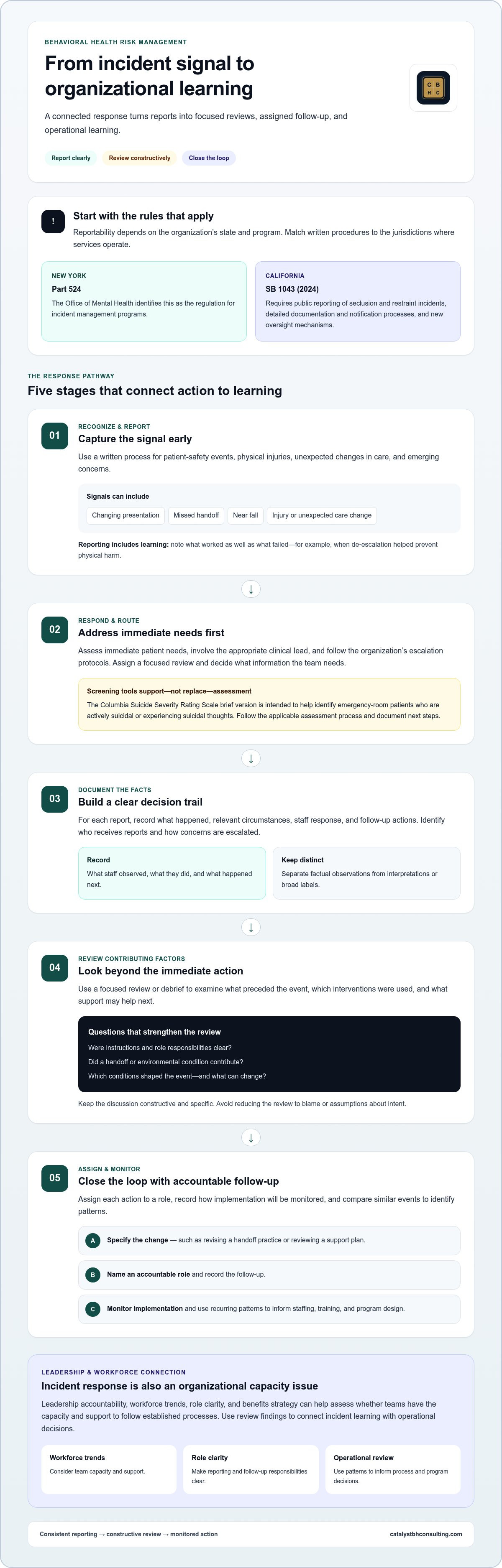
In the United States, identify reportability using the requirements applicable to the organization’s state and program. New York’s Office of Mental Health identifies Part 524 as the regulation for incident management programs. California SB 1043 2024 requires public reporting of seclusion and restraint incidents, detailed documentation and notification processes, and new oversight mechanisms. These examples show why organizations need procedures matched to their operating jurisdictions.
Start with a written process explaining how staff report incidents, including patient-safety events, physical injuries, and unexpected changes in care. New York’s Office of Mental Health defines sentinel events as unexpected incidents involving death or serious physical injury. Staff should know who receives reports, what details to record, and how to escalate concerns under the organization’s protocols.
Reporting should capture successes as well as failures, not just adverse outcomes. A staff member might note that de-escalation helped prevent physical harm, while also documenting where a handoff left important information unclear. Consistent reporting makes patterns easier to assess, helps leaders identify process weaknesses, and informs decisions about mitigating recurring risks.
For each report, record what happened, the relevant circumstances, the staff response, and follow-up actions. Keep the account factual and separate observations from interpretations. For example, describe what staff saw and did during an incident rather than relying on broad labels. Behavioral health facilities should document incidents and staff responses according to established protocols, creating a clear decision trail for later review.
New York’s Office of Mental Health reviews and tracks root cause analyses and associated corrective action plans as part of sentinel event oversight. A root cause analysis should examine contributing conditions, not stop at one employee’s immediate actions. The associated plan should specify corrective steps and how the organization will monitor implementation, linking findings to operational changes.
New York’s Office of Mental Health reviews and follows up on serious incidents occurring in State operated and licensed programs each year. Follow-up may include phone or email inquiries, technical assistance, investigation reviews, and on-site investigations and site visits. For exceptionally serious incidents, the agency conducts special investigations to determine and mitigate underlying systemic factors associated with the adverse event.
Training gives staff a shared method for reporting and reviewing events. New York’s Office of Mental Health conducts incident investigation training annually for State operated and State licensed programs in each region of the state. Organizations can reinforce that learning through case-based practice: walk through a sample event, complete its report, and identify what information an investigator would need.
2. Adverse-event identification and follow-up
Organizations must identify potential risks before they can mitigate them. Create a practical path from initial observation to follow-up: recognize a concern, assess immediate needs, involve the appropriate clinical lead, and review what happened. This supports consistent responses while allowing for professional judgment. For example, a change in a patient’s behavior may call for prompt assessment before an adverse event occurs.
Make risk recognition part of routine practice, not just a response to visible injury. A patient’s changing presentation, a missed handoff, or a near fall can signal an emerging concern. Falls are described as a common adverse event for behavioral health patients. Teams can use this example to examine environmental conditions, communication, and support needs instead of treating each fall as an isolated event.
Screening tools can support identification when used for their intended purpose. The Columbia Suicide Severity Rating Scale brief version is intended to help identify emergency-room patients who are actively suicidal or experiencing suicidal thoughts. Staff should follow the applicable assessment process, share relevant findings with appropriate clinical personnel, and document next steps. A tool informs the process; it does not replace clinical assessment.
After an adverse event or crisis, address immediate patient needs first. Then decide who will conduct a focused review, what information they need, and when the team will reconvene. A debrief can help healthcare providers and patients evaluate the event and plan to avoid future episodes during the patient’s stay. For example, discuss what preceded a crisis, which interventions were used, and what support may help next.
Keep the review constructive and specific. Ask which conditions shaped the event, whether staff had clear instructions, and whether a handoff or environmental factor played a role. Avoid reducing the discussion to blame or assumptions about intent. Separating observed facts from interpretations gives leaders a stronger basis for selecting strategies, assigning follow-up, and considering whether an operational issue also needs liability review.
Close the loop by assigning each follow-up action to a role, such as revising a handoff practice or reviewing a patient’s support plan. Record how the team will determine whether the change was made and addressed the concern. If similar events occur, compare their circumstances and responses to identify patterns. This connects individual learning to broader decisions about staffing, training, and program design.
When teams need a structured review of their processes, a behavioral health business assessment can help identify operational and workforce factors that shape risk.
3. Consultation, referral, documentation, and records
Consultation and referral procedures should clarify who receives a concern and what information is shared. For example, staff escalating a change in a patient’s presentation need a defined clinical contact and a documented handoff. Specify how staff record the reason for consultation, the guidance received, and next steps. This creates a useful account of decisions without relying on memory or informal messages.
HIPAA and applicable state privacy laws should guide how behavioral health facilities manage clinical records, access, and disclosure. Procedures should reflect the rules that apply to the organization’s setting, rather than assuming one process works in every state. Staff should know how to route an information request and where to document the response.
The 21st Century Cures Act obligates many behavioral health providers to provide clients and patients with remote access to their clinical records. That access has operational implications: facilities need a process for handling requests, maintaining records, and directing questions to the appropriate staff. For example, a documented workflow can distinguish a request for records from a referral that requires clinical coordination.
The HITECH (Health Information Technology for Economic and Clinical Health) Act includes privacy audit requirements relevant to agencies’ electronic records. A practical records process should identify where relevant information is stored, who maintains it, and how the organization reviews access. Clear responsibilities help leaders assess whether recordkeeping supports consistent oversight.
For each consultation or referral, record its purpose, the decision, and assigned follow-up. A referral entry, for instance, can identify the receiving service, information shared through approved procedures, and any remaining coordination. Keep descriptions factual and distinguish direct observations from conclusions. This makes the record more useful to the next professional involved in care.
When an incident leads to consultation, connect related records without blending separate accounts. Preserve the chronology of the event, consultation, and resulting actions. A supervisor reviewing an escalation should be able to see when staff sought guidance and how it informed the response. Consistent organization also helps leaders spot gaps, such as repeated delays in routing requests.
Test these workflows with specific scenarios. Ask staff to trace a clinical referral, a patient record-access request, and a consultation following a change in presentation. Note where responsibilities are unclear or documentation ends before follow-up. Use the findings to update procedures and training, then assess whether staff can apply the revised process in routine work.
Behavioral health providers should use screening tools, documentation, staff training, and crisis intervention plans to manage suicide and patient-harm risks. New York State Office of Mental Health operated and licensed providers must have an incident management system to protect consumer health and safety and improve quality of care. Consistent reporting supports data-informed risk management by enabling staff to record incidents, successes, and failures.
California SB 1043 requires public reporting of seclusion and restraint incidents, detailed documentation and notification processes, and new oversight mechanisms. Louisiana law offers limitation of liability for hospital staff who use violence and de-escalation techniques in good faith, provided they have documented training from an instructor certified in a formal nonviolent crisis intervention program.
4. Insurance coverage and risk transfer
Insurance transfers some organizational risk, but policy wording determines which roles, services, and events are covered. Behavioral health providers should compare coverage with their actual operations, not rely on a policy label alone. For example, a practice adding telehealth or changing clinical leadership should assess whether coverage still aligns with those activities.
Start by identifying the insured parties. A professional liability policy may cover only mid-level providers, leaving a facility’s medical director uninsured unless the policy includes that role. Compare the policy’s definition of insured professionals with the organization’s staffing structure. Review employed clinicians, contractors, supervisors, and medical leadership, then address any mismatch before relying on the policy.
Review abuse and molestation liability specifically. Behavioral health providers should check whether their professional liability policy includes this coverage and consider increasing the limit above the minimum included amount. Examine how the policy defines covered claims and who is protected. Abuse claims can require dozens or even hundreds of billable hours to defend, making coverage scope and defense provisions important considerations.
Review telehealth coverage separately. Services may not be covered unless they are specifically scheduled or endorsed in the behavioral health provider’s insurance policy. Compare the policy with how care is delivered, including remote services and the providers involved. When operations change, such as adding remote appointments, align the coverage documentation with the change.
Use a repeatable review process rather than waiting for renewal. Assign a leader to gather current policies, rostered roles, service descriptions, and relevant operational changes. Compare these materials to identify gaps involving people, activities, and coverage terms. Record questions, decisions, and follow-up owners to keep compliance responsibilities and executive oversight clear.
Transactions are another important point for review. Behavioral health providers should assess insurance adequacy during transactions and consider coverage gaps or inadequate limits as part of due diligence. Compare actual services, staffing, and risk profile with the coverage under review. A mismatch may affect continuity of protection and should inform the transaction’s risk assessment.
Connect insurance review to the organization’s broader risk process. A policy does not replace incident controls, staff guidance, or sound operational decisions; it is one part of a coordinated strategy. Leaders can review claims themes, service changes, and staffing changes together, then document whether coverage reflects the organization’s exposure. This aligns risk transfer with actual operations, not assumptions about what a policy covers.
5. Behavioral health safety and security
Hospitals, clinics, and private practices need safety processes suited to their services, staffing, and settings. A hospital may coordinate emergency-room protocols across departments, while a clinic may focus on appointment workflows and staff escalation roles. Private practices can specify who coordinates safety concerns and how that responsibility is covered when usual personnel are unavailable.
Common organizational risks include suicide and patient-harm concerns, falls, elopement, difficult interactions, and gaps in staff competency or supervision. Assess each risk in context: identify where it may arise, who is responsible, and which procedures guide the response. For example, review whether a program’s environment and staffing plan address a patient’s documented support needs.
Providers should manage suicide and self-harm risks through screening, assessment, reassessment, education, documentation, and prevention. The National Institute of Mental Health adult suicide risk screening tool helps healthcare providers assess suicide risk in adult patients. For pediatric patients who screen positive, the National Institute of Mental Health pediatric brief suicide safety assessment guidelines describe what providers should do.
For telehealth and AI, define how these activities fit into the organization’s safety processes. Document the intended role of a tool or service, identify who is accountable for decisions, and establish how staff escalate concerns. Review procedures alongside clinical workflows and insurance coverage. This gives leaders a concrete basis for assessing operational exposure without assuming every technology presents the same risks.
Physical security requires more than controlling entry. The Emergency Department Brief Behavioral Health Risk Assessment Tool helps organizations evaluate processes and protocols for a safe emergency-room environment. The Elopement Screen helps staff identify patients at risk of elopement and select interventions. Use each tool for its stated purpose, then connect findings to assigned responsibilities and an environmental review.
Staff practices also affect security. Behavioral health providers should avoid being alone with vulnerable clients, such as minors or people with mental illness. Establish protocols for assessing patient behavior, handling difficult situations, de-escalation training, and staff support. If security officers serve as sitters or one-on-one observers, ensure they are trained and competent in delegated tasks.
Review risks across behavioral health services rather than treating security as a separate function. A behavioral health environmental checklist identifies risks specific to behavioral health patients in care settings. The Intensive Outpatient Safety Checklist evaluates critical processes for reducing risks and compliance issues in outpatient behavioral health settings. Use results to assign improvements and strengthen staff training. Review your behavioral health safety processes to identify practical areas for improvement.
Catalyst Behavioral Health Consulting: Licensing and accreditation support
Catalyst Behavioral Health Consulting supports organizations aligning licensing and accreditation needs with their operations. This can help when requirements, procedures, and responsibilities need a clearer structure. Fractional HR leadership supports workforce priorities, while Catalyst Continuum startup packages and Catalyst Academy digital downloads offer resources for organizational development.
Consider this support when preparing for growth, clarifying internal processes, or strengthening how teams carry out their responsibilities. The next step depends on the challenge, whether it involves licensing and accreditation, HR leadership, or practical learning resources.
Contact Catalyst Behavioral Health Consulting or visit catalystbhconsulting.com to discuss your organization’s needs.
Build a stronger foundation for what comes next
Risk planning is most useful when it keeps pace with organizational change. As services evolve, responsibilities shift, or teams grow, review whether policies, leadership structure, and workforce practices still support consistent decisions. A deliberate review can reveal where processes need greater clarity and staff need practical guidance.
Catalyst Behavioral Health Consulting offers licensing and accreditation support, Fractional HR leadership, and Catalyst Continuum startup packages. These services can support organizations strengthening their operational foundation, developing leadership capacity, or planning for growth. A focused conversation can connect these priorities with practical next steps for your behavioral health risk management approach.
Contact Catalyst Behavioral Health Consulting to discuss your organization’s priorities. A clear plan can help your team move forward with greater coordination and purpose.
Frequently Asked Questions
What does behavioral health risk management include?
Behavioral health risk management brings clinical, operational, workforce, and organizational safeguards into a coordinated approach. It includes identifying potential hazards, clarifying who responds, reviewing how systems perform, and acting on patterns. For example, a clinic could examine whether staffing arrangements, appointment handoffs, and escalation procedures work together when a patient’s needs change. The goal is to make risk awareness part of routine decisions, not an isolated compliance task.
What are best practices for assessing and reducing behavioral health patient safety risks?
Assess safety by considering patient needs alongside the environment, staffing, and care processes. Use a structured review to identify hazards, assign an owner to each action, and revisit the plan when circumstances change. For example, if a patient’s needs shift during a service transition, review whether staff know the escalation route and whether the setting supports the updated plan. Record how follow-up actions are completed.
What are the steps for reporting and investigating behavioral health incidents?
Address immediate safety first, then preserve a clear account of the event and decisions made. Gather relevant records and staff perspectives, compare the timeline with applicable procedures, and identify contributing process factors. For example, an investigation of a missed handoff can examine how information moved between shifts. Assign corrective actions to responsible roles and track their implementation.
What risk management resources and reporting requirements vary by state?
State requirements and resources vary by jurisdiction, program type, and event category. Differences may affect which events are reportable, what documentation is expected, who must be notified, and how oversight or follow-up works. Build a state-by-state matrix for each program, link each requirement to an internal procedure, and assign an owner to review changes. This helps multi-state organizations manage requirements without assuming one workflow fits every setting.
What are the risks of using telehealth and AI in behavioral health care?
Telehealth services may not be covered by a provider’s insurance policy unless they are specifically scheduled or endorsed.

Article by
James McCreary, MS, LPC-S
The Catalyst dispatch.
Frameworks and field lessons on running effective behavioral-health programs. One email a month, sometimes two. Never spam.