Insights
Behavioral Health Staff Retention Strategies for Pay and Support
Higher wages and stronger benefits can support retention, but they won’t address every cause of turnover. Effective behavioral health staff retention strategies also focus on career growth, manageable workloads, supportive leadership, and predictable schedules. In community behavioral health, these conditions influence whether organizations can retain experienced staff and maintain continuity of care.
Pay matters, particularly when employees weigh demanding work against available benefits and opportunities. But a compensation adjustment alone may not resolve burnout, limited advancement, or a lack of support. A stronger retention plan considers compensation alongside everyday working conditions.
This article explains how benefits, career development, flexibility, and mental health resources can support staff, and why turnover creates broader operational strain. It also shows how workforce data can help leaders identify priorities, so retention efforts address real organizational challenges instead of relying on a single solution.
Key Takeaways
- Connect compensation and benefits with clear development pathways, mentorship, and opportunities to build clinical expertise.
- Make pay practices understandable and consider how demanding shifts and direct-service expectations affect staff experience.
- Track turnover, absenteeism, and overtime together to identify workforce pressures before they compound.
- Use predictable scheduling, accessible supervision, and mental health resources to strengthen day-to-day support.
- In community behavioral health, align retention plans with staffing capacity and program needs to protect workforce stability.
Table of Contents
- 1. Do Pay and Growth Reduce Behavioral Health Turnover?
- 2. Compensation pressures and pay transparency
- 3. Clinician replacement costs and staff turnover
- 4. Mental health resources and flexible scheduling
- 5. Community behavioral health workforce limitations
- Catalyst Behavioral Health Consulting: Licensing and accreditation support
1. Do Pay and Growth Reduce Behavioral Health Turnover?
Pay and career development both affect whether behavioral health employees see a future with their organization. Competitive compensation supports recruitment and retention, while clear advancement paths give skilled clinicians reasons to stay. A plan focused only on salary may overlook other drivers, including limited mentorship, inaccessible training, or unclear promotion criteria.
Create career pathways that recognize clinical expertise as well as management ability. For example, an experienced clinician might advance into a specialty role, mentor colleagues, or lead a clinical project while remaining connected to client care. Clinical career tracks help employees grow without requiring them to leave that work. Specialty pay can recognize additional skills and responsibilities within those tracks.
Make each pathway practical. Define the skills, training, and experience required for each role, then explain how employees can demonstrate readiness. For instance, a clinician developing crisis intervention expertise could complete relevant training and apply those skills in supervised practice. Clear criteria help leaders link professional development to organizational needs and compensation decisions.
Mentorship can create growth opportunities when a promotion isn’t available. Pairing a newer employee with an experienced clinician provides a structured setting to discuss challenging cases, communication, and behavioral strategies. Project assignments can also build experience. A staff member might help revise an onboarding resource or improve a clinical workflow, then receive feedback from a supervisor.
How can organizations improve retention among behavioral health staff from underrepresented groups? Use transparent promotion criteria, accessible mentorship, and consistent feedback so employees understand how advancement works. Review aggregated workforce data for patterns in development opportunities and promotions, then address barriers with targeted training and leadership accountability.
Professional development should reflect actual job demands. Training in crisis intervention, communication, and behavioral strategies can build staff skills and confidence. Workshops, ongoing education, and training stipends can make learning more accessible. Organizations can also connect learning plans to specialty roles, showing employees how new capabilities can support career progression.
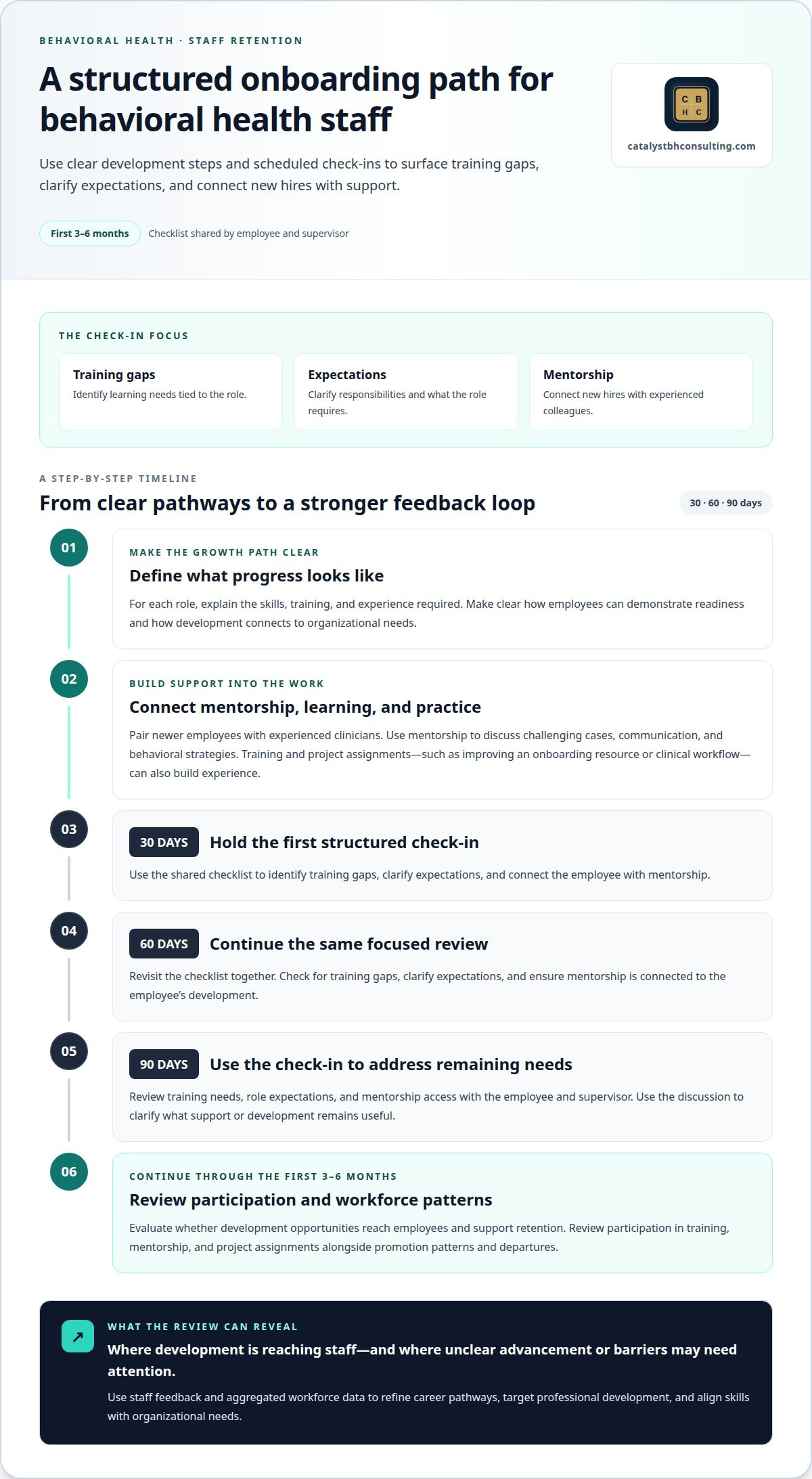
Onboarding is an early test of whether those commitments are real. Use a checklist covering the employee’s first 3-6 months, with progress shared by the employee and supervisor. Structured check-ins at 30, 60, and 90 days create opportunities to identify training gaps, clarify expectations, and connect new hires with mentorship before preventable frustration grows.
Evaluate whether development opportunities reach employees and support retention. Review participation in training, mentorship, and project assignments alongside promotion patterns and departures. Ask staff which skills they want to develop and where advancement feels unclear. These measures help leaders improve career pathways, target professional development, and align compensation with the expertise the organization needs.
2. Compensation pressures and pay transparency
Compensation can influence whether behavioral health organizations attract talent and retain experienced employees. A fair approach considers responsibilities, experience, credentials, and work schedules together. For example, roles with different clinical duties shouldn’t automatically share identical pay structures. Documenting the reasoning behind compensation decisions helps leaders explain how pay reflects each role’s scope.
Transparency makes compensation decisions easier to understand. Organizations can outline internal salary ranges, explain how experience and added responsibilities affect placement, and define when pay is reviewed. When a supervisor discusses a new responsibility, such as taking on complex cases, they can clarify whether it changes the role or compensation. Clear criteria reduce confusion and give employees a practical way to discuss advancement.
Benefits also shape the overall employment offer. Health benefits, leave, retirement options, and training stipends address different needs, so consider the full package rather than salary alone. For example, a training stipend may support an employee preparing for a specialized clinical role. Explain eligibility and access consistently so staff understand how benefits relate to their work and growth.
Flexible compensation structures can recognize work that standard salary models may overlook. Organizations can offer shift differentials for nights, weekends, or holidays, reflecting demanding schedules in compensation decisions. They can also offer threshold-based bonuses tied to clinicians’ direct-service levels, calculated monthly, quarterly, or annually. Define the threshold, measurement period, and qualifying service clearly before employees rely on the incentive.
Measurement matters. Some behavioral health organizations reward clinicians for direct-service hours rather than measuring productivity as billable hours compared with total work hours. The distinction affects how administrative duties, documentation, and client-facing work appear in performance discussions. State which measure applies, how it is calculated, and how employees can interpret their results. Clear definitions make compensation decisions easier to communicate and review.
To assess fairness, compare roles with similar responsibilities and examine how pay decisions vary by experience, specialty, shift, and performance criteria. Review benefits access and incentive eligibility across teams, then investigate patterns that may affect morale or engagement. These steps help leaders direct investment toward pressures employees actually face instead of relying on a broad pay adjustment.
For organizations working to connect compensation practices with broader HR priorities, compensation and HR planning can help structure the review around roles, policies, and workforce needs.
3. Clinician replacement costs and staff turnover
Turnover creates operational and financial pressure beyond the vacant position. Organizations must recruit, onboard, and support a replacement while managing coverage gaps and extra work for remaining providers. A departure can also disrupt continuity for patients and require teams to rebuild working relationships. Turnover is more than a human resources metric.
The reported turnover rate for the behavioral healthcare workforce in the United States is 40%. Annual turnover rates in the U.S. behavioral health field have also been reported at 30-60%. These figures describe a serious workforce stability challenge, but leaders should examine their own patterns by program, role, and departure timing. A single organization’s rate can conceal concentrated turnover in a specific team.
What are the leading causes of turnover among behavioral health workers? Burnout, inconsistent scheduling, and feeling unsupported in demanding roles are associated with staff departures. Regular check-ins and accessible supervision give employees a place to raise workload concerns, seek clinical guidance, and receive timely feedback before frustration builds.
Replacement planning should map the full sequence of work after a clinician leaves. Track recruitment activity, onboarding time, coverage arrangements, and added demands on remaining staff. For example, if a team repeatedly relies on overtime during recruitment, leaders can review both the vacancy and the workload it creates. This connects workforce decisions with service continuity and daily operations.
Student debt can add pressure for clinicians, particularly when early-career salaries seem disconnected from education commitments and demanding work. When reviewing retention, consider how compensation, benefits, workload, and development opportunities fit together. A salary review alone may not resolve unclear advancement or limited supervision. Examine employee feedback alongside departures to distinguish pay concerns from broader workplace issues.
Clinical supervision supports retention, not just a meeting on the calendar. Schedule regular check-ins, make supervisors accessible for case-related guidance, and create a clear process for escalating workload concerns. A planned conversation can address caseload strain, professional goals, and support needs. Consistent follow-through helps staff see whether their feedback leads to operational changes.
Use turnover, absenteeism, and overtime together as indicators of workforce stability. If departures rise while overtime increases, leaders can investigate staffing capacity and program demands before strain spreads. Compare results across roles and teams, then record the actions taken. The cited review identifies 10% annual turnover as the optimal benchmark for maintaining stability and expertise in behavioral health workforces, giving organizations a reference point for their own trend analysis.
4. Mental health resources and flexible scheduling
Turnover in behavioral health can be associated with burnout, inconsistent scheduling, and feeling unsupported in demanding roles. These pressures affect everyday work, not just employee satisfaction. For example, a clinician dealing with repeated last-minute schedule changes may struggle to plan personal responsibilities or maintain a routine. Retention planning should connect mental health resources with the conditions shaping each workday.
Which flexible scheduling and workload practices help retain behavioral health staff? Publish schedules in advance, minimize last-minute changes, and consider flexible shifts, remote work, or compressed workweeks where roles allow. Align staffing with program needs, then use supplemental staff to address coverage gaps and peak demand.
Predictability is a practical starting point. Establish a process for publishing schedules, communicating changes, and recording staff availability. If an unexpected absence affects a team, review coverage options before redistributing work to clinicians who already have demanding caseloads. This helps leaders weigh service needs alongside workload instead of treating each schedule change in isolation.
Flexibility can look different across roles. A clinician whose work includes documentation may be able to complete some tasks remotely, while a direct-service role may benefit more from shift flexibility. Compressed workweeks can also support personal responsibilities when coverage and program operations remain coordinated. Define options by role, explain how requests are handled, and apply the process consistently.
Mental health resources work best when staff know how to access them and leaders encourage their use. Communicate available support through onboarding materials, supervision, and regular staff updates. During a scheduled check-in, a supervisor can ask about workload and support needs, then direct the employee to the appropriate organizational resource. Keep workplace surveys focused on work experience, not clinical symptom screening.
Workload reviews should include caseload, schedule stability, and coverage demands. If a team repeatedly absorbs uncovered shifts, leaders can examine program staffing and adjust assignments or supplemental coverage. Technology can also streamline workflows and reduce administrative burden. For instance, improving documentation processes may reduce time spent on repetitive tasks and leave clinicians more time for client care.
Use staff feedback to assess whether changes are working. Ask about workload, supervision, safety, and schedule flexibility, then compare responses with turnover, absenteeism, and overtime patterns. Anonymous surveys and stay interviews can surface concerns before employees leave. Explain how feedback informs scheduling or support decisions so staff can see a clear link between their input and workplace action.
5. Community behavioral health workforce limitations
Community behavioral health organizations face a workforce challenge that individual recruitment campaigns can’t solve alone. Staff shortages, high service demand, and limited coverage can reinforce one another: vacancies increase pressure on existing teams, and pressure can make retention harder. Reported annual staff churn in some community behavioral health settings can reach 40%, making workforce stability an operational priority.
The scale of the pipeline problem also matters. The United States was projected to have a shortage of about 31,000 full-time equivalent mental health practitioners by 2025. In a 2023 survey, 48% of behavioral health workers said workforce shortages had caused them to consider other employment options. These findings connect staffing capacity directly to workplace experience.
Community providers can strengthen the workforce pipeline through partnerships among behavioral health services, physical health organizations, community groups, and educational institutions. For example, an organization can work with an educational partner to introduce students to community behavioral health roles and provide practical career information to interested candidates. Partnerships expand workforce pathways and help organizations communicate the skills and services their programs need.
Retention planning should use workforce data rather than assume every program faces the same pressures. Track vacancies, departures, absenteeism, overtime, and unfilled shifts by role and program. Repeated vacancies in one service area, for example, may signal a different operational constraint than departures across the organization. These measures help leaders tailor responses to actual service demands.
A staff survey can reveal how workplace culture and workload affect employees’ plans to stay. Ask whether respondents expect to remain with the organization in two years, alongside questions about caseload, supervision, safety, growth, recognition, and schedule flexibility. Repeat the survey once or twice a year, keep question wording and scales consistent, and use short pulse checks between rounds to track emerging concerns.
Protect trust when interpreting results. Tell employees how small groups will be combined or suppressed, and report a subgroup separately only after five or more responses. Limit access to raw responses, then share aggregated findings and explain the actions leadership will take. Surveys are most useful when staff can see how feedback informs staffing plans, workplace culture, and program operations.
Community workforce capacity can also grow through peer supports, peer-operated services, and community roles. For example, leaders can identify needs that trained peers or community workers can help address, then define how those roles fit alongside clinical staff. Workforce research and data collection can clarify where these approaches may strengthen capacity and inform interventions suited to program needs.
When workforce constraints cross programs, leadership, and operations, book a workforce stability discussion to identify where a coordinated review can support your organization.
Catalyst Behavioral Health Consulting: Licensing and accreditation support
Catalyst Behavioral Health Consulting helps behavioral health organizations address workforce and operational challenges through structured consulting. When retention concerns stem from unclear HR processes, limited leadership capacity, or inconsistent staff development, fractional HR leadership can strengthen the systems shaping the employee experience.
For organizations building or expanding programs, licensing and accreditation support can help align operational foundations with organizational goals. Catalyst Academy digital downloads and Catalyst Continuum startup packages offer additional resources for developing organizational infrastructure. The right starting point depends on whether the immediate need is HR leadership, program development, or practical learning resources.
Contact Catalyst Behavioral Health Consulting to discuss the organizational priorities shaping your retention efforts.
Build Retention Into Your Operating Plan
Make workforce stability an ongoing leadership priority, not just a response to vacancies. Regularly review staff feedback, departure patterns, and operational pressures, then assign clear responsibility for acting on the findings. This creates a practical link between employee experience and the organization’s ability to sustain its programs.
Effective behavioral health staff retention strategies rely on systems that support people as well as operations. Catalyst BH Consulting helps organizations strengthen those foundations through fractional HR leadership, licensing and accreditation support, and Catalyst Continuum startup packages. These services can be relevant when internal HR capacity, organizational readiness, or program development needs closer attention.
The next step is to identify the workforce challenge that most affects your organization and decide what support would help address it. Contact Catalyst Behavioral Health Consulting to discuss your priorities and explore a practical path forward. Thoughtful planning can help your organization build a more stable workplace and keep its mission moving.
Frequently Asked Questions
Do Higher Wages, Benefits, and Career Development Reduce Turnover in Behavioral Health?
Retention efforts can help when they address why employees consider leaving. A clinician may value stronger benefits but still leave if advancement feels inaccessible or work demands remain unsustainable. Review compensation alongside role expectations, access to professional development, and staff feedback. For example, a career plan linking specialty training to a defined clinical role gives employees a visible next step, rather than a general promise of growth.
What are the most effective behavioral health staff retention strategies?
An effective approach combines fair compensation, clear career pathways, supportive supervision, and workable schedules. Start by identifying where departures cluster, such as a particular program or role, then choose an intervention that addresses the pattern. If new employees struggle with unclear expectations, strengthen onboarding and supervisor check-ins. If experienced clinicians see no professional path, establish clinical advancement options that recognize expertise without requiring a move into management.
How do compensation and benefits affect behavioral health staff retention?
Compensation and benefits shape how employees assess a role’s overall value. Transparent pay criteria help staff understand how experience, responsibilities, and specialized skills influence compensation. Benefits such as leave, health coverage, and retirement options address different needs, so explain eligibility and access clearly. When comparing roles, employees may consider schedule expectations and benefits alongside salary, not salary alone.
How can behavioral health organizations reduce burnout and improve staff well-being?
Address workload conditions as well as access to mental health resources. Review caseload distribution, administrative demands, schedule changes, and coverage gaps to identify recurring pressure points. Assign an owner and follow-up process to each concern. For example, if documentation routinely extends beyond scheduled work, leaders can examine workflow steps and remove avoidable duplication. Make support resources easy to find and discuss them during routine supervision.
How do supervision, mentorship, and professional development improve retention?
Consistent supervision gives employees a defined place to raise clinical questions, workload concerns, and development goals. Mentorship offers practical guidance from experienced colleagues, while professional development helps staff build skills for future roles. For example, a supervisor and employee can agree on a learning objective, identify relevant training, and revisit progress at a later check-in. This makes growth visible and connects learning with the organization’s clinical needs.
What are the costs of behavioral health staff turnover compared with retention programs?
Turnover creates direct and indirect demands, including recruitment, onboarding, temporary coverage, and lost team knowledge. Retention initiatives also require staff time and operational resources, so assess them using the organization’s own records rather than a generic estimate. Track recruiting effort, onboarding workload, overtime, and program disruption alongside resources devoted to supervision, training, or schedule improvements.
How can behavioral health employers measure whether retention strategies are working?
Track departures alongside absenteeism, overtime, vacancies, and employee feedback, then review results by role and program. Use consistent survey questions over time to make changes easier to interpret. For example, if a team receives additional supervision, compare feedback about support with subsequent turnover patterns. Protect anonymity in small groups, share aggregated findings, and document the actions leadership takes in response.

Article by
James McCreary, MS, LPC-S
The Catalyst dispatch.
Frameworks and field lessons on running effective behavioral-health programs. One email a month, sometimes two. Never spam.