Insights
Behavioral Health Toolkits for Screening and Education
One in five U.S. adults experience mental illness each year, according to the National Institute of Mental Health. Behavioral health toolkits can help providers locate anxiety and depression screeners, suicide-risk screening resources, and mental health education materials. One listed suicide-risk screener has four questions, is designed for people aged 8 and older, and takes 20 seconds to administer.
Providers know a screening resource must fit the population, workflow, and next steps to be useful. The challenge is finding practical tools and clear educational materials that support consistent conversations and work for both staff and the communities they serve.
This guide organizes resources by purpose and explains how to assess age range, format, interpretation, and operational fit. The aim is to build a usable resource pathway, not collect disconnected documents, while keeping screening and education aligned with established care processes.
Key Takeaways
- Choose screening and education resources that fit the population, setting, and purpose, then integrate them into a clear workflow.
- Pair suicide-risk screening with defined steps for responding to results and connecting people with appropriate support.
- Match substance use prevention and treatment resources to the needs of the community and the organization’s capacity to deliver them.
- Clinicians, employers, and community organizations need different toolkit components, from care processes to staff guidance and public education.
- Use a structured implementation process to assign responsibilities, prepare staff, and review whether resources are working as intended.
Table of Contents
- Mental health education and resources
- Suicide-risk screening tools
- What toolkits support substance use prevention and treatment?
- How do behavioral health toolkits compare for clinicians, employers, and community organizations?
- What are the steps for implementing a behavioral health toolkit?
- Catalyst Behavioral Health Consulting: Licensing and accreditation support
Mental health education and resources
Mental health education works best when it pairs clear information with practical next steps. The National Institute of Mental Health reports that 5.5% of U.S. adults experienced mental illness in the past year in 2022. Providers can organize screening measures, plain-language education, and referral processes into one coordinated resource set, giving staff a consistent starting point for conversations.
Start by matching each resource to its intended population and purpose. The Depression, Anxiety and Stress Scale has 21 items and is listed for teens and adults. A depression screener can help structure conversations, but it does not replace clinical assessment. These tools support structured screening; they don’t replace clinical assessment or a plan for responding to results.
Other measures can help teams organize conversations across age groups. The Pediatric Symptom Checklist has 35 items in its original form and 17 items in short versions. PROMIS measures offer short forms with 4, 6, or 8 items per domain. Their mean score is 50, with a standard deviation of 10; listed T-score cutoffs include 60 and 70. Select a measure based on the question being assessed, the respondent, and the workflow for interpreting results.
Choosing evidence-based, culturally appropriate resources requires attention to both measure quality and community fit. Review the tool’s intended population, scoring guidance, language options, and supporting evidence. Then consider whether its examples, terminology, and delivery methods make sense for the people served. Community members can help review educational materials, while communication can be adapted without changing a screener’s validated wording or scoring.
State and local behavioral health agencies may provide toolkits that reflect community needs and regional services, including referral guidance, outreach materials, and public education messaging. Compare these resources with your organization’s service pathways and communication practices, then use relevant components to make local information clearer for staff and community members.
- For screening: Pair each measure with instructions for scoring, documentation, and follow-up.
- For education: Use plain-language materials that explain symptoms, available support, and how to access services.
- For local outreach: Align public messages with community needs and accessible service information.
A useful resource set is more than a folder of forms. Assign someone to maintain the materials, orient staff to their intended use, and clarify the next step after a screening or educational conversation. Staff, for example, should know where to find referral guidance and how to use it when a need arises. These practices connect mental health education with an organized service response.
Suicide-risk screening tools
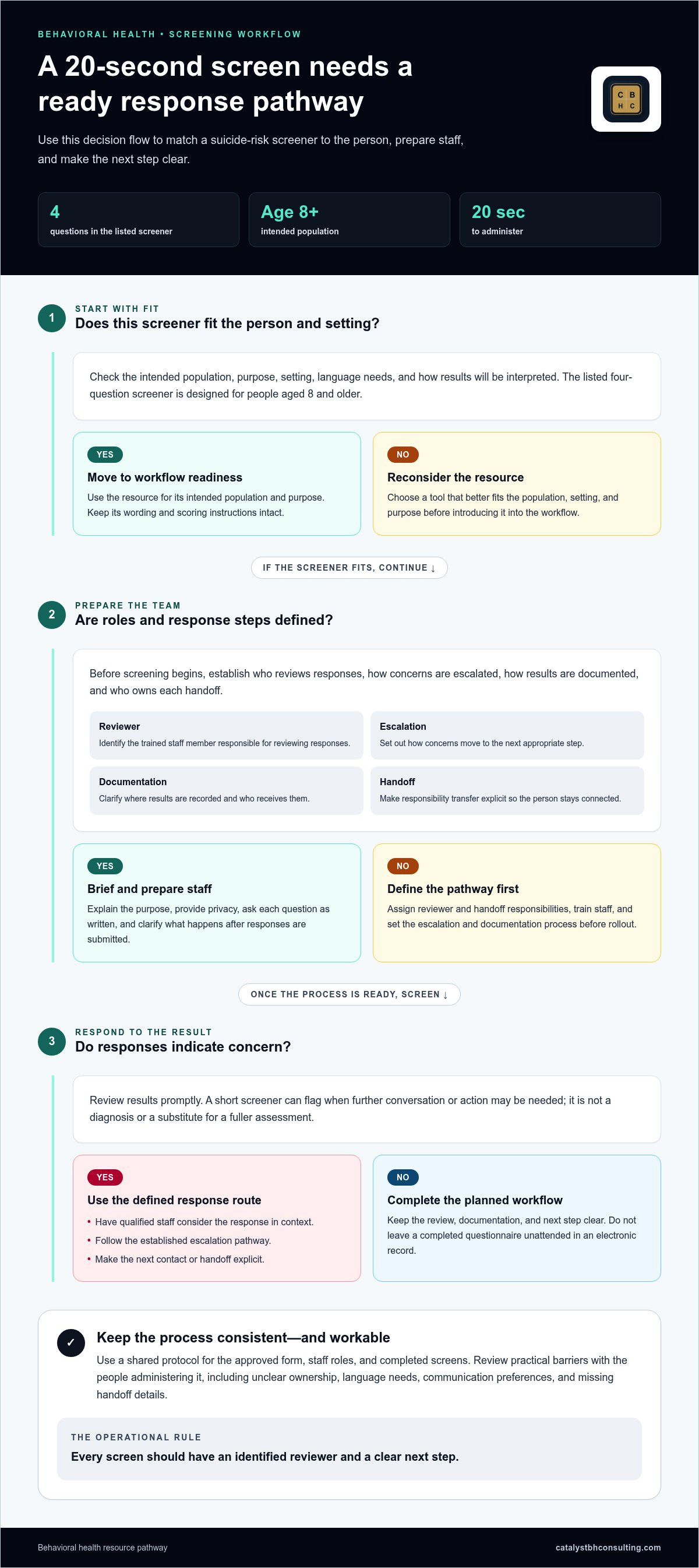
A brief screener can create a consistent starting point for conversations about suicide risk. The four-question suicide-risk screener described in the available resources is designed for people aged 8 and older and takes 20 seconds to administer. Its concise format can support structured intake or follow-up workflows, provided staff understand what happens after someone’s answers indicate concern.
Build the response process before introducing a screening form. Identify which trained staff member reviews responses, how concerns are escalated, and how the person stays connected during a handoff. A completed questionnaire should lead to a clear next step, not sit unattended in an electronic record. Document who receives results and how follow-up responsibilities transfer between staff.
Use a consistent administration process. Explain the purpose in plain language, ask each question as written, and provide an appropriate setting for responses. Do not treat a short screener as a diagnosis or a substitute for a fuller assessment. Its purpose is to flag when further conversation or action may be needed, while qualified staff consider the response in context.
- Before screening: Train staff on the questions, documentation process, and escalation pathway.
- During screening: Provide privacy, explain how answers will be used, and allow time for responses.
- After screening: Review results promptly and make the next contact or handoff explicit.
Consistency matters across national and multi-site organizations. A shared protocol can define the approved form, staff roles, and process for handling completed screens. Local teams can account for their actual referral pathways without changing the screener’s wording or scoring instructions. For example, a clinic can specify who reviews an alert during intake and who takes responsibility if that clinician is unavailable.
Plan for accessibility, too. Consider whether the screening process works for the population served, including language needs, communication preferences, and the setting where questions are asked. Staff can explain unfamiliar terms without altering the instrument. Review the workflow with the people who will administer it, then address practical barriers such as unclear ownership or missing handoff details.
Operational leaders can assess whether roles, documentation, and escalation processes fit together before rolling out a screening protocol. A structured behavioral health operations discussion can help teams examine those organizational processes alongside their wider priorities.
Screening recommendations depend on population and purpose. The epilepsy-care screening guidance says evidence is insufficient for routine suicide-risk screening in asymptomatic adolescents, while recommending depression screening for adolescents aged 12-18. For adults aged 18-64 in primary care-like settings, it recommends anxiety and depression screening. These distinctions help teams avoid treating a suicide-risk screener as a universal requirement or a replacement for other indicated behavioral-health screening.
Suicide is the 2nd leading cause of death among people aged 10-34 in the United States. A listed general behavioral screener has an emotional-symptoms scale with 5 items and a total measure with 25 items, and takes 5 minutes to administer. Teams can distinguish these broader symptom measures from a brief suicide-risk tool and select screening according to the population and clinical question.
What toolkits support substance use prevention and treatment?
Useful substance use resources connect prevention, identification, and treatment coordination rather than treating them as separate tasks. A provider toolkit can organize staff education, screening procedures, referral information, and follow-up steps. Each component has a distinct purpose: education supports informed conversations, screening helps identify concerns, and referral pathways connect people with appropriate care.
Start with prevention materials that explain substance use and available support in plain language. A staff education guide can help teams discuss concerns without stigma or assumptions. Community-facing materials can explain how to seek help and what happens after a referral. Keep information consistent across intake conversations, printed handouts, and digital resources so people receive a clear message at each point of contact.
For identification, provide a defined screening process, not just a form without context. Specify who offers screening, where responses are recorded, and who reviews them. A screening tool is useful only when the workflow explains how results guide the next conversation. Distinguish screening from diagnosis and connect the process to qualified assessment and treatment services.
For treatment coordination, map referral options across primary care, behavioral health, and community services. Integrating mental health and substance use disorder treatment into primary care can make those services more accessible near patients’ homes. A referral directory can specify the service type, intake route, and handoff process. Keep it actionable: staff need to know how to connect someone, not just which organizations exist.
- Prevention and education materials: Support consistent, non-stigmatizing conversations with staff and community members.
- Screening workflow: Clarify administration, review, documentation, and the next clinical step.
- Referral directory: Connect primary care and behavioral health with community services.
- Follow-up procedure: Assign responsibility for tracking whether a referral moves forward.
Start implementation with the population and service setting. A community organization may prioritize accessible education and referral information, while a clinical team may need screening and documentation procedures. In either setting, assign a resource owner, train staff on their roles, and establish a routine for reviewing materials. Update referral details when local pathways change, and revise unclear instructions based on staff experience.
Finally, assess whether the toolkit supports a continuous pathway from prevention to care. Check whether staff can find the right resource, explain the next step, and complete a handoff. These operational checks reveal gaps between written guidance and daily practice, helping leaders align education, screening, and treatment coordination with the needs of the people served.
How do behavioral health toolkits compare for clinicians, employers, and community organizations?
The strongest toolkit supports the decisions an organization needs to make. Clinicians need resources that support care delivery. Employers need materials that connect people strategy, benefits, and workplace culture. Community organizations need practical ways to coordinate outreach and service access. Compare toolkits by audience to avoid adopting materials staff cannot put into practice.
For clinicians, assess how resources fit existing roles and workflows. A useful toolkit helps teams clarify who introduces materials, who reviews information, and how responsibilities move across the care team. Clinical curricula and training systems can support consistent staff preparation. Leaders can assess whether training prepares employees to apply guidance confidently, while workforce analytics can reveal patterns in training completion, capacity, or workflow bottlenecks.
Employers should assess how workplace resources connect to HR strategy and total rewards. Benefit navigation materials can show employees where to find information about available support. Manager guidance can help leaders respond consistently and foster a culture where people feel able to raise concerns. Toolkit content should clarify the boundary between workplace support and clinical care. HR teams can also assess whether managers understand their roles and employees can readily find relevant benefit information.
Workforce analytics adds a planning perspective. Organizations can identify which teams need more training, where staff encounter process obstacles, and whether resource use varies across departments. Use appropriate, aggregated information to guide decisions about communication, training, and support. Define the question before selecting a measure, and assign responsibility for reviewing findings. Data should inform workforce planning and service improvement, not replace individual clinical judgment.
Community organizations can assess resources by how well they support coordination among outreach teams, partner organizations, and local services. A directory or shared referral guide can help staff provide consistent information. Leaders should clarify who maintains these resources and how updates reach frontline teams. This makes toolkit maintenance part of organizational planning, rather than an informal task that depends on individual staff members.
- Clinicians: Assess fit with team roles, training needs, and care workflows.
- Employers: Evaluate links to HR priorities, benefits communication, and manager culture.
- Community organizations: Focus on coordination, resource ownership, and reliable outreach.
Compare each option with organizational priorities, workforce capacity, and the decisions it supports. Leaders can then identify where training, benefits communication, or operational ownership needs strengthening. A toolkit earns its place when staff can use it consistently and its information supports clearer, more coordinated decisions.
What are the steps for implementing a behavioral health toolkit?
A practical rollout turns selected resources into repeatable work. Implementing behavioral health toolkits requires clear ownership, staff preparation, and defined workflows. Before staff use a screening form, for example, assign someone to review responses and establish the follow-up process.
- Define the operational need. Identify the population, setting, and decision the toolkit must support. A community clinic may prioritize intake screening, while a workforce program may need manager education. Record the problem first, then select resources that address it. This prevents teams from assembling forms that don’t connect to an organizational priority.
- Set selection criteria. Compare each resource’s intended audience, purpose, format, and administration guidance. A tool comparison matrix can capture those details in one place. Include language accessibility, staff training needs, and the process for interpreting results. Keep the criteria visible so clinical and operational leaders can explain why each resource was selected.
- Map the workflow. Document what happens before, during, and after each resource is used. For a screening process, identify who introduces the questions, who reviews responses, and who owns follow-up. A simple workflow map can show handoffs between intake staff, clinicians, and referral coordinators. Resolve unclear ownership before launch.
- Assign accountable roles. Name a toolkit owner and define responsibilities for staff who administer, review, or update materials. A responsibility chart can distinguish the person who maintains the referral directory from the person who trains new staff. Clear assignments reduce the chance that outdated instructions or incomplete handoffs remain unnoticed.
- Prepare and pilot staff. Use a training checklist to cover the tool’s purpose, approved instructions, documentation, and escalation pathway. A pilot with a small team can reveal confusing wording or workflow bottlenecks before broader use. Gather feedback from staff who perform each step, then revise internal instructions without changing a tool’s validated content.
- Review performance and maintain resources. Create a review log that records staff questions, process gaps, and updates to referral information. Leaders can examine whether staff can locate materials and complete assigned steps. Use those observations to refine training and workflow design. Set an owner and review trigger for changes in services, organizational procedures, or community referral pathways.
Keep the implementation record concise: chosen resources, rationale, role assignments, training materials, and review actions. This helps leaders distinguish a resource-selection issue from a workflow or training gap. A structured approach to behavioral health toolkits also makes it easier to align responsibilities before rollout. Discuss implementation planning to clarify organizational priorities and roles.
Catalyst Behavioral Health Consulting: Licensing and accreditation support
Catalyst Behavioral Health Consulting provides licensing and accreditation support to behavioral health organizations aligning programs, policies, and operational processes. This support is relevant when developing a program, preparing for accreditation, or assessing whether internal procedures support consistent service delivery.
Screening and education resources are one part of organizational readiness. Teams also need clear responsibilities, staff preparation, and documented processes for using those resources. Catalyst Behavioral Health Consulting helps organizations address these operational and regulatory priorities through licensing and accreditation support. Fractional HR leadership, Catalyst Continuum startup packages, and Catalyst Academy digital downloads can support related organizational needs.
Contact Catalyst Behavioral Health Consulting to discuss how to align your organization’s priorities and processes.
Build a stronger foundation for ongoing support
Turn resource selection into an organizational capability. Behavioral health toolkits are more useful when teams assign ongoing ownership, align staff development with daily responsibilities, and review how processes work in practice. This structure helps organizations adapt as programs, workforce needs, and community priorities evolve.
For organizations addressing licensing and accreditation, workforce leadership, or startup planning, Catalyst Behavioral Health Consulting offers licensing and accreditation support, fractional HR leadership, and Catalyst Continuum startup packages. These services help leaders address operational priorities alongside broader organizational plans.
Identify the next organizational gap, clarify who owns it, and set a practical direction for addressing it. Contact Catalyst Behavioral Health Consulting to discuss your organization’s needs. A thoughtful next step can help your team build a more coordinated foundation for behavioral health work.
Frequently Asked Questions
What are behavioral health toolkits?
Behavioral health toolkits are organized collections of resources that help teams address a defined mental health or substance use need. They can bring together staff guidance, educational materials, screening forms, and operational aids. For example, a provider preparing to expand a program might use a toolkit to align staff orientation with its resource directory and documentation process. Their value lies in making related materials easier to apply consistently, not merely storing documents together.
What types of behavioral health toolkits are available?
Common toolkit types support screening and assessment, suicide-risk response, substance use prevention, treatment coordination, and public education. Some are designed for clinical workflows; others help employers guide workplace conversations or community organizations share local resources. Choose according to the intended user and task: a manager education package serves a different purpose from a clinician’s assessment materials. Clarify a toolkit’s audience and use case before integrating it into routine work.
Where can I find free behavioral health toolkits from trusted U.S. organizations?
Start with mental health education from the National Institute of Mental Health and state or local behavioral health agencies. The Massachusetts Behavioral Health Roadmap Toolkit is one example of a state resource. Public agencies may provide materials for education, outreach, and service navigation. Check that each resource fits its intended audience and setting, and review its guidance before adapting materials. Local resources can add relevant service information that national education materials may not cover.
Which toolkits help with mental health screening and assessment?
Tool choice depends on the population and the concern being assessed. The DASS-21 addresses depression, anxiety, and stress symptoms; PROMIS measures focus on specific health domains. The NDDI-E is intended for depression screening among adults with epilepsy, while the Pediatric Symptom Checklist supports child-focused behavioral assessment. A four-question suicide-risk screener serves a different purpose. Treat screening results as a prompt for appropriate follow-up, not as a diagnosis.
What privacy, safety, and licensing risks should users consider?
Provide privacy during screening, explain how answers will be used, and ensure trained staff review concerns promptly and follow clear escalation and handoff steps. Employers should establish safeguards for workplace discussions. The material provides no specific licensing requirements.

Article by
James McCreary, MS, LPC-S
The Catalyst dispatch.
Frameworks and field lessons on running effective behavioral-health programs. One email a month, sometimes two. Never spam.