Insights
CARF Accreditation Consulting and State Rules for Behavioral Health
CARF accreditation is more than a credential: it is an external peer-review process that assesses whether a behavioral health organization’s services and systems conform to CARF standards. A CARF accreditation consultant can help providers assess readiness, address gaps, and prepare for a survey. State requirements may also affect an organization’s path.
Accreditation is a substantial operational project. Preparation goes beyond policies to include documentation, staff training, clinical practices, and outcomes. The work can shape how an organization manages quality and accountability.
This article explains what CARF accreditation involves, how state rules may apply, and what behavioral health providers can gain from the process. It also covers how consulting support can coordinate preparation, strengthen internal systems, and help sustain progress beyond the survey.
Key Takeaways
- Understand how CARF’s consultative peer-review survey assesses an organization’s services, systems, and conformance to standards.
- Identify how accreditation can support quality improvement, accountability, and stronger organizational relationships.
- See why accreditation preparation is ongoing, involving continued monitoring, staff education, and updates to organizational practices.
- Learn how consulting can bring readiness assessment, gap-focused planning, and staff support into a coordinated process.
- Understand how licensing and accreditation support can help behavioral health organizations align compliance work with operational priorities.
Table of Contents
What Is CARF Accreditation?
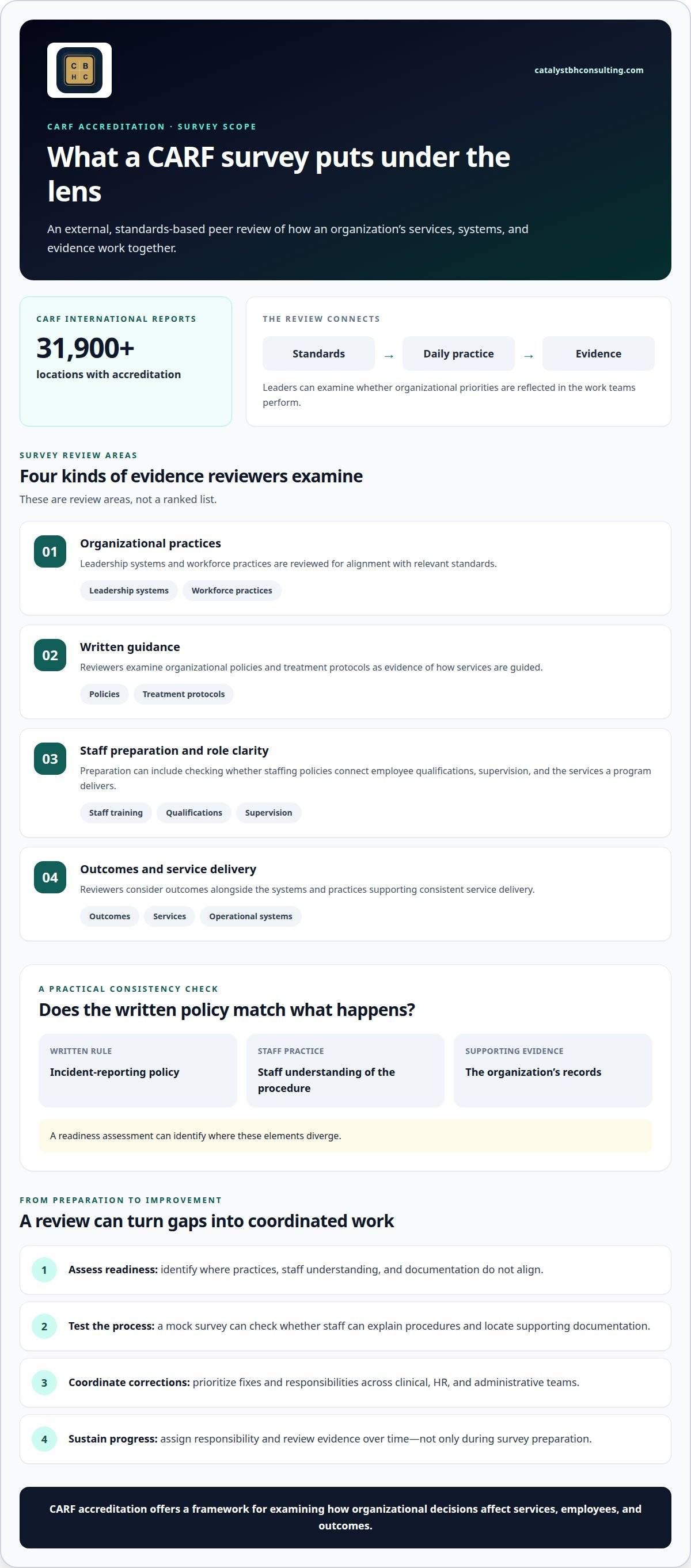
The Commission on Accreditation of Rehabilitation Facilities (CARF) is an independent nonprofit that develops standards for health and human service providers. Its accreditation process reviews how an organization’s services, leadership systems, and workforce practices align with relevant standards. CARF International reports accreditation across more than 31,900 locations. For behavioral health organizations, this external review can help leaders examine whether workforce and operational systems support consistent service delivery.
CARF uses consultative peer-review surveys to assess conformance with its standards. Reviewers examine organizational practices and evidence, including policies, treatment protocols, staff training, and outcomes. This process can help organizations connect strategic goals with day-to-day decisions: leaders may need to show how staffing policies relate to employee qualifications, supervision, and the services a program delivers. Accreditation thus provides a framework for evaluating whether organizational priorities are reflected in practice.
Human resources and compensation and benefits practices influence how an organization recruits, supports, and retains qualified staff. CARF preparation can help leaders assess whether job expectations, training, supervision, and workforce policies align with program needs. A review might reveal inconsistent guidance about responsibilities across shifts, or highlight a need to examine how compensation and benefits support workforce goals. Addressing these issues can clarify accountability, strengthen team culture, and help leaders make more deliberate workforce decisions.
Workforce analytics can help leaders identify patterns rather than rely on isolated observations. Comparing staff training records with program assignments, for example, can show where additional instruction may be needed. Reviewing these patterns alongside employee feedback can inform workforce planning and help leaders assess whether staffing practices support service needs. Stakeholder surveys can also capture perspectives from employees, people served, and referral partners. A structured survey defines whose feedback matters, asks consistent questions, and groups responses into themes leaders can act on.
Accreditation connects written policies with everyday behavioral health practice. An incident-reporting policy, for example, should match staff understanding and the organization’s records. A readiness assessment can identify where these elements diverge, while a mock survey can test whether staff can explain procedures and locate supporting documentation. These operational reviews help leaders prioritize corrections and coordinate responsibilities across clinical, HR, and administrative teams.
CARF accreditation does not replace effective management or leadership. It offers a standards-based framework for examining how organizational decisions affect services, employees, and outcomes. Leaders can use findings to set improvement priorities, assign responsibility, and review evidence over time. For behavioral health providers, its practical value lies in connecting quality expectations with the people, policies, and operational systems needed to meet them.
Benefits of accreditation for behavioral health providers
For behavioral health providers, CARF accreditation offers an external review of whether services meet international standards. Leaders can use its findings to connect service quality with broader business priorities, such as workforce capacity, consistent decision-making, and measurable outcomes. A finding about inconsistent documentation, for example, can prompt a review of role expectations and staff processes. Accreditation provides a framework for accountability and continuous improvement, while leaders remain responsible for setting organizational priorities.
CARF standards also link treatment goals with evidence. The measurement-informed care standard calls for written procedures on using standardized measures with people served. Organizations can specify when measures are collected, how staff record results, and how teams apply findings in care planning. Reviewing these data across services can help leaders assess whether workforce practices and resources support consistent care, rather than leaving outcomes isolated in individual records.
The CARF Behavioral Health Standards Manual reflects changes in service delivery. CARF’s 2026 Behavioral Health Standards Manual includes sobering center standards that apply to surveys beginning July 1, 2026. Organizations can use that timeline to assess program readiness, assign responsibilities, and plan staff preparation. These steps connect operational requirements with HR strategy: leaders can identify the roles, training, and supervision needed to meet service expectations.
Workforce planning also involves leadership, culture, and employee support. When turnover disrupts consistent practices, managers can examine how role clarity, training, supervision, and performance reviews work together. Reviewing these factors alongside compensation and benefits policies can help leaders understand whether workforce arrangements align with organizational needs. Accreditation findings can inform that review, but decisions should be based on relevant workforce and service data.
External accreditation may support organizational relationships, including access to funding opportunities and insurance contracts, referrals, and healthcare-system partnerships. Leaders can assess these possibilities as part of broader planning, alongside service outcomes and workforce capacity. Accreditation provides an external quality signal, but it does not establish that any particular partnership or funding outcome will follow.
To make findings useful beyond a survey, leaders can prioritize improvements, assign accountable owners, and define the evidence that will show progress. Reviewing results in quality meetings can bring HR, clinical, and operations teams together around shared goals. A structured planning discussion can help connect accreditation priorities with organizational needs.
Ongoing organizational support
CARF accreditation requires attention after the survey, but it is one part of a broader organizational challenge: keeping services, workforce plans, and policies aligned as needs change. Leaders can link monitoring, updates, and staff education to strategic priorities. For example, when a treatment procedure changes, they can update the related policy, brief affected employees, and track whether the change was implemented.
Document control can support both accountability and workforce planning. Behavioral Health Resources states that many documents, including program plans, strategic plans, and risk management plans, require annual review. A review calendar can assign each document an owner, due date, and approval record. Personnel files also need attention: routine reviews 90 days before the CARF survey help identify any missing license verification, background checks, or evaluations. Reviewing workforce records can help leaders identify gaps in staffing readiness and development.
New organizations may need a different follow-up schedule. CARF’s Inaugural One-Year Accreditation is available to a new organization that has not yet started serving people. The organization has a return survey roughly six months into service. Early operational records can help leaders assess how policies, staffing responsibilities, and services work once service begins.
How do CARF accreditation consultants compare with independent accreditation coaches? The difference depends on scope: a qualified CARF accreditation consultant may provide defined preparation and ongoing support, while a coach may focus on guidance and leadership reflection. Compare the proposed work, deliverables, and level of hands-on implementation, and consider how each approach supports organizational priorities.
Organizations assessing a consultant should consider experience, knowledge, and success with past clients. They should also examine how findings become measurable action: Does support connect CARF standards to policy updates, staff training, quality monitoring, and clear workforce responsibilities? A work plan can identify owners, evidence to maintain, and how progress will be reviewed. Leaders can also consider whether compensation and benefits practices support their workforce goals.
Overreliance on outside help can leave staff unable to sustain procedures after the work ends. Copying policies without adapting them to actual services can create a gap between written expectations and practice. Leaders should retain ownership of decisions and use quality and workforce information to assess whether records accurately reflect service delivery and organizational needs.
Ongoing support is most useful when it builds internal capability rather than replacing it. Working with Catalyst Behavioral Health Consulting can help organize recurring reviews of policies, training records, and quality actions, while organizational leaders remain accountable for implementation. When a service change affects several teams, review should connect behavioral health services, workforce responsibilities, and evidence of conformance. This approach supports future CARF surveys while making standards part of routine operations.
Benefits of consulting for CARF accreditation
Consulting is valuable when accreditation work must align with organizational goals and workforce capacity. A consultant can translate CARF standards into a coordinated work plan, identify responsible leaders, and track evidence of progress. For example, a policy gap can become a defined task with an owner, a revision, staff communication, and documentation showing the change in practice.
This approach helps organizations avoid treating preparation as a document-collection exercise. A readiness assessment connects written policies with staff knowledge, service delivery, and quality records. If employees do not consistently follow a policy’s review process, a consultant can identify the gap and help leaders plan corrective action. This gives leaders evidence to guide improvements in both workforce practices and service delivery.
Can organizations get CARF accredited without a consultant? Yes. A provider can coordinate the process internally. Consulting adds external expertise, structured preparation, and support for complex gaps.
Consulting can also help leaders allocate limited capacity. IHS planning ranges allocate 0.25 to 0.5 FTE to the Executive Director for CARF preparation and 0.5 to 1.0 FTE to the Quality Assurance Lead. These planning ranges illustrate why role clarity matters: the executive can maintain oversight while the quality lead coordinates evidence and follow-up. A consultant can help organize the work without taking those internal responsibilities away. Workforce planning can also prompt leaders to review whether compensation and benefits policies support their broader staffing priorities.
Staff development is another practical benefit. Consultants can provide training and resources that connect CARF standards to employees’ roles. A training session might use a real workflow, such as documenting a treatment plan review, to clarify what staff need to understand and where records should show the process. Virtual training and digital resources can also support teams across locations or schedules.
Consulting can help turn survey findings into continuous improvement instead of isolated corrections. A customized action plan can group findings by service, policy, or workforce process, then assign owners and follow-up evidence. Leaders can review completion in quality meetings and assess whether a change improved the underlying practice. For example, updated staff training should appear in training records and in consistent application of the revised procedure.
The strongest benefit is organizational learning. A consultant can model how to interpret standards, assess evidence, and prioritize unresolved gaps, while leaders build their ability to maintain the process. Tracking findings, owners, and follow-up gives leaders a basis for reviewing progress and setting priorities. The organization gains repeatable methods, not just a completed set of documents, supporting future preparation. This creates a clearer link between accreditation work, workforce capability, service quality, and measurable organizational follow-through.
How can CARF preparation support organizational priorities?
CARF preparation can help an organization connect standards with broader business priorities. A readiness assessment may identify gaps in policies, staff knowledge, or quality records, giving leaders a basis for prioritizing work. It can also prompt a review of how workforce strategy supports service goals, including whether roles and responsibilities are clear enough to sustain consistent processes.
Action plans can link each finding to a response, an accountable role, and evidence of completion. For example, improving documentation of treatment outcomes may involve updating a procedure, instructing staff, and reviewing completed records. Workforce analytics can help leaders examine relevant records and identify where processes or training need attention, supporting decisions based on evidence rather than assumptions.
Training can connect CARF standards in Sections 1-5 to employees’ daily responsibilities. Staff can practice explaining how a service procedure works and where its documentation is maintained. For leaders, this work also creates an opportunity to reinforce a culture of accountability and clarify how teams contribute to organizational goals.
Virtual training, remote readiness assessments, and digital resources can distribute guidance across teams and locations. A remote assessment may review policies and records, then identify questions for leadership follow-up. These approaches can support coordinated preparation while keeping attention on workforce capacity and organizational priorities.
Preparation may involve organizing documentation, clarifying staff roles, and tracking open actions. Leaders need to understand which records support a process, while employees need to explain their responsibilities accurately. Reviewing staffing priorities alongside compensation and benefits practices can help leadership consider how workforce decisions relate to organizational needs, without shifting accountability for services away from organizational leaders.
The appropriate scope depends on the organization’s services and internal capacity. A new program may need to build standards into its operating structure, while an established provider may focus on resolving identified gaps. Useful deliverables can include assessment findings, prioritized actions, training materials, and a defined follow-up approach, connected to existing quality and compliance routines.
For behavioral health organizations seeking structured support with licensing and accreditation preparation, discuss your CARF preparation needs. A focused conversation can clarify organizational priorities, current processes, and the support needed to move preparation forward.
Behavioral health licensing and accreditation support
Licensing and accreditation work, including CARF readiness and survey management, can help behavioral health organizations connect standards with practical policies, staff responsibilities, and organized evidence. A clear process also helps leaders coordinate accreditation priorities with workforce planning and day-to-day operations. Reviewing these areas together can make it easier to identify gaps and assign responsibilities.
Organizations addressing leadership capacity can also review workforce plans and internal systems alongside accreditation priorities. The starting point depends on the organization’s stage and the operational or workforce challenge it needs to address.
Discuss licensing and accreditation support for your organization.
Turn Accreditation Priorities Into a Sustainable Plan
Connect accreditation priorities with the decisions shaping your organization’s future. Use available workforce data to assess how state requirements, staffing capacity, compensation and benefits, behavioral health service needs, and operational demands fit together before assigning deadlines or responsibilities. A clear plan can help leaders prioritize work, maintain operational focus, and build processes that remain useful beyond the survey.
A CARF accreditation consultant can help translate that plan into coordinated action while your leadership team retains ownership of organizational decisions. The most useful support aligns HR strategy, leadership responsibilities, and workplace culture with your organization’s needs, whether you are strengthening established programs or building new operations.
Catalyst Behavioral Health Consulting provides organizational support for behavioral health organizations. To discuss a practical next step, contact Catalyst Behavioral Health Consulting. With clear priorities and aligned support, your team can move forward with purpose.
Frequently Asked Questions
How can survey preparation support organizational priorities?
Preparation organizes the people, records, and workflows needed to demonstrate how a program operates. Teams can rehearse explaining their roles and retrieving records that support their explanations. For example, a survey coordinator might assign a point person to each service area and organize requested materials by topic. This helps reduce interview confusion while connecting accreditation work to operational priorities and actual practice.
How should leaders coordinate internal staffing for CARF preparation?
Preparation needs an executive sponsor, a quality lead, and input from the teams delivering and supporting services. The executive sponsor resolves priorities; the quality lead coordinates evidence and tracks open work. Clinical, HR, and operations representatives can explain how procedures function day to day. Clear responsibilities help leaders connect accreditation tasks to workforce planning and routine decision-making.
What does CARF accreditation cover, and how does it affect workforce planning?
CARF accreditation applies to health and human service programs seeking an external review against standards relevant to their services. Whether it is required depends on the organization’s jurisdiction, contracts, and program type. For example, an organization serving Medicaid health home participants in Maryland must be accredited as a health home by an approved accrediting body or show that it has started the process. Understanding the requirement helps organizations plan staffing and service delivery.
How can a consultant support leadership and organizational culture?
Choose a CARF accreditation consultant with relevant experience and a clear approach to transferring knowledge to your team. Ask how recommendations will be tailored to your programs, how unresolved issues will be communicated, and how completed work will be documented. A useful working arrangement defines who makes operational decisions and who carries out each action. That clarity supports leadership accountability and keeps external guidance aligned with internal expertise.
Can state rules make accreditation mandatory?
Yes. State requirements can make accreditation or progress toward accreditation a condition for particular services or provider categories. Maryland, for example, requires a Medicaid health home provider to hold health home accreditation from an approved accrediting body or demonstrate that it has started the process. The requirement is specific to that provider category, so consider state rules alongside program scope and related workforce needs.
How can organizations use workforce data during accreditation preparation?
CARF standards are international consensus standards organized around service areas and the programs seeking accreditation. Eligibility and applicable standards depend on what the organization provides and its stage of operation. A new organization that has not started serving people may be eligible for CARF’s Inaugural One-Year Accreditation. Reviewing available workforce records alongside program scope can help leaders identify which standards apply and where preparation is needed.
How do compensation and benefits connect to accreditation planning?
An organization first identifies the relevant service area and standards, then organizes preparation, addresses gaps, and proceeds to the survey. The timeline depends on the work needed to align policies, records, and practice. A project schedule can assign owners to tasks and include leadership reviews of unresolved issues. Reviewing staffing needs as part of that schedule helps leaders coordinate workforce planning, including compensation and benefits decisions, with service requirements.
How can a consultant help teams prepare for a survey and support employee well-being?
A CARF accreditation consultant can help coordinate survey preparation by organizing materials, clarifying staff roles, and rehearsing how employees describe their work. For example, the consultant can help a team trace a service process from written procedure to staff practice and supporting records. The organization remains responsible for its operations and decisions. Clear role boundaries and realistic preparation can help teams manage demands while keeping survey responses grounded in routine practice.

Article by
James McCreary, MS, LPC-S
The Catalyst dispatch.
Frameworks and field lessons on running effective behavioral-health programs. One email a month, sometimes two. Never spam.