Insights
Clinical Curricula for Treatment Centers: 2026 Buying Guide
What if the curriculum that looks strongest on paper is the hardest for your team to use consistently? Clinical curricula for treatment centers can be difficult to compare when options cover different topics, approaches, and formats. A good fit depends on more than the materials themselves. Consider whether staff across roles can put them into practice and whether the approach aligns with your care model and operational priorities.
That makes curriculum selection an organizational decision, not just a clinical one. Leadership needs to weigh clinical fit alongside staff capacity, adoption, and implementation support, without assuming one solution will suit every program.
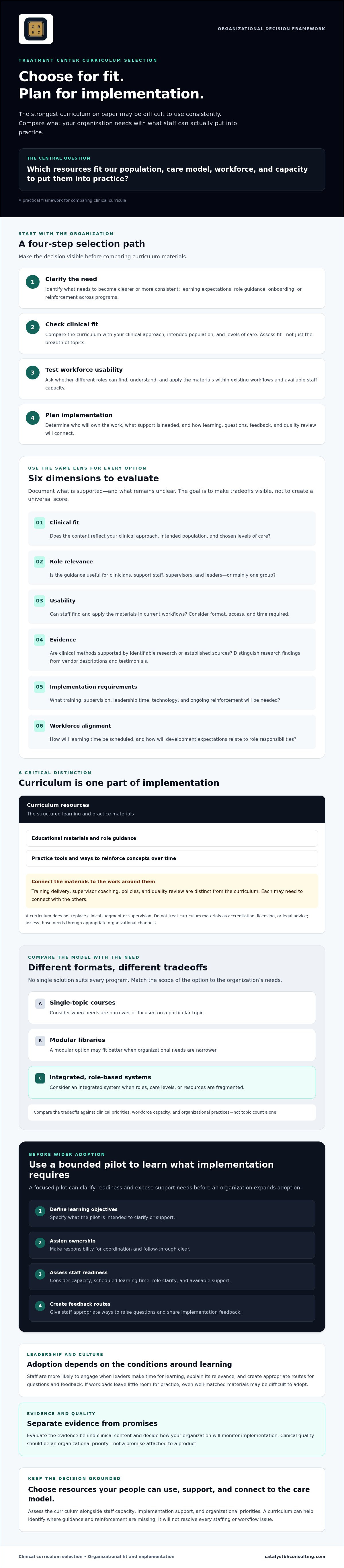
This 2026 buying guide offers a practical framework for comparing those factors. You’ll assess how well a curriculum fits your population and levels of care, how usable it is for different roles, how it connects with organizational systems, and what evidence is available about implementation. The goal is to clarify your needs and identify what to evaluate next, so staff development and clinical practice can support broader organizational priorities.
Key Takeaways
- Compare clinical curricula for treatment centers by clinical fit, role relevance, usability, training support, and implementation requirements.
- Separate curriculum materials from the training, supervision, policies, and quality review needed to put them into practice.
- Weigh the tradeoffs between single-topic courses, modular libraries, and integrated role-based systems against your organization’s needs.
- Use a bounded pilot to clarify learning objectives, ownership, staff readiness, and feedback routes before wider adoption.
- Consider an integrated system when roles, care levels, or resources are fragmented. A modular option may fit better when needs are narrower.
Table of Contents
- Why Clinical Curricula for Treatment Centers Must Fit the Organization
- How to Evaluate Clinical Curricula for Treatment Centers
- How to Compare Curriculum Models Without Assuming One Size Fits All
- How to Pilot and Assess a Clinical Curriculum Before Wider Adoption
- When an Integrated Clinical Curriculum System May Be the Right Next Step
Why Clinical Curricula for Treatment Centers Must Fit the Organization
The strongest curriculum is not necessarily the one with the broadest library of topics. Its value depends on whether the resources support the treatment center’s clinical approach and can be used across the organization’s actual roles, programs, and workflows. Materials designed for one population or level of care may not transfer neatly to another. Assess fit, not just coverage.
This makes selection an organizational decision. Population needs and the care model shape what staff need to learn; staffing capacity and implementation support shape whether they can apply it consistently. A useful starting point is Evidence-based practice, which frames clinical decisions around relevant evidence while leaving room for professional judgment and the needs of the people served.
What counts as clinical curriculum in a treatment center?
A clinical curriculum is a structured set of learning and practice resources that supports an organization’s clinical approach. It may include educational materials, role guidance, practice tools, and processes for reinforcing concepts over time. These resources are distinct from training delivery, supervisor coaching, policies that govern work, and quality review. Each element may need to connect with the others, but a curriculum alone is not the entire system.
It also doesn’t replace clinical judgment or supervision. Nor should curriculum materials be treated as accreditation, licensing, or legal advice. Assess those needs through the appropriate organizational channels.
Which organizational problems should curriculum selection address?
Start with the work that needs to become clearer or more consistent. New staff may need a defined path for learning expectations. Experienced employees may need role-specific guidance when responsibilities vary across programs. If materials are scattered or onboarding depends heavily on individual managers, consider curriculum selection alongside workforce development and role clarity. A curriculum won’t resolve every staffing or workflow issue, but it can help leaders identify where guidance and reinforcement are missing.
Leadership and culture matter, too. Staff are more likely to engage when leaders make time for learning, explain its relevance, and create appropriate routes for questions and feedback. If workloads leave little room for practice, even well-matched materials may be difficult to adopt. Assess the organization’s capacity to introduce, support, and review the curriculum before choosing its scope.
Clinical quality should be an organizational priority, not a promise attached to a product. Evaluate the evidence behind the clinical content and decide how your organization will monitor implementation. The central question is not, “Which curriculum includes the most?” It’s, “Which resources fit our population, care model, workforce, and capacity to put them into practice?”
How to Evaluate Clinical Curricula for Treatment Centers
A structured comparison helps leaders look beyond a curriculum’s stated topics. Use the same criteria for each option, document what is supported, and flag what remains unclear. The goal isn’t a universal score. It’s to make tradeoffs visible against your clinical priorities, workforce capacity, and organizational practices.
Which clinical and workforce criteria belong in the comparison?
For each curriculum, review these dimensions:
- Clinical fit: Does the content reflect your clinical approach, intended population, and chosen levels of care?
- Role relevance: Is the guidance useful for clinicians, support staff, supervisors, and leaders, or is it focused mainly on one group?
- Usability: Can staff find and apply the materials within existing workflows? Consider format, access, and the time required to use them.
- Evidence: Are clinical methods supported by identifiable research or established sources? Separate research findings from vendor descriptions and testimonials.
- Implementation requirements: What training, supervision, leadership time, technology, and reinforcement will be needed?
- Workforce alignment: How will learning time be scheduled, and how will development expectations relate to role responsibilities?
This framework helps determine whether clinical curricula for treatment centers align with care delivery and workforce realities. Ask whether staff can participate during scheduled work time, whether access is equitable across roles and programs, and whether existing policies affect training availability. These are internal planning questions, not reasons to assume that a curriculum will change retention or performance.
How should leaders compare implementation and organizational impact?
Review the full adoption pathway. Map how staff will be introduced to the curriculum, who will deliver training, how supervisors will reinforce learning, and how questions or updates will be handled. Estimate the time required using your own workflows, including coverage for staff attending training and manager capacity to support follow-through.
Workforce information can provide a baseline and inform follow-up. Consider existing information on training participation, staff readiness feedback, recurring questions, and workflow barriers. Interpret these indicators carefully: participation records can show exposure, but they don’t prove learning transfer or establish that a curriculum caused an outcome.
Assess readiness across leadership, culture, technology, and operations. Check whether managers can reinforce the materials, staff can access them, and learning expectations fit current schedules. This helps identify dependencies before selection and supports a realistic implementation plan, without promising results.
Leaders seeking to connect curriculum evaluation with organizational priorities can explore a conversation about curriculum fit.
How to Compare Curriculum Models Without Assuming One Size Fits All
Curriculum models differ in scope and coordination demands. A single-topic course may address a defined learning need, while a modular library gives leaders components to select for different programs. An integrated, role-based system may organize guidance across responsibilities or care settings. Treat these distinctions as comparison criteria, not proof that one model is more effective. Verify each provider’s claims against evidence relevant to your organization.
When does a focused course differ from an integrated curriculum system?
A focused course may suit a specific learning priority and a clearly identified group of learners. A modular library offers choice, but leaders must determine which components apply and how their use will be coordinated. An integrated system may cover a wider range of roles or processes, which makes implementation scope important to examine. These descriptions indicate differences in structure, not proof of clinical impact.
Map your priority learning needs to the people and programs involved. Then ask providers to identify the evidence behind their clinical content, including the source, population, setting, and outcomes studied. Distinguish published research from testimonials, internal evaluations, and vendor claims. Workforce information, such as existing training records or staff feedback, can help you identify questions for a pilot. Treat it as local planning data: completion records show participation, but alone they don’t establish learning transfer or cause and effect.
How should curriculum scope reflect care levels and staff roles?
List the care settings in scope and identify intended users, such as clinicians, support staff, supervisors, and leaders. For each role, assess whether the guidance is relevant and workable within existing responsibilities. Ask how shared materials differ from setting-specific content, and what local adaptation requires. These questions help evaluate scope without presuming that a single resource applies equally across programs.
As a product example, the Catalyst Continuum is described as including 19 integrated frameworks, including ASAM 4th, NARR, ROSC + 16 more. It addresses 6 levels of care, from recovery housing to ASAM 4.0. It includes 152 role playbooks delivered as a PDF and editable Word bundle, along with a live searchable portal and 10+ interactive tools. These are product components, not independent evidence of effectiveness.
For any model, include workforce capacity in the comparison. Consider how learning time, workload, and coverage affect participation. Treat leadership support and learning culture as implementation conditions to assess locally, not as proven guarantees of retention or performance. The appropriate scope is the one that matches organizational priorities and can be supported and reviewed.
How to Pilot and Assess a Clinical Curriculum Before Wider Adoption
A bounded pilot gives leaders a practical way to test whether clinical curricula for treatment centers fit staff responsibilities and day-to-day operations before committing to broader use. Define the scope in advance: choose a program or team, identify accountable leaders, set learning objectives, and establish how staff can ask questions and share feedback. The pilot should be focused enough to support active oversight and broad enough to reveal relevant workflow considerations.
What should a treatment-center curriculum pilot include?
Select a team whose roles and work reflect the intended use. Before the pilot starts, explain its purpose, what staff are expected to use, where materials are available, and who can help resolve access or implementation issues. Set a feedback route that staff can realistically use. Track practical observations, including relevance to responsibilities, clarity of role guidance, access barriers, and fit with existing workflows.
Establish a baseline using questions and information your organization already has. For example: How prepared do staff feel to use the current approach? Where do onboarding or handoffs create uncertainty? What workflow demands could limit time for learning? Staff feedback, existing training records, and manager observations can help answer these questions. Don’t create numeric benchmarks without an appropriate basis. The purpose is to understand starting conditions and decide what to examine during the pilot.
How can leaders assess adoption and workforce impact?
Review adoption through more than completion records. Consider whether intended users can access and apply the resources, what questions recur, and whether managers observe consistent use across relevant roles. Pair workforce information with qualitative feedback so leaders can distinguish an access problem from a relevance, workload, or reinforcement issue. Treat early indicators as signals about implementation, not proof of clinical impact.
Before launch, agree on decision criteria for adapting, expanding, or discontinuing the approach. Adapt if materials are relevant but access or workflow barriers need attention. Consider expansion if intended users can apply the resources and leadership can support continued implementation. Pause or discontinue if the curriculum does not address the defined need or required support cannot be sustained. Document the rationale, unresolved concerns, and next steps so the decision informs workforce planning and operations.
A pilot is most useful when findings lead to a clear organizational decision, not simply a completion report. If you’re assessing how a curriculum fits your organization’s roles and implementation capacity, discuss your curriculum needs.
When an Integrated Clinical Curriculum System May Be the Right Next Step
An integrated system may be worth evaluating when clinical guidance is spread across disconnected materials, staff responsibilities span multiple roles, or programs serve several levels of care. In those conditions, leaders may need to consider not only learning content but also how guidance is organized and connected to workforce development and operations. These signals point to a question for assessment, not an automatic case for a larger system.
A modular curriculum may be the better fit if the need is limited to a specific topic, program, or staff group. Consider the size of the problem, the number of teams affected, and the capacity available to coordinate implementation. Match the solution’s scope to organizational priorities rather than taking on broad materials staff may not need or have time to use.
What does the Catalyst Continuum include for behavioral health organizations?
As one option to assess against your criteria, the Catalyst Continuum is described as an audit-ready operating model with 19 integrated frameworks, including ASAM 4th, NARR, ROSC + 16 more. It addresses 6 levels of care, from recovery housing to ASAM 4.0, and includes 152 role playbooks delivered as a PDF and editable Word bundle. The system also provides a live searchable portal and 10+ interactive tools. These are product components, not evidence of a particular outcome or a substitute for evaluating organizational fit.
When reviewing the system, ask which frameworks, role playbooks, and tools correspond to your organization’s priorities. Clarify how staff will access the materials, which roles will use them, and what implementation support your organization needs. These questions help translate a list of components into a practical assessment of fit.
What should leaders clarify before discussing curriculum support?
Prepare a concise picture of your current state: care settings, staff roles, existing materials, and the organizational problems you want to address. Identify questions about how implementation is supported, what training and reinforcement may involve, which workforce information could inform review, and how materials might fit existing operations. This groundwork keeps the discussion practical and focused on your requirements.
Related resources can help frame adjacent planning questions, including clinical training for behavioral health staff and behavioral health accreditation support. Consider how those topics connect to your curriculum needs without treating curriculum as a replacement for training plans or accreditation support.
If your organization is weighing a modular resource against a more integrated approach, a focused curriculum-fit conversation can help clarify the questions to resolve before deciding on next steps.
Turn Your Curriculum Review Into a Practical Next Step
Choosing clinical curricula for treatment centers is an organizational decision. Compare clinical fit, role relevance, and implementation demands, then use a bounded pilot to learn whether staff can apply the materials within existing workflows. The right choice may be focused or integrated, depending on your programs, workforce, and capacity to support adoption.
For organizations evaluating a broader system, the Catalyst Continuum includes 19 integrated frameworks, 6 levels of care, and 152 role playbooks. Catalyst leadership includes James McCreary, LPC, a licensed professional counselor with 15+ years of behavioral health operations experience. Consider those components alongside your own implementation requirements and evidence review.
A clear discussion can help you define your priorities and identify what to assess next. Book a discovery conversation to discuss your organization’s curriculum needs and potential fit. Bring your care settings, staff roles, and key evaluation questions to make the conversation focused and useful.
Frequently Asked Questions
How do treatment centers choose clinical curricula for their staff?
Treatment centers should compare clinical curricula for treatment centers against their clinical approach, population, care settings, staff roles, and implementation capacity. Check whether the content has a clear evidence basis, whether guidance is relevant to each intended role, and what training or supervision will support use. A pilot can help assess fit before wider adoption. Use staff feedback and existing workforce information to inform the decision, without assuming broader materials are automatically a better match.
What should a clinical curriculum for a treatment center include?
A clinical curriculum should provide structured learning and practice resources relevant to the organization’s clinical approach. Depending on the need, that may include educational materials, role guidance, practice tools, and ways to reinforce learning. Review how the content fits the population and care settings it’s intended to support, and ask for the sources behind clinical claims. A curriculum doesn’t replace training delivery, supervision, organizational policies, or quality review.
How can a treatment center compare different clinical curriculum models?
Compare models by scope, adaptability, role relevance, usability, implementation support, and coordination requirements. A focused course may address a specific learning need; a modular library allows leaders to select resources; an integrated role-based system may span more responsibilities or programs. For each option, identify who will use it, how learning will be reinforced, and what staff or manager capacity is required. Choose based on organizational priorities, not breadth alone.
Can one clinical curriculum support multiple levels of care?
It can, if its content and role guidance are relevant to the care settings in scope. Map the levels of care, intended users, and shared versus setting-specific learning needs before deciding. A common curriculum structure may provide a basis for consistency, while modules or role materials may need to differ across programs. Verify clinical fit for each setting; don’t assume that coverage of multiple levels means every resource applies equally to all of them.
How do treatment centers measure whether staff are using a new curriculum?
Use existing workforce information alongside direct feedback. Leaders might review available training records, ask staff about access and relevance, collect recurring questions, and discuss manager observations of use across roles. Compare these signals with baseline questions about readiness and workflow fit. Participation or completion can indicate exposure, but it doesn’t establish that staff have applied learning or that clinical outcomes changed. Treat early findings as implementation evidence, not proof of impact.
What is the difference between clinical curriculum and staff training?
A clinical curriculum is the structured content and practice resources that support an organization’s clinical approach. Staff training is how people are introduced to, taught, and supported in using those resources. Supervision, policies, and quality review are also distinct, though they may reinforce or govern practice. When evaluating a curriculum, clarify who will deliver training, how managers will support learning, and how questions or implementation issues will be addressed.
How can a treatment center adapt curriculum without losing consistency?
Define the shared clinical principles and essential guidance that should remain consistent, then identify which materials may need to reflect specific roles, care settings, or workflows. Assign an accountable leader to review proposed changes and communicate approved updates. Gather staff feedback to spot unclear or impractical guidance, but evaluate adaptations against the organization’s clinical approach and evidence sources. This creates room for relevant local use without allowing uncoordinated edits to fragment practice.

Article by
James McCreary, MS, LPC-S
The Catalyst dispatch.
Frameworks and field lessons on running effective behavioral-health programs. One email a month, sometimes two. Never spam.