Insights
How to Choose a Texas Behavioral Health Facility License
Could a Texas behavioral health clinic need no state facility license while a similar-sounding program requires one? Texas behavioral health facility licensing depends on the services provided, including whether care is residential, inpatient, or substance-use treatment, not simply the clinic’s name.
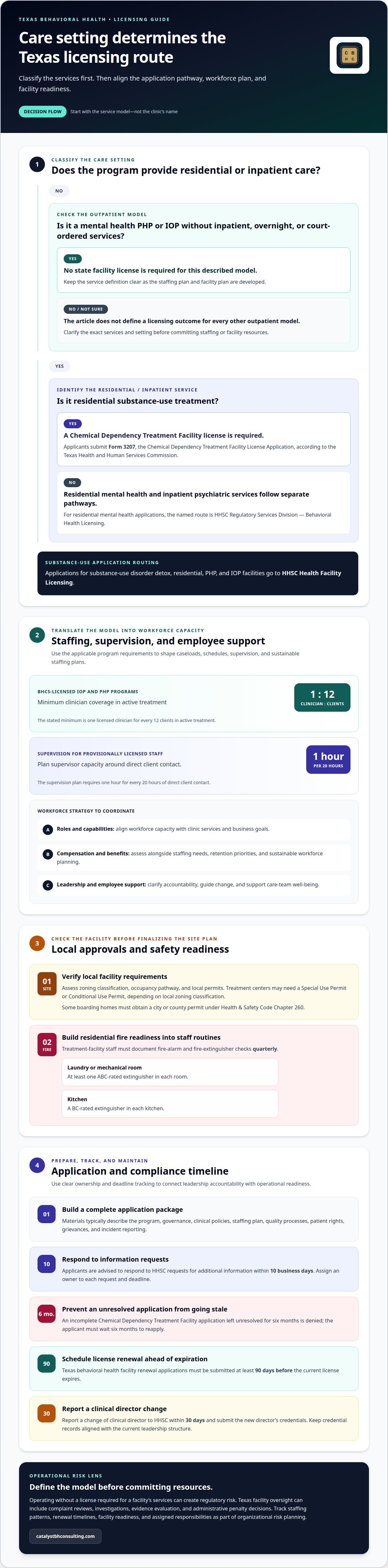
That distinction can shape the application pathway, facility planning, staffing model, and launch timeline. Mental health PHP and IOP programs that do not provide inpatient, overnight, or court-ordered services do not require a state facility license in Texas. Residential substance use treatment, by contrast, requires a Chemical Dependency Treatment Facility license.
At Catalyst Behavioral Health Consulting, we understand these complex regulatory requirements. This guide explains which Texas HHS license may apply to your clinic, which agency and application pathway to consider, and what facility requirements to plan for. For a Chemical Dependency Treatment Facility license, applicants submit Form 3207, the Chemical Dependency Treatment Facility License Application, according to the Texas Health and Human Services Commission. You’ll also see how residential mental health, outpatient, and substance-use pathways differ, and why aligning the program model with the facility plan matters before an application moves forward.
Key Takeaways
- Align workforce strategy with clinic services and setting, using roles and capabilities to support business goals.
- Assess compensation and benefits alongside staffing needs, retention priorities, and sustainable workforce planning.
- Equip leaders to guide change, clarify accountability, and foster a culture that supports care teams.
- Use workforce analytics to track staffing patterns, renewal timelines, and operational risks.
- Support behavioral health and employee well-being while coordinating facility readiness and licensing needs.
Table of Contents
- Which Texas HHS License Type Supports Your Behavioral Health Clinic’s Strategy?
- Texas HHSC licensing agencies, workforce analytics, and application pathways
- Behavioral health crisis stabilization, team leadership, and outpatient mental health
- Facility readiness, workforce planning, accessibility, and safety
- Texas licensing pathways, workforce planning, and behavioral health strategy
- Licensing and accreditation support for behavioral health organizations
Which Texas HHS License Type Applies to Your Behavioral Health Clinic?
Classify the proposed services and care setting before designing the workforce plan. Texas rules distinguish outpatient, residential, inpatient, and substance use treatment models; that distinction affects service capacity, staffing, and operational readiness.
Mental health PHP and IOP programs without inpatient, overnight, or court-ordered services do not require a state facility license. Residential mental health facilities and inpatient psychiatric services follow separate pathways. Residential substance use treatment requires a Chemical Dependency Treatment Facility license under the applicable Texas framework. Use the service model to guide hiring, supervision, and employee support planning.
Operating without a license required for a facility’s services can create regulatory risk. Texas facility oversight can include complaint reviews, investigations, evidence evaluation, and administrative penalty decisions. Treat these requirements as inputs to organizational risk planning, and define the service model before committing staffing and facility resources.
-
How a Licensing Professional Assesses Staffing and Program Requirements
Engage a licensing professional to align the proposed program with workforce capacity, supervision, and employee support. For BHCS-licensed IOP and PHP programs, the stated minimum is one licensed clinician for every 12 clients in active treatment. The supervision plan for provisionally licensed staff requires one hour for every 20 hours of direct client contact. Use these requirements to assess scheduling, caseloads, and the support clinicians need to deliver behavioral health services.
-
How a Licensing Professional Verifies Local Facility Requirements
Ask a licensing professional to assess the facility’s zoning classification, occupancy pathway, and local permits before finalizing the site plan. Texas treatment centers may need a Special Use Permit or Conditional Use Permit, depending on local zoning classification. Some boarding homes must obtain a city or county permit under Health & Safety Code Chapter 260. Track local approvals alongside the state facility pathway to coordinate operational decisions and reduce avoidable delays.
- Build renewal and leadership-change reporting into the organization’s compliance calendar and succession planning. Texas behavioral health facility renewal applications must be submitted at least 90 days before the current license expires. A change of clinical director must be reported to HHSC within 30 days, with the new director’s credentials submitted. Assign accountability for each filing, and keep credential records aligned with the current leadership structure.
- Build residential fire readiness into the facility plan and staff routines. Treatment-facility staff must document fire-alarm and fire-extinguisher checks quarterly. Texas rules specify at least one ABC-rated extinguisher in each laundry or mechanical room and a BC-rated extinguisher in each kitchen. Include these requirements in safety procedures, site-readiness planning, and clear staff responsibilities.
Texas HHSC licensing agencies and application pathways
Match the facility and services to the appropriate HHSC division before preparing an application. The pathway determines the reviewing agency, required materials, and inspection sequence, with implications for workforce planning and opening readiness.
-
Identify the Application Pathway and Workforce Needs
Map the proposed facility to the relevant HHSC agency and application pathway. Residential mental health applications go to the HHSC Regulatory Services Division - Behavioral Health Licensing. Applications for substance use disorder detox, residential, PHP, and IOP facilities go to HHSC Health Facility Licensing. Confirm program type and service setting before selecting forms; this helps align staffing plans and clinical support with the appropriate regulatory team.
-
Prepare Applications, Policies, and Staffing Plans
Assemble the application using information supplied by the organization. Texas applicants for a Chemical Dependency Treatment Facility license submit Form 3207, the Chemical Dependency Treatment Facility License Application, according to the Texas Health and Human Services Commission. Materials typically describe the program, governance, clinical policies, staffing plan, quality processes, patient rights, grievances, and incident reporting. Consistent documents help connect leadership accountability, workforce processes, and behavioral health services to the proposed operating model.
-
Track Application Requests and Organizational Responses
Track application requests, deficiencies, and response deadlines, assigning responsibility for each item. Applicants are advised to respond to HHSC requests for additional information within 10 business days. An incomplete Chemical Dependency Treatment Facility application left unresolved for six months is denied, and the applicant must wait six months to reapply. These stated deadlines make timely document tracking an operational priority and can help prevent avoidable delays.
- Build review and inspection stages into the opening plan. Initial HHSC review is expected to take 30 to 45 days; this stated estimate should inform planning, not substitute for facility-specific coordination. Procedures vary by facility type and may include application review, architectural and life-safety code approval, and an initial on-site survey. Align program documents, site readiness, staffing, and inspection preparation across workstreams.
- Prepare the facility for inspection. Reviewers may assess submitted evidence, the physical site, and compliance with applicable requirements. Resolve document gaps and site-readiness issues before the survey, and assign responsibility for follow-up. Coordinated preparation helps keep the application, facility setup, workforce plan, and intended services aligned as the organization prepares to open.
For structured licensing-pathway planning, organize agency selection, application materials, workforce readiness, and inspection preparation as one process.
Behavioral Health Crisis Stabilization and outpatient mental health license types
Classify each mental health service by setting, intensity, and intended function. Texas requirements distinguish outpatient programs from residential facilities and crisis stabilization services.
-
How a Licensing Professional Assesses PHP and IOP Exemptions
Assess the program’s services and setting against Texas’s outpatient exemption. Mental health PHP and IOP programs that provide no inpatient, overnight, or court-ordered services do not require a state facility license. Distinguish those programs from services operating under a Behavioral Health Crisis Stabilization license, where structured programming requirements apply.
- Map crisis stabilization services to their governing framework before establishing the program schedule. Texas Health and Safety Code Chapter 577 governs psychiatric hospitals and crisis stabilization units. Under a Behavioral Health Crisis Stabilization license, an adult IOP must provide at least 9 hours per week of structured programming; an adolescent IOP must provide at least 6 hours per week. Keep the age group and weekly schedule explicit in the program design.
- Classify residential mental health treatment separately from outpatient care. Texas residential mental health facilities are subject to HHSC Behavioral Health Licensing regulations under TAC Title 26, Part 1, and must provide care in a structured environment 24/7. Applications go to the HHSC Regulatory Services Division - Behavioral Health Licensing. A program that includes overnight residential care should not be planned as an outpatient-only model.
-
When a Licensing Professional Recommends Community Mental Health Center Licensing
Ask a licensing professional to assess whether the community mental health center pathway fits the organization’s services and operating model. The review should distinguish outpatient counseling, PHP or IOP, crisis stabilization, and residential treatment rather than relying on the organization’s chosen label. Align the service description and facility model before selecting an application pathway or committing to a program schedule.
- Define the outpatient model clearly enough to support a licensing assessment. Document whether services include PHP, IOP, crisis stabilization, or community-based mental health care, and identify any inpatient or overnight component. These distinctions affect whether the outpatient exemption applies or another HHSC pathway needs consideration. A clearly defined service scope also helps keep program materials consistent with the intended operating model.
- Separate facility licensure from other program decisions. The survey or application pathway depends on the facility type and services, while the exemption described above applies to qualifying mental health PHP and IOP programs. Plan around the actual service model, including residential care and crisis stabilization, rather than assuming every mental health outpatient program needs the same facility license.
Facility readiness, workforce planning, accessibility, and safety
Connect the building plan to the behavioral health services and workforce needed to deliver them. Texas facility readiness includes accessibility, life safety, and environmental health requirements, which should inform operational and staffing plans.
- Have the facility planner map rooms to the treatment model and projected census. For Texas outpatient clinics, use 25 square feet per participant as the standard minimum group therapy room size. Plan usable clinical space around program capacity, room functions, and schedule. Use projected census and service requirements to align patient flow, staffing, and the work delivered at the site.
- Integrate accessibility into the architectural plan before construction or renovation proceeds. The 2010 ADA Standards are a recommended reference for Texas clinic build-outs. Coordinate accessible routes, treatment areas, and shared spaces with planned operations, rather than treating access as a final inspection task. A layout that reflects the service model can help organize patient movement between group sessions and other program activities.
- Coordinate architectural and life-safety code approval with site readiness. Texas facility licensing procedures may include architectural and life-safety code approval followed by an initial on-site survey. The Texas Health and Human Services Commission regulates certain facilities to protect consumer and patient health and safety through compliance with state law and rules. Match site documentation and physical spaces to the submitted program description, planned services, and workforce needs.
- Build safety planning around applicable state and local requirements. Texas behavioral health facilities must demonstrate compliance with fire codes, life-safety standards, accessibility requirements, and environmental health regulations. Include emergency procedures and patient-safety policies in the operating plan, and ensure staff responsibilities and the site support them. For residential treatment, account for safety systems and emergency readiness before the survey, not after operations begin.
- Connect workforce readiness with facility safety and administrative controls. Texas treatment-facility employers address background checks and staffing compliance during licensing. Assign responsibility for required records, staff readiness, and keeping safety procedures aligned with daily operations. This links the people providing behavioral health services, the spaces where care takes place, and emergency procedures, rather than treating facility approval as a building-only task.
- Use the inspection process to identify gaps between plans and the operating site. An initial on-site survey can assess whether the facility is ready to deliver the services described in its application. Review the layout, accessibility, safety systems, and supporting procedures as one coordinated readiness plan. Considering architectural, life-safety, and environmental health requirements together helps align facility design, treatment operations, and patient protection.
Texas licensing pathways for behavioral health and substance use disorder facilities
Develop the licensing pathway alongside the workforce and operating model. The treatment scope, staffing design, and location strategy should inform one coordinated plan for organizational readiness and behavioral health service delivery.
- Map each service line to its applicable facility pathway, then connect that map to the organization’s operating plan. For a chemical dependency treatment facility, Health and Safety Code Chapter 464 establishes the statutory framework, and 26 TAC Chapter 564 sets facility standards. Use these requirements to define accountable roles, documentation ownership, and operational milestones. This evidence-based planning approach helps leaders identify interdependent workstreams and align decisions with the intended service model.
- Plan staffing around the services and capacity the organization intends to provide. Build a workforce model that shows role coverage, recruitment priorities, credentialing needs, and the anticipated hiring sequence. Pair it with compensation and benefits planning to assess how the structure supports recruitment and retention. Review workforce data, including vacancies, turnover patterns, and projected service demand, to identify staffing risks and inform implementation priorities.
- Keep multi-site planning distinct from organization-wide policy design. Texas requires a separate chemical dependency treatment facility license for each physical location. Coordinate site-level application work while standardizing shared processes, reporting responsibilities, and workforce measures where appropriate. This allows leaders to compare staffing readiness and operational gaps across locations while accounting for differences in services and needs.
- Separate narcotic treatment program requirements from other substance use disorder services. Texas Health and Safety Code Chapter 466 governs these programs, and 26 TAC Chapter 563 took effect as the replacement rule chapter on November 29, 2024. Applicants submit Form 3203, but HHSC requires SAMHSA certification and DEA registration before considering the application. Include these prerequisites in the implementation sequence, with clear role assignments and readiness checks.
- Assess the service model carefully when considering special pathways. Texas faith-based substance use programs using only nonmedical methods are exempt from chemical dependency treatment facility licensure but must register with HHSC using Form 3202. The distinction turns on program methods, not the organization’s label. Align service scope, workforce design, and performance measures so leaders can assess whether resources support the behavioral health services the program is intended to provide.
For coordinated planning across licensing and organizational operations, discuss licensing pathway support.
Licensing and accreditation support for behavioral health organizations
Licensing readiness connects behavioral health program requirements with operational capacity. Aligning application documents, facility planning, and organizational processes can help clarify launch responsibilities and identify gaps before services begin. A defined program model is only one part of readiness; coordinated documentation and compliance systems also matter.
Workforce planning can connect staffing needs with organizational priorities. Clarifying responsibilities, organizing policies, and reviewing workforce requirements helps leaders build a structure that supports intended services and informs operational decisions.
For information on licensing and accreditation support, contact Catalyst Behavioral Health Consulting.
Turn your licensing plan into an operating foundation
Connect regulatory planning with the organization you intend to build. Texas behavioral health facility licensing affects how leadership, staffing, and operational responsibilities fit together. Treat these choices as one design process: define ownership, align workforce plans with organizational priorities, and use documented information to guide decisions.
As you plan, consider how workforce needs, compensation and benefits, leadership, and employee well-being relate to operational goals. Catalyst Behavioral Health Consulting provides licensing and accreditation support, Fractional HR leadership, and startup packages. These services may be relevant as you clarify licensing work and align workforce planning.
Bring your plans and priorities into a focused conversation, then identify the work that will move the organization forward. Discuss your priorities with Catalyst Behavioral Health Consulting and determine a practical next step.
Frequently Asked Questions
Which Texas agency licenses behavioral health facilities?
The Texas Health and Human Services Commission (HHSC) oversees licensing for regulated health care facilities, making the correct pathway an early operational planning decision. The reviewing division depends on the facility type: residential mental health applications go to HHSC Regulatory Services Division - Behavioral Health Licensing, while applications for substance use disorder detox, residential, PHP, and IOP facilities go to HHSC Health Facility Licensing. Identify the program and care setting first, then match them to the appropriate application route to align compliance planning with intended services.
Which types of behavioral health facilities require a Texas license?
Texas licensing depends on the services and setting, not the organization’s name. Residential substance use treatment requires a Chemical Dependency Treatment Facility license, and residential mental health facilities follow HHSC Behavioral Health Licensing rules. Psychiatric hospitals and crisis stabilization units have a separate statutory framework. Mental health PHP and IOP programs without inpatient, overnight, or court-ordered services do not require a state facility license. Mapping services to these distinctions helps leaders assess regulatory scope before committing operational resources.
What are the licensing requirements for Texas mental health and substance use treatment facilities?
Requirements depend on the program model. Chemical dependency treatment facilities operate under Health and Safety Code Chapter 464 and 26 TAC Chapter 564. Residential mental health facilities follow HHSC Behavioral Health Licensing regulations under TAC Title 26, Part 1. Applications commonly address governance, clinical policies, staffing, quality processes, patient rights, grievances, and incident reporting. These requirements connect regulatory readiness with workforce planning, service quality, and organizational accountability. The facility must also align its physical site and operating procedures with applicable safety and accessibility standards.
How can a licensing professional guide a behavioral health facility through the Texas license application process?
A licensing professional can match the proposed services to an HHSC pathway, organize application materials, and coordinate preparation for review. For example, the professional can help align the program description, governance information, staffing plan, and clinical policies. If HHSC requests additional information, applicants are advised to respond within 10 business days. This support helps keep the application, site plan, and intended operations consistent, reducing avoidable misalignment between workforce capacity and the services the organization plans to deliver.
How should Texas behavioral health facilities plan for license renewal and leadership changes?
Renewal timing depends on the license type. Texas outpatient behavioral health facility licenses are issued for a two-year period, and renewal applications must be submitted at least 90 days before the current license expires. A clinical director change must be reported to HHSC within 30 days, with the new director’s credentials submitted. Tracking renewal deadlines and leadership transitions separately supports continuity in compliance and clarifies accountability during organizational change.
What staffing, credentialing, and background-check rules apply to Texas behavioral health facilities?
Staffing obligations depend on the licensed program and roles involved. BHCS-licensed IOP and PHP programs require at least one licensed clinician for every 12 clients in active treatment. This ratio is a concrete input to workforce capacity planning; employers must also address background checks and staffing compliance during licensing. Before hiring, treatment-facility employers must check the Employee Misconduct Registry and Nurse Aide Registry. Health and Safety Code §250.006 identifies criminal offenses that can bar employment in healthcare facilities. Together, these requirements inform hiring controls and workforce risk management.
What building, safety, and accessibility standards must Texas behavioral health facilities meet?
Facilities must demonstrate compliance with applicable state and local fire codes, life safety standards, accessibility requirements, and environmental health regulations. The 2010 ADA Standards are a recommended reference for clinic build-outs. Local zoning can also affect whether a behavioral health operation may use a proposed site. Coordinating the architectural plan, intended services, and site-readiness work helps ensure the building supports patient access and safe operations while keeping facility planning aligned with service delivery.
What inspections and documentation are required for a Texas behavioral health facility license?
Depending on the facility type, the process may include application review, architectural and life-safety code approval, and an initial on-site survey. Application materials typically describe the program, governance, staffing, clinical policies, quality processes, patient rights, grievances, and incident reporting. After licensing, Texas facility oversight can include surveys, complaint reviews, investigations, evidence evaluation, and review of plans of correction. These review activities make organized records important for both application readiness and ongoing operational oversight. Keep supporting documentation current and accessible.

Article by
James McCreary, MS, LPC-S
The Catalyst dispatch.
Frameworks and field lessons on running effective behavioral-health programs. One email a month, sometimes two. Never spam.