Insights
How to Optimize Your Technology Workforce Planning
Technology workforce planning connects workforce skills, roles, and capacity to business goals. Technology helps align talent decisions with HR, finance, and operational needs, giving leaders a clearer view of existing capabilities, emerging gaps, and their potential impact on business plans. The goal is not simply to fill positions, but to prepare the workforce for the work ahead.
Workforce planning is easy to mistake for a headcount exercise or an HR-owned spreadsheet. Yet decisions about hiring, development, redeployment, and restructuring affect budgets, service delivery, and employees’ ability to grow. Planning is more useful when those decisions draw on connected, reliable information rather than disconnected assumptions.
This article explains what workforce planning involves, how skills-based and role-based approaches differ, and how technology can support better decisions. It also shows why workforce information should connect with HR, finance, and operational systems, and how to align talent decisions with changing business needs.
Key Takeaways
- Anchor workforce decisions in business priorities so hiring, development, and redeployment address real capacity needs.
- Compare current workforce capabilities with future demand to identify skill gaps and prepare for different business scenarios.
- Use role-based planning to manage positions and staffing needs, and skills-based planning to understand capabilities that can move across roles.
- Connect workforce data with HR, finance, and operational systems to give leaders a more coherent view of talent and business needs.
- Build reliable data and clear governance into technology decisions, then focus implementation on the workforce questions that matter most.
Table of Contents
- Aligning talent strategy with organisational goals
- What is workforce planning?
- Skills-based versus role-based workforce planning
- How technology supports strategic workforce planning
- Integration with HR, finance, and operational systems
- Catalyst Behavioral Health Consulting: Licensing and accreditation support
Aligning talent strategy with organisational goals
Talent strategy turns organizational goals into decisions about people, skills, and working conditions. Connecting those decisions helps leaders support performance while protecting workforce capacity and employee experience.
Aligning Talent Strategy with Organisational Goals
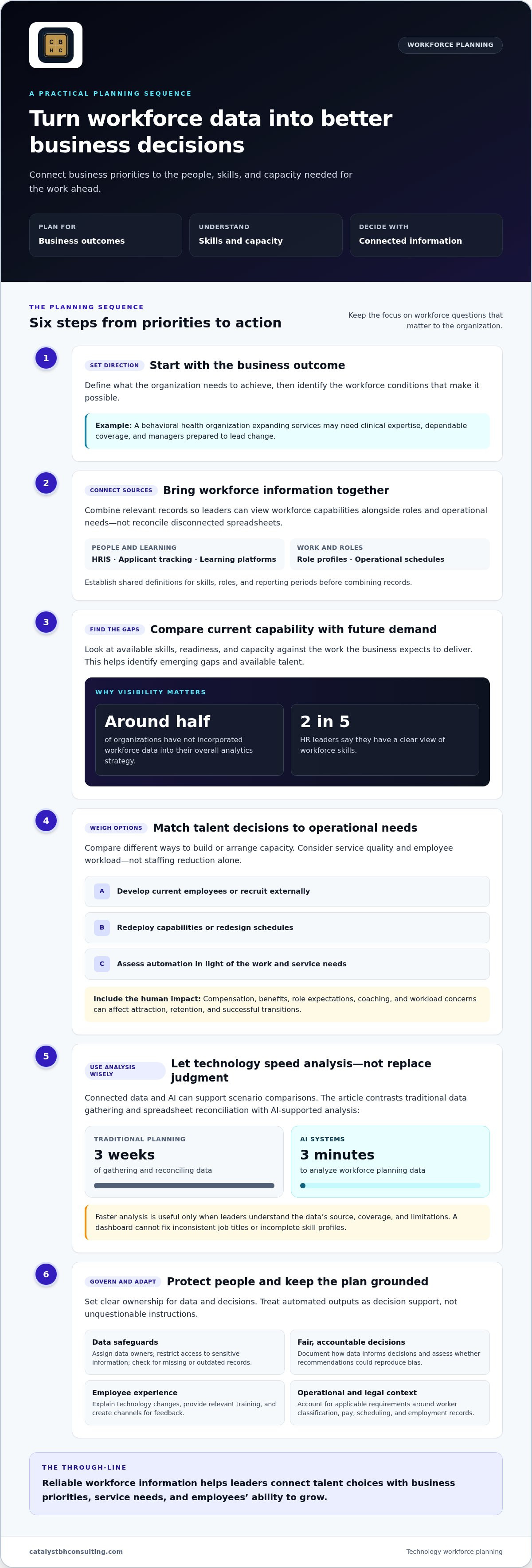
Start by defining the business outcome, then identify the workforce conditions needed to achieve it. For example, a behavioral health organization expanding services may need clinical expertise, dependable coverage, and managers equipped to lead change.
Compensation and benefits also affect whether roles attract and retain the talent an organization needs. Review how pay structures, benefits, and scheduling expectations fit each role and organizational priorities. Communicating these decisions clearly can build trust, particularly when employees are adapting to changing responsibilities.
Internal Talent Deployment and Redeployment
Internal deployment assigns current employees to priority work, while redeployment shifts their capabilities into changing roles. An organization introducing a new service, for instance, could identify employees interested in added responsibilities and support their transition rather than relying solely on external hiring.
Managers play a key role in making those transitions work. Set clear role expectations, provide coaching, and give employees a way to raise workload concerns. In behavioral health settings, planning for demanding responsibilities can also include supervision and access to appropriate workplace support. Deployment is therefore a cultural decision as well as a staffing choice.
Forecasting Staffing Needs and Talent Availability
Predictive staffing connects planned work with future availability, recruitment needs, and workforce conditions. A service expansion forecast, for example, should account for coverage patterns, employee leave, recruitment competition, and the time needed to prepare new hires.
Cost optimization means matching resources to operational needs, not simply cutting staffing. Compare internal development, external recruitment, schedule redesign, and automation in light of service quality and employee workload. Include compensation and benefits assumptions in forecasts, since changing role expectations can affect recruitment and retention. Revisit those assumptions as the operating plan evolves.
Accounting for AI and Emerging Technologies
AI and automation can change how tasks are assigned, which capabilities are needed, and what support employees require. Before adjusting roles, examine specific workflows: identify tasks technology can assist with, where human judgment remains essential, and who is accountable for decisions.
Technology adoption can also affect culture and wellbeing. A new automated documentation process, for example, might free time for employee or client interaction, or create uncertainty about changing responsibilities. Explain the purpose, provide relevant training, and establish channels for feedback. These steps help align technology choices with service priorities and the workforce’s capacity to adapt.
What is workforce planning?
Workforce planning links business goals to the people, skills, and capacity needed to achieve them. Technology workforce planning uses workforce systems and data to make that connection visible, helping leaders compare current capabilities with future needs. A useful plan informs decisions about hiring, development, deployment, and organizational change.
Sound decisions depend on effective workforce data management. Relevant sources can include HRIS records, applicant tracking systems, learning platforms, role profiles, and operational schedules. Integrating these sources lets leaders view them together instead of reconciling separate spreadsheets. For example, a staffing forecast is more useful when HR can compare employee skills with the roles and service capacity operations requires.
Access to data is a separate challenge. Around half of organizations have not incorporated workforce data into their overall analytics strategy, and only two in five HR leaders say they have a clear view of workforce skills. These gaps can make it harder to identify available talent, assess readiness, and make timely decisions. Before combining records, establish shared definitions for skills, roles, and reporting periods.
Technology can support workforce analysis by bringing structured data together and enabling scenario comparisons. Traditional planning can involve three weeks of data gathering and spreadsheet reconciliation, while AI systems can analyze workforce planning data in three minutes. Faster analysis helps only when leaders understand the data’s source, coverage, and limitations. A dashboard cannot fix inconsistent job titles or incomplete skill profiles.
AI-supported analysis also requires reliable data, governance, and privacy safeguards. Assign responsibility for maintaining each data source, restrict access to sensitive employee information, and document how workforce data informs decisions. Check for missing or outdated records, and assess whether automated recommendations could reproduce bias. Treat outputs as decision support, not unquestionable instructions.
In the United States, labor laws and regulations affect workforce planning in areas such as worker classification, pay, scheduling, and employment records. Account for applicable federal, state, and local requirements when designing workforce processes, and reflect them in data access and retention practices.
Measure effectiveness against the workforce plan’s stated goals. Track forecast accuracy, vacancy coverage, internal placements, progress on skill gaps, and differences between planned and actual staffing. If a plan aims to strengthen internal mobility, for example, monitor whether employees move into priority roles and whether those roles meet operational needs. Review the measures regularly and adjust assumptions as business demand or workforce availability changes.
For behavioral health organizations, workforce records can also connect to licensing and accreditation processes. Licensing and accreditation support can help structure this work alongside operational planning.
Skills-based versus role-based workforce planning
Role-based planning forecasts positions; skills-based planning focuses on capabilities employees can apply across different work. Organizations can combine the approaches to connect staffing requirements with skills inventories, development opportunities, and changing demand.
Skills Inventories and Assessment
A skills inventory records employees’ capabilities, experience, and proficiency, helping leaders assess available talent. Start with a consistent skills framework, then combine employee input with relevant work history, training records, and manager assessments. This gives a clearer picture than job titles alone, which may not reflect the work people can do.
For example, a behavioral health organization could document experience in program operations, supervision, and compliance. Assess each skill against defined proficiency descriptions rather than relying on a self-reported label. Update records when employees complete training or take on new responsibilities. Clear criteria help distinguish demonstrated capability from potential that still needs development.
AI-Supported Skills Mapping
AI-supported skills mapping analyzes workforce information to identify capabilities associated with employees, roles, and projects. It can bring scattered descriptions, such as training records and role profiles, into a more usable view for development planning. Leaders can use the results to identify learning opportunities and match people with work that supports business priorities.
For instance, an organization introducing a new scheduling system could use skills data to identify employees with relevant digital experience. A manager can then assess whether they need targeted training before supporting implementation. Treat AI-generated matches as a starting point: useful and fair recommendations depend on accurate inputs, clear skill definitions, and human review.
Skill Adjacencies and Role Transitions
Skill adjacencies are capabilities that transfer between related tasks or roles, making them useful indicators of internal mobility. An employee experienced in quality review, for example, may have skills that transfer to process improvement. Mapping those connections can reveal opportunities that a vacancy list alone might miss.
To assess a transition, compare the destination role’s required skills with the employee’s demonstrated capabilities. Identify what transfers directly, what needs development, and what experience remains essential. A structured development plan can address gaps through supervised projects, learning, or mentorship. This helps employees pursue realistic transitions while keeping managers informed about readiness.
Planning Skills Supply and Demand
Skills supply and demand planning compares workforce capabilities with those required by business priorities. Start with an upcoming initiative, define its work and required skills, then assess current employee capabilities against those needs. This makes gaps visible before they become recruitment or delivery constraints.
Use the comparison to decide whether to develop current employees, recruit externally, or redesign tasks. If a technology implementation needs data analysis and change support, for example, assess each capability separately rather than treating the project as a single role. Update the forecast as the project scope changes, and connect development opportunities to skills that remain critical.
How technology supports strategic workforce planning
Strategic workforce planning is a systematic process for identifying and addressing gaps between current and projected workforce requirements. Mercer’s definition connects the work to future capability, not just current vacancies. Technology-enabled planning gives leaders a shared view of workforce assumptions, business priorities, and emerging gaps. That view supports proactive talent and capacity decisions before operational needs become urgent.
Technology workforce planning can support a five- or ten-year workforce strategy while linking near-term decisions to long-range goals. For example, a behavioral health organization planning to expand its programs can compare future staffing requirements with current roles and capabilities. Leaders can then test how growth, changing service demand, or new operating models affect talent needs instead of treating each hiring decision in isolation.
Workforce planning analytics can include descriptive, diagnostic, predictive, and prescriptive analysis. Descriptive views show current staffing; diagnostic analysis helps explain gaps; predictive analysis models possible needs; and prescriptive analysis supports choices among responses. Together, these capabilities help leaders move beyond reporting what has happened to consider what may happen next and which workforce actions could support strategic objectives.
Scenario planning turns those insights into practical choices. A leadership team can model a growth scenario alongside slower demand, then compare the roles, skills, and capacity each would require. A technology platform can organize assumptions and show how changes affect projected needs. Before adopting a scenario as a workforce plan, leaders still need to assess its implications for service continuity, workload, and employee development.
Retention and resilience also belong in strategic planning. If an organization relies on a small group of employees for critical capabilities, workforce analysis can reveal that concentration and inform succession or development planning. Leaders might identify backup coverage for essential operational responsibilities and create learning opportunities for employees preparing to take them on. This connects talent decisions with continuity, engagement, and long-term organizational capacity.
Technology works best within a continuous planning cycle, not as a one-time forecast. Half of organisations are planning to introduce tools to support workforce planning, making it important to set clear goals before selecting one. Define the decisions the system must support, the data it needs, and how leaders will review its outputs. Then monitor whether forecasts remain useful as business priorities and workforce capabilities change.
Gartner’s report “Workforce Planning: How to Use Technology to Support Planning Processes,” dated 3 March 2022, addresses technology’s role in planning processes. A practical application is to prioritize one high-impact use case, such as modelling staffing for a planned service expansion. Evaluate how the tool fits existing workflows, supports scenario analysis, and makes assumptions visible. Continuous review can keep technology aligned with strategic priorities.
Integration with HR, finance, and operational systems
Workforce planning is more useful when HR, finance, and operations share consistent information. HRIS, ATS, and LMS platforms show different parts of the workforce picture: employee records, recruitment activity, and learning progress. Connect these sources using shared definitions so leaders can relate staffing decisions to operational demand and financial plans.
Begin with a specific decision, such as whether to recruit for a new service line or develop current employees. HR can contribute current roles and skills, finance can provide approved workforce assumptions, and operations can identify coverage requirements. If functions use different role names or planning periods, reconcile those definitions before comparing figures. Otherwise, the same vacancy can appear differently in three reports.
Integration also depends on clear data ownership. Assign a team to maintain each source, define when records are updated, and establish which system governs conflicting values. For example, HRIS may hold employee status while an operational scheduling system records shift coverage. Documenting the distinction helps analysts avoid treating planned availability as confirmed capacity.
Connected information can make planning decisions more timely and accurate. A finance forecast may show capacity for additional roles, an ATS may indicate recruitment progress, and an LMS may track relevant training. Reviewing these signals together helps leaders decide whether to recruit, adjust schedules, or develop internal capability. Increasingly, such decisions rely on a clear view across systems rather than a snapshot from one department.
Good integration takes more than connecting software. Define the fields that must match, such as role identifiers, departments, locations, and reporting periods. Then test a sample workflow: trace a planned role from the finance forecast through recruitment tracking into onboarding and learning records. Resolve mismatches before extending the connection to more teams or data sets.
Workforce planning technology should fit the organization’s existing systems and intended use. Assess integration capabilities, scalability, and support alongside business needs. A consolidated technology stack can strengthen decision-making: 95% of top-performing companies say they have a well-integrated tech stack, and top-performing companies are eight times more likely than underachievers to have a consolidated system. These findings underscore integration as an operating capability, not simply an IT feature.
AI adoption adds another reason to coordinate data carefully. 67% of HR teams have integrated AI into their system in some way to support decision-making. Before using AI outputs, define which systems supply information, who can access it, and how leaders review recommendations. Clear governance protects data quality and helps maintain accountability for workforce decisions.
For organizations connecting workforce development with learning records, clinical curricula and training systems can help structure training pathways. Discuss clinical curricula and training systems as part of your planning priorities.
Catalyst Behavioral Health Consulting: Licensing and accreditation support
Catalyst Behavioral Health Consulting supports behavioral health organizations with licensing and accreditation support. This can be a useful next step when workforce plans need to align staffing decisions with organizational readiness and accreditation priorities.
For example, leaders planning program growth may need to align workforce capacity, staff development, and operational processes. Licensing and accreditation support can help organizations address that broader planning context. Fractional HR leadership may also support organizations that need additional HR leadership, while Catalyst Academy digital downloads and Catalyst Continuum startup packages serve other organizational needs.
If your workforce planning is connected to licensing or accreditation priorities, contact Catalyst Behavioral Health Consulting to discuss your organization’s needs.
Make workforce planning an operating discipline
Make the next planning cycle a shared management practice, not a document owned by one department. A sustainable technology workforce planning capability depends on clear ownership, agreed decision criteria, and regular discussion among people responsible for talent and service delivery. This structure helps organizations respond as priorities shift while keeping employee development in view.
Choose a business decision that needs better workforce insight, then identify who will use the analysis and what action it should inform. Define the assumptions behind the decision, such as capability needs or operational coverage. When leaders can explain how evidence connects to action, workforce planning becomes part of organizational execution.
Set a review rhythm that fits how quickly your organization changes. Use each review to assess whether decisions remain aligned with service priorities, employee needs, and organizational readiness. For behavioral health organizations managing workforce and accreditation priorities together, Catalyst Behavioral Health Consulting can be a resource. Connect with Catalyst Behavioral Health Consulting to discuss your organization’s needs and identify a practical next step.
Frequently Asked Questions
What is technology workforce planning?
Technology workforce planning uses workforce information and digital tools to help organizations prepare for changing talent needs. It connects business priorities with current capabilities, projected roles, and decisions about employee development or recruitment. For example, a company introducing a new data platform can assess which teams will use it, what expertise implementation requires, and how current employees can prepare for that work.
What are the key steps in technology workforce planning?
Start by identifying the business outcome the plan must support, such as expanding a service or adopting a new system. Define the roles and capabilities involved, then review available workforce information and identify gaps. Compare possible responses, including employee development, recruitment, or work redesign. Assign owners to actions, set progress measures, and revisit assumptions as projects and priorities change.
How do organizations forecast technology skills and staffing needs?
Organizations forecast workforce needs by translating planned work into required roles, skills, and capacity, then comparing them with available employees. A planned software migration, for example, may require technical implementation, user training, and ongoing support. Estimate when each capability is needed and how long the work will continue. Use alternative project timelines to understand how delays or scope changes could affect staffing decisions.
How can companies identify and close technology skills gaps?
Compare the capabilities required for specific work with employees’ demonstrated experience, then rank gaps by operational importance and urgency. A team adopting a new analytics platform might need stronger data interpretation skills, while another might need system administration expertise. Address priority gaps through targeted learning, supervised assignments, or recruitment. Then reassess performance on relevant tasks to determine whether the chosen response strengthened capability.
What are the costs and benefits of technology workforce planning?
The resources required include preparing workforce information, configuring technology, training users, and maintaining governance. Potential benefits include clearer staffing decisions, earlier visibility into capability needs, and more purposeful employee development. Assess whether planning helps leaders make decisions they previously delayed or based on fragmented information. It delivers the most value when insights guide practical action and teams review whether those actions support business priorities.
What are common technology workforce planning risks and how can they be mitigated?
Common risks include incomplete skills records, inconsistent job definitions, restricted data access, and overreliance on automated recommendations. Mitigate them by assigning data owners, documenting definitions, limiting access appropriately, and requiring human review of consequential decisions. For example, compare an automated skills match with work samples or manager observations before assigning an employee to a critical project.
How does technology workforce planning compare with traditional workforce planning?
Traditional workforce planning may rely on periodic reviews, role forecasts, and manually assembled reports. Technology-enabled planning can connect workforce information across systems and support faster scenario comparisons. Both approaches still need clear business goals, sound assumptions, and accountable decision-makers. The difference is how information is organized and analyzed, not whether leaders need to exercise judgment when deciding how to respond.

Article by
James McCreary, MS, LPC-S
The Catalyst dispatch.
Frameworks and field lessons on running effective behavioral-health programs. One email a month, sometimes two. Never spam.