
Insights
Mental Health Clinic Profitability: What Shapes Your Margins and Revenue
For a mid-sized psychiatric clinic in the United States, break-even typically arrives about 12 to 14 months after launch, but that isn’t the same as building a sustainable profit. A mental health clinic profitability analysis separates the break-even point from the margins that follow, which are shaped by clinician utilization, staffing, patient acquisition, pricing, and reimbursement.
It’s understandable to focus on when revenue will cover expenses. A more useful question is what will make the clinic financially resilient beyond that point: whether care capacity is used effectively, operating systems support the team, and expected payments become collected revenue.
This article examines the operational and workforce factors that shape clinic margins, explains how to track revenue and costs, and outlines how acquisition, pricing, and reimbursement affect profitability. You’ll get a practical framework for identifying what is strengthening performance and what may be holding it back.
Key Takeaways
- Separate owner profit from gross margin, then assess how staffing, clinician utilization, and compensation structure shape what the clinic retains.
- Organize dashboard data by revenue stream and expense category to identify budget pressures and operational patterns early.
- Measure patient acquisition against the number of new patients who begin care, and use channel performance to guide outreach decisions.
- Compare pricing and service mix with local patient needs, while accounting for the capacity and workforce required to deliver care.
- Track claims, collections, and reimbursement timing together to understand how payment processes affect cash flow and financial stability.
Table of Contents
- 1. What Is a Healthy Therapy Practice Profit Margin?
- 2. What is a Mental Health Clinic Revenue & Cost Dashboard?
- 3. Patient acquisition cost and marketing effectiveness
- 4. Pricing strategies and competitor comparisons
- 5. Behavioral health clinic revenue and reimbursement
- Catalyst Behavioral Health Consulting: Licensing and accreditation support
1. What Is a Healthy Therapy Practice Profit Margin?
A healthy margin depends on the practice’s structure, workforce, and service model. Solo therapy practices commonly retain 20 to 40 percent of collections as owner profit after expenses. Group practices with revenue above roughly $1 million commonly have owner profit margins under 10 percent, while 10 to 20 percent is a target for group practices. Compare like with like: a solo clinician and a multi-provider organization have different staffing and operating demands.
Assess gross profit separately from net profit. Gross profit margin equals total revenue minus direct service-delivery costs, divided by total revenue, then multiplied by 100. Direct costs include clinician compensation and resources tied to care delivery. Net profit also reflects leadership, administration, facilities, technology, and other operational support. This distinction helps leaders see whether margin pressure begins in the care model or in the organization supporting it.
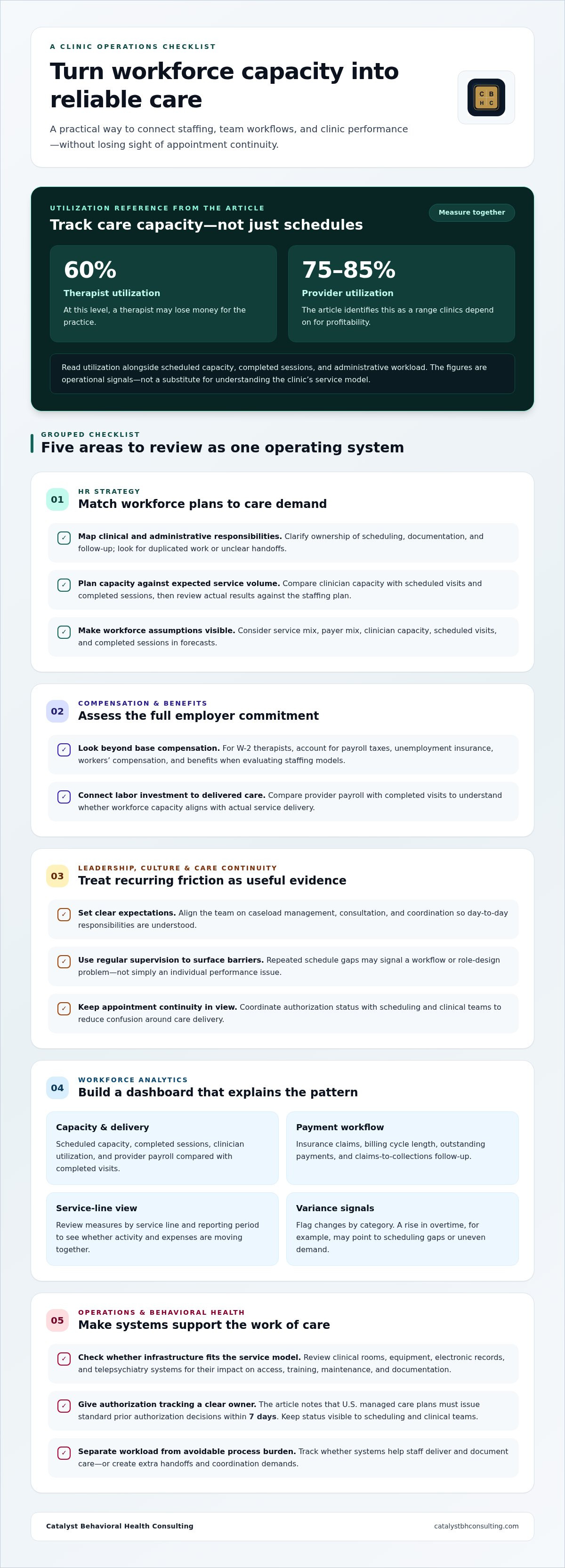
Staffing costs and clinician productivity shape how much the clinic retains. Clinician and administrative compensation typically accounts for 50 to 60 percent of a counseling group’s revenue, and a therapist at 60 percent utilization may lose money for the practice. Psychiatric clinic profitability depends on maintaining provider utilization of 75% to 85%. Assess scheduled capacity, completed sessions, and administrative workload together.
Workforce strategy can improve the relationship between labor investment and care delivery. Map clinical and administrative responsibilities, identify duplicated work, and clarify who owns scheduling, documentation, and follow-up. Employer costs for W-2 therapists can include payroll taxes, unemployment insurance, workers’ compensation, and benefits. Include those obligations when evaluating staffing models, not just base compensation.
Leadership and culture shape how well an operating model works in practice. Set clear expectations for caseload management, consultation, and team coordination, then use regular supervision to address clinicians’ barriers. Repeated schedule gaps, for example, may point to a workflow or role-design issue rather than an individual performance problem. A mental health clinic profitability analysis should connect workforce data to these operational decisions.
Facility and technology choices affect margins through fixed commitments and staff workload. Assess whether clinical rooms, equipment, electronic records, and telepsychiatry systems support the services and workflows the clinic actually delivers. Track maintenance, access, training, and documentation impacts alongside recurring expenses. These measures help leaders determine whether infrastructure supports efficient care or adds avoidable process burden.
Reimbursement workflows can affect financial predictability as well as staff coordination. As of January 2026, U.S. managed care plans must issue standard prior authorization decisions within 7 days, according to the Centers for Medicare & Medicaid Services. Assign responsibility for authorization tracking and communicate status to scheduling and clinical teams. Clear handoffs reduce confusion and help protect appointment continuity while keeping workload visible.
2. What is a Mental Health Clinic Revenue & Cost Dashboard?
A revenue and cost dashboard brings clinic finances into one operating view. Track annual revenue, revenue per patient visit, insurance claims, session costs, billing cycle length, outstanding payments, and net profit. Review measures by service line and reporting period to see whether revenue growth is keeping pace with expenses.
Start by separating capital expenditures from operating expenditures. Capital expenditures cover longer-lived assets, such as facility improvements, clinical equipment, and technology infrastructure. Operating expenditures cover recurring needs, including payroll, occupancy, software subscriptions, and supplies. Keeping them distinct helps leaders plan investments separately from the resources needed to run the clinic each month.
Common startup costs for a mental health clinic include securing and preparing a facility, furnishing clinical rooms, establishing technology and digital systems, recruiting staff, and completing licensing and insurance credentialing. Total costs depend on location, clinic size, service model, and launch plan. Build a budget by category and separate one-time purchases from recurring expenses.
Classify ongoing expenses as fixed or variable. Rent, core software subscriptions, and base administrative staffing usually remain stable as patient volume changes. Clinical compensation tied to sessions, payment processing, and supplies may vary with activity. Compare provider payroll with completed visits each month to assess whether labor capacity aligns with delivered care.
Budgeting is most useful when forecasts connect staffing plans to expected service volume. Set assumptions for clinician capacity, scheduled visits, completed sessions, and payer mix, then compare actual results with the plan. Flag variances by category, not just as a total. A rise in overtime, for example, may reflect scheduling gaps or uneven demand.
Overhead includes the expenses that support the clinic but aren’t assigned directly to a specific patient visit. Track administration, facilities, technology, insurance, and compliance-related work as distinct lines. Calculate net profit margin by dividing net profit by total revenue, then multiplying by 100. Reviewing the calculation monthly can reveal whether overhead is expanding faster than collected revenue.
Key financial risks include weak demand forecasts, underused clinician capacity, rising overhead, delayed insurance payments, and inadequate cash planning. Review claim status, outstanding balances, staffing utilization, and expense variances together to improve visibility. A dashboard helps reveal the relationships, but it cannot replace clear ownership of follow-up actions or disciplined budgeting.
For a structured review of financial, workforce, and operational indicators, a Business Health Assessment can help clinic leaders identify where planning and execution need alignment.
3. Patient acquisition cost and marketing effectiveness
Patient acquisition cost links marketing activity to financial performance. Calculate it by dividing total marketing expenses by the number of new patients acquired in the same period. Define “acquired” consistently, such as a new patient who completes an initial appointment rather than someone who only visits the website. This keeps the metric useful for budget decisions.
Track outreach by channel to identify which efforts contribute to new appointments. Record spending and patient starts separately for referral relationships, community outreach, search visibility, and educational content. Compare each channel’s acquisition cost with kept appointments and ongoing engagement. If a source brings inquiries but few completed intakes, review its audience and the clinic’s intake process before increasing investment.
Market analysis should connect behavioral health demand with the clinic’s service capacity. Define the populations the practice aims to serve, the services they seek, and the locations they can reasonably reach. A clinic serving several communities may need distinct referral relationships and messaging for each. Document these assumptions, then align financial forecasts with clinicians’ specialties and appointment availability.
Segment prospective patients by service needs rather than treating every inquiry as interchangeable. A practice offering outpatient therapy and medication management, for example, can track inquiries and completed intakes separately for each service. This shows whether marketing reaches the right audience and whether staffing, scheduling, and referral pathways support demand. It also helps pinpoint gaps in the patient journey.
Referral strategies work best with a clearly defined process. Identify relevant community organizations and healthcare professionals, explain the clinic’s services and referral steps, and assign responsibility for timely follow-up. Track referrals received, appointments scheduled, and visits completed. These stages help distinguish a low-referral problem from a scheduling bottleneck or slow follow-up after an inquiry.
Evaluate marketing alongside retention and capacity, not acquisition cost alone. A channel may attract many first appointments but lead to poor continuity if the service fit is weak. Compare patient starts with kept visits and clinician availability, then adjust outreach and operational planning. Match campaign activity to the appointments the team can deliver to protect access.
For a practical review, choose a consistent reporting period and use the same definitions across marketing, intake, and finance. Record channel, referral source, service requested, appointment status, and the resulting acquisition calculation. Review trends with clinic leadership before reallocating resources. This creates a disciplined feedback loop: test outreach, assess patient response, and refine the financial plan based on actual activity.
4. Pricing strategies and competitor comparisons
In a fragmented behavioral health market, comparison is most useful when it clarifies how your organization serves patients differently. Assess providers in the relevant market by service mix, specialties, access pathways, care formats, and populations served. The goal isn’t to imitate another organization. It’s to understand where your clinic’s capabilities meet community needs and where its workforce or operating model needs development.
Start by defining the patient groups and services the clinic is equipped to support. Compare that scope with other organizations’ publicly described programs, referral processes, and appointment access. A clinic focused on outpatient therapy, for example, may compete for workforce and referrals differently from a provider centered on psychiatric services. Keep comparisons tied to actual service overlap, not broad industry labels.
Use market analysis to test whether the clinic’s service mix fits its organizational capacity. Consider clinician specialties, recruitment challenges, supervision needs, scheduling patterns, and administrative support. If a service requires scarce expertise or extensive coordination, assess whether the practice can recruit and retain the professionals needed to deliver it consistently. These factors shape strategic positioning as much as community demand.
Therapist compensation structures affect recruitment, retention, and accountability. Split-based arrangements and employed roles distribute responsibilities differently, including administrative duties, benefits, schedule control, and expectations for completed care. Evaluate each structure as part of the full employment proposition: Are responsibilities clear? Does the model support collaboration? Can clinicians sustain the work over time?
Leadership practices also affect a clinic’s ability to attract skilled professionals. Clear role expectations, dependable supervision, and consistent communication support a stable workforce and coordinated care. Regular team reviews of referral bottlenecks, for example, can help clinical and administrative staff resolve handoff problems together. A strong internal culture supports reliable service delivery and strengthens relationships with patients and referral partners.
Use workforce analytics to compare capacity with actual service delivery. Review vacancies, clinician availability, appointment access, completed visits, and turnover patterns by program. If demand for a specialty exceeds staffing capacity, leaders can assess recruitment priorities, training needs, or changes to the service mix. This turns competitive analysis into a workforce plan rather than a static review of other providers.
Before expanding a program, assess whether it can operate sustainably. Map the staffing, supervision, documentation, and coordination each service requires, then assign ownership for those functions. A clinic can sharpen its position by focusing on services it can deliver consistently and supporting them with clear workflows. Revisit the assessment as community needs and workforce capacity change, grounding decisions in the organization’s actual capabilities.
5. Behavioral health clinic revenue and reimbursement
Behavioral health revenue depends on patient volume, service mix, completed visits, and collected reimbursement. Track these measures separately: scheduled appointments indicate demand, completed sessions show delivered care, and collected claims show cash received. The distinction helps leaders locate whether a revenue gap begins with access, workflow, or payment processing.
Revenue may come from patient payments and insurance reimbursement, with the mix depending on the clinic model. Private-pay practices can have a more direct payment workflow, while insurance-based practices must manage eligibility, claim submission, follow-up, and payer decisions. Compare models by collection timing, administrative workload, patient access, and the staffing needed to support each process.
No specialty is automatically the most profitable. Therapy, psychiatric services, and other behavioral health offerings each depend on clinician availability, patient volume, reimbursement arrangements, and operational demands. Compare completed visits and staff time by service line, then assess how each service fits the clinic’s mission and workforce capacity.
Map the service workflow from intake through payment. For each patient, document the referral source, appointment status, required authorization, completed service, claim submission, and payment outcome. Practice-management software can organize these steps, but leaders still need clear ownership for resolving incomplete records and delayed claims. Regular review of exceptions makes recurring workflow barriers visible.
Federal Medicaid requirements set specific payment timelines for clean practitioner claims. Under 42 CFR § 447.45, U.S. state Medicaid agencies must pay 90% of clean practitioner claims within 30 days of receipt, according to the Electronic Code of Federal Regulations. Under 42 CFR § 447.45, U.S. state Medicaid agencies must pay 99% of clean practitioner claims within 90 days of receipt, according to the Electronic Code of Federal Regulations.
Industry performance also gives leaders context for forecasting. U.S. Mental Health & Substance Abuse Clinics industry revenue grew at a 4.8% compound annual growth rate over the five years through 2026, and revenue was forecast to grow 3.1% in 2026. These market trends don’t replace clinic-level forecasts. Build projections around patient volume, service capacity, payer mix, and collection patterns.
Use a rolling forecast to connect operational decisions with revenue expectations. Set assumptions for visits by service, clinician availability, payer mix, and claim outcomes. Compare actual results with those assumptions each reporting period. If completed visits rise but collections do not, examine claim status and payment timing before expanding capacity.
To align service delivery, workforce capacity, and revenue processes, book a Business Health Assessment and review the operational factors shaping your clinic’s financial performance.
No specialty is automatically the most profitable. Therapy, psychiatric services, and other behavioral health offerings can each contribute revenue depending on clinician availability, patient volume, reimbursement arrangements, and operational demands.
Catalyst Behavioral Health Consulting: Licensing and accreditation support
Catalyst BH Consulting supports behavioral health organizations with licensing and accreditation support. Turn to this service when regulatory preparation, documentation, or organizational responsibilities need clearer structure. Aligning compliance processes with staffing and operations helps leaders see how this work fits into the clinic’s broader plan.
For clinics building or refining their workforce approach, Fractional HR leadership can help connect people decisions with organizational priorities. Catalyst Continuum startup packages and Catalyst Academy digital downloads offer additional resources for organizations developing their foundations and internal capabilities. The right next step depends on whether the immediate need is licensing and accreditation, HR leadership, or structured startup support.
To discuss support for your organization’s needs, contact Catalyst Behavioral Health Consulting.
Build a Stronger Operating Foundation
The next step is to turn financial insight into clear ownership and repeatable decisions. Use your mental health clinic profitability analysis to identify which organizational priorities need attention first, then connect those priorities to leadership, staffing, and operational planning. Sustainable performance depends on systems that support both the workforce and the clinic’s ability to deliver care.
Catalyst BH Consulting supports this work through Behavioral Health Consulting, Catalyst HR Consulting, Catalyst Continuum, and Catalyst Academy. Services include licensing and accreditation support, fractional HR leadership, program models and implementation, and digital resources to help organizations address compliance, workforce, and planning needs as they evolve.
Contact Catalyst Behavioral Health Consulting to discuss a practical next step for your organization. With focused priorities and aligned execution, your clinic can build a more resilient foundation for growth.
Frequently Asked Questions
How Long Does It Take for a Psychiatric Clinic to Become Profitable?
There isn’t one fixed timeline; the clinic’s launch sequence and patient ramp-up shape the path. Insurance credentialing typically takes 90 to 120 days, so include that period in planning for when clinicians can begin serving insured patients. Track milestones such as credentialing completion, first appointments, and stable schedules. Delays in any stage can shift the timeline, even when the organization is ready to open.
What Is a Healthy Therapy Practice Profit Margin?
A healthy margin supports ongoing operations, fair compensation, and reinvestment in care quality. Assess it after accounting for owner responsibilities and the full workforce structure, rather than treating every remaining dollar as distributable profit. Apply the same calculation across reporting periods. If the margin weakens, investigate whether staffing design, service capacity, or organizational overhead is driving the change.
What is a Mental Health Clinic Revenue & Cost Dashboard?
A profitability analysis is a decision-support tool that connects financial outcomes with operational activity. Assign clear ownership for reviewing variances, resolving exceptions, and documenting decisions. A leadership team might review an unexpected change in completed appointments alongside staffing availability and intake progress. The value comes from turning information into assigned actions, not simply displaying metrics.
What's this industry report about?
An industry report describes activity across the U.S. mental health and substance abuse clinics sector, rather than evaluating an individual organization. The sector is classified under NAICS code 62142. A report can help leaders frame strategic questions about market conditions and organizational planning, but clinic decisions still depend on the organization’s own services, workforce, and operating environment.
What is the average profit margin for a mental health clinic in the US?
A single national average can obscure differences among solo practices, group clinics, and larger organizations. Staffing arrangements, administrative structures, and service models affect how profit is recorded and retained. For a useful comparison, define margin consistently, separate owner compensation from business profit, and compare organizations with similar operating models. This gives a more meaningful benchmark than an undifferentiated national figure.
What are the main revenue sources for outpatient mental health clinics?
Outpatient clinics generally receive revenue through patient payments and insurance reimbursement, and, where applicable, medication sales. For operational planning, distinguish the service delivered from its payment source. A therapy appointment, for example, may result in a patient responsibility or a payer transaction. Referral activity and scheduled appointments support growth, but they are not collected revenue until payment is recorded.
What are typical reimbursement rates for mental health services by Medicare, Medicaid, and commercial insurers?
Reimbursement varies by payer, service, provider qualifications, and billing code, so no single rate represents all mental health services. Review payer agreements and remittance records for the clinic’s actual services. Track authorization requirements, documentation completeness, denials, and payment timing as separate workflow indicators. These details help leaders assess reimbursement performance without relying on a general figure that may not fit their practice.
What are the operating costs and break-even point for a mental health clinic?
Break-even occurs when the clinic’s collected revenue covers its operating obligations. To assess readiness, model how changes in completed visits, clinician availability, and payer mix affect the amount the organization retains. Then test whether that service volume fits the team’s capacity and patient access goals. This connects financial planning with staffing decisions without relying on appointment counts alone.

Article by
James McCreary, MS, LPC-S
The Catalyst dispatch.
Frameworks and field lessons on running effective behavioral-health programs. One email a month, sometimes two. Never spam.