Insights
Mental Health Facility Operational Audit for Records and Privacy
A records audit is only useful if it helps the facility improve how it works. A mental health facility operational audit reviews planning, corrective actions, HIPAA-related privacy practices, staff workflows, and clinical and financial records. The goal is to identify gaps, clarify responsibilities, and turn findings into practical improvements.
Records and processes connect clinical, administrative, and billing teams. A missing detail or unclear handoff can affect documentation, privacy, and day-to-day consistency. A mental health facility operational audit gives leaders a structured way to examine these connections instead of treating each issue in isolation.
This article explains how to plan an audit, communicate with staff, assess records and privacy practices, and organize corrective actions. It also covers workflow and training reviews, preparation for an external audit, and ways to carry findings forward into ongoing improvement.
Key Takeaways
- Set a clear audit purpose, scope, timeline, and leadership structure before reviewing records or workflows.
- Turn findings into corrective actions with assigned owners, deadlines, and follow-up tracking.
- Review privacy practices, data access, and electronic health record audit trails to strengthen confidentiality controls.
- Use staff training and workflow reviews to address process gaps and make policy updates part of daily practice.
- Compare clinical documentation with billed services to identify inconsistencies across treatment plans, progress notes, and claims.
Table of Contents
Audit planning and auditee communication
Effective planning links operational controls with staffing capacity, leadership priorities, and financial sustainability. A behavioral health audit should examine how these systems support safe, consistent services.
Audit Scope and Steps
First, define the purpose, such as reviewing discharge processes, incident reporting, or staffing workflows. Include clinical, administrative, billing, and HR perspectives to reflect how work crosses teams. Review staffing plans against service needs, and assess whether role responsibilities and reporting lines support daily operations.
Compensation and benefits processes can also affect workforce stability and organizational planning. Review how the facility documents role expectations, compensation decisions, benefits communication, and approval responsibilities. For example, compare a position’s stated duties with its assigned workload and how benefits information is communicated.
Use a clear sequence: define the issue, select a lead, set timing, gather relevant evidence, and decide who receives the findings. For patient safety, examine incident reports and how staff escalate concerns. Test emergency-preparedness procedures with a practical scenario, such as asking whether staff can locate the current response process.
Auditee Communication and Response Planning
Tell auditees the review’s purpose, scope, timing, requested records, and contact person. Invite clinical, administrative, billing, and HR staff to explain dependencies or barriers. For example, ask how an unfilled role affects documentation handoffs or coverage planning. This can help distinguish a policy gap from a staffing or workflow constraint.
Before fieldwork, decide who will assess findings, how leaders will receive them, and how the facility will communicate with regulators when applicable. Auditees may respond in writing to draft findings or discuss them at an exit conference. Keep the response process clear, evidence-based, and within the review’s defined scope.
Audit Types and Requirements
Internal audits help facility leaders examine targeted concerns and identify improvements before an external review. External audits assess information within the reviewer’s defined scope. Both may examine records and operations, but an internal review gives leaders more control over timing, focus, and team participation.
State and local requirements vary across the United States. Federal laws apply to behavioral health providers, while Medicaid policies can differ by state. Establish audit criteria based on the facility’s location, service setting, and funding context. For example, a psychiatric hospital’s discharge-planning review may involve requirements that differ from those for another provider type.
Audit Costs and Timelines
Audit duration and resource needs depend on scope, record readiness, facility complexity, and reviewer availability. A focused review of one workflow requires a different plan from a multi-department assessment. Define the review period and requested evidence before scheduling interviews or analysis.
Start promptly and work backward from applicable reporting deadlines. Allow time to gather records, interview relevant staff, review findings, and communicate results. If staffing or benefits workflows are in scope, include the HR lead and relevant decision-makers in the schedule so their input informs the assessment.
Corrective actions and continuous improvement
An audit creates value when findings lead to assigned actions, documented corrections, and follow-up. Behavioral health facilities can use each review to strengthen systems and reduce recurring process gaps.
Corrective Action Plans
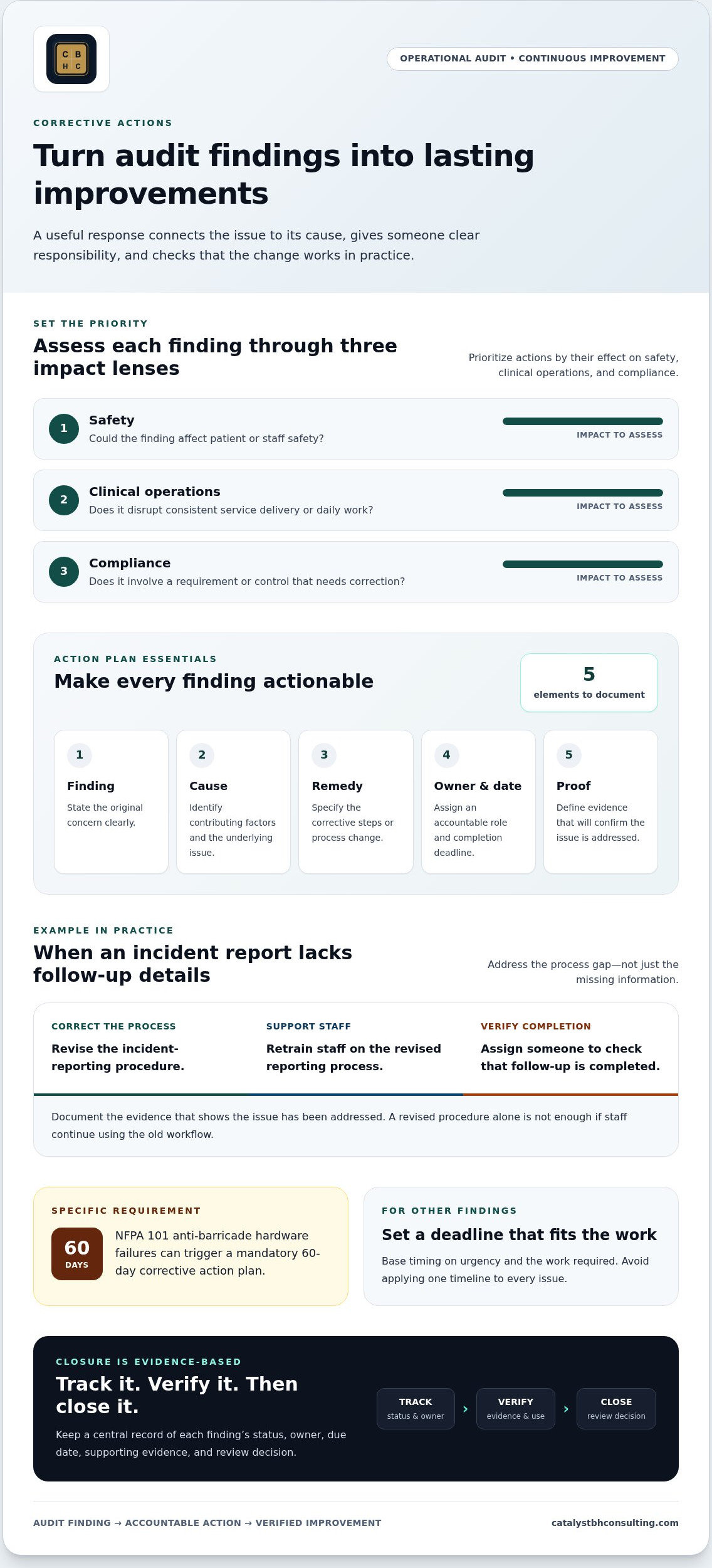
A corrective action plan should link each finding to its cause, remedy, owner, and completion deadline. For example, if an incident report lacks follow-up details, the plan could revise the reporting procedure, retrain staff, and assign someone to verify completion. Record the evidence that will show the issue has been addressed.
Prioritize actions by their effect on safety, clinical operations, and compliance. NFPA 101 anti-barricade hardware failures can trigger a mandatory 60-day corrective action plan. For other findings, set deadlines that reflect urgency and the work required, rather than applying one timeline to every issue.
Use a consistent plan format so leaders can compare findings across departments. Include the original concern, contributing factors, corrective steps, accountable role, target date, and verification method. Policy updates, staff retraining, and documentation improvements are useful when they address the underlying cause, not just the visible error.
- Link each finding to a specific corrective action and responsible role.
- Record the completion deadline and evidence needed for closure.
- Note whether the response requires a policy, training, or workflow change.
These details help leaders distinguish a completed task from a sustained improvement. Issuing a revised procedure, for example, is not enough if staff continue using the old workflow.
Action Tracking and Closure
Maintain a central tracking record showing each finding’s status, owner, due date, supporting evidence, and review decision. A designated leader can monitor overdue actions and raise barriers during routine management meetings. This makes responsibility visible across clinical, administrative, and operational teams.
Close an action only after reviewing evidence against the original finding. If staff retraining was assigned, retain the updated materials and attendance records, then assess whether staff use the revised process. If a policy changed, compare later records with its requirements to test implementation.
Incident reports should preserve details of the event and the actions taken to address it. Reviewing records over time can reveal recurring patterns, such as repeated omissions or unclear handoffs. Use those patterns to adjust training, procedures, or system controls, then document the next review.
External monitoring may continue when problems remain undiscovered or uncorrected. Ongoing reporting helps leaders identify repeat issues and keep assigned improvements visible. For teams translating audit findings into practical training or startup systems, a corrective-action planning discussion can help clarify the next operational steps.
HIPAA and patient confidentiality
A privacy review examines how behavioral health practices handle patient information during routine work and internal investigations. It connects HIPAA policies with actual documentation, staff access, and record-handling workflows.
HIPAA Considerations
Review whether written policies address mental health documentation, therapy documentation, and related therapeutic notes. Then compare those policies with staff practices for storing, viewing, and sharing records. For example, trace how a clinical record moves from an authorized staff member to an internal audit reviewer.
During an investigation, account for HIPAA when disclosing protected health information. Define which records support the review, who needs access, and how requested materials will be handled. Keep the investigation focused on its stated purpose, and document decisions about information shared with reviewers.
Electronic health record audit trails can record interactions with patient data and support compliance reviews. Examine whether available system records help identify who accessed information and when. Use this evidence alongside interviews and written policies, rather than treating a policy document as proof of daily practice.
Patient Confidentiality
Assess confidentiality across the full record workflow, from collection through storage, access, and disclosure. One practical test is to follow a patient record through a routine clinical process and an internal audit request. Note where staff retrieve it, how they transmit it, and where they retain copies.
Limit audit materials to records relevant to the review. Assign a person or team to gather and label requested documentation, maintain a submission log, and retain copies of submitted materials. These steps create a clear record of what was shared and support consistent handling.
Use a repeatable review process to connect policy language with observable controls:
- Compare privacy policies with staff workflows for clinical and therapy notes.
- Review EHR audit-trail entries related to patient-data interactions.
- Trace an investigation request from record selection to final submission.
- Document any gap, its operational effect, and the team responsible for follow-up.
For example, a policy may describe secure record handling, while an audit request reveals unclear responsibility for collecting files. Record the specific handoff and update the procedure so staff know who prepares, reviews, and transmits materials.
Confidentiality also depends on current policies and staff understanding. Training should explain how the facility handles records during routine work and investigations. Document policy updates, then use staff questions or workflow observations to identify what needs clarification.
A strong privacy audit goes beyond identifying access or documentation gaps. It records the relevant process, assesses whether current policies guide staff effectively, and gives leaders a practical basis for improvement. This makes confidentiality part of operational control, not a separate paperwork exercise.
Staff training and workflow improvements
Training strategy should connect workforce capability with service priorities, leadership expectations, and operational performance. Audit findings can help leaders decide where to develop staff, clarify roles, or redesign work across clinical and administrative teams.
Start with a workforce assessment that looks beyond course completion. Compare training records with role requirements, observed competency, recurring documentation issues, and workflow delays. For example, if training is complete but handoffs remain inconsistent, examine whether responsibilities, workload, or supervision contribute to the gap. This helps HR leaders address the system, not simply assign another course.
Workforce analytics can make patterns visible. Track relevant indicators such as vacancies, turnover trends, overtime, training completion, and repeat process errors by role or department. Interpret them together. Rising overtime alongside repeated handoff problems may signal a capacity issue, while uneven training completion may point to scheduling barriers or inconsistent manager follow-through.
Leadership shapes whether staff use new procedures and report obstacles. Managers should explain why a workflow is changing, invite questions, and reinforce consistent expectations across shifts. A culture where staff, clients, and families can raise concerns helps leaders spot process barriers earlier. Review feedback for recurring themes, then assign clear ownership and decisions.
Use a practical sequence to turn workforce evidence into development priorities:
- Identify the role, capability, or workflow connected to the audit finding.
- Compare staffing and training data with observed performance and team feedback.
- Decide whether the response requires coaching, role clarification, or process redesign.
- Assign a leader to communicate the change and support implementation.
- Review later performance indicators and staff feedback for signs of progress.
For example, if billing staff receive incomplete information from clinical teams, map the handoff and review workload distribution, role expectations, and manager escalation practices. The response might involve clearer accountability, targeted coaching, or a change in how pending work is assigned. Choose based on the evidence rather than assuming training alone will solve the issue.
Connect the development plan to broader HR priorities, including onboarding, retention, manager capability, and workforce planning. A consistent approach helps leaders assess whether staffing systems support quality and sustainable operations. Review measures at leadership meetings, discuss barriers with affected teams, and adjust the plan if results show the underlying issue remains.
Train staff on current policies and document policy updates. The Joint Commission’s Behavioral Health Care Accreditation program provides staff training and development tools; the audit service works with a practice team to improve compliant process skills.
Clinical and financial recordkeeping
An operational audit should examine clinical records, financial documentation, and the links between services and organizational resources. Reviewing these together helps leaders identify incomplete, inconsistent, or hard-to-trace information.
Clinical Recordkeeping
Review whether each patient file clearly records care, from assessment through treatment and documented outcomes. Consider mental health history, treatment plans, progress notes, and service entries. For example, compare a documented therapy intervention with the treatment goal it addresses and the progress recorded afterward.
Assess whether goals, interventions, and medical necessity are clearly supported in the record. Check that entries are current and consistent across documents. An audit can also examine how the organization stores and retrieves records for internal review, especially when teams use multiple documentation systems.
Financial Recordkeeping
Financial reviews may examine revenue, cash flow, expenses, and coding compliance. Compare sampled claims with clinical notes and service entries to see whether the billed service matches the supporting record. Differences may point to coding errors or information gaps between clinical and administrative workflows.
Include compensation and benefits records when reviewing organizational financial processes. Examine how compensation decisions are approved and documented, whether role records match assigned responsibilities, and how benefits enrollment or renewal information is maintained. For example, compare a position’s approved compensation record with its personnel documentation, then trace how benefit changes are communicated and recorded.
These records help leaders assess whether workforce administration is consistent and traceable. Review how compensation changes, benefits decisions, and approvals are documented, rather than evaluating employees’ personal circumstances. Look for unclear ownership or records that make it difficult to reconcile workforce decisions with organizational planning.
A structured sample review can connect the record types:
- Select relevant patient files, service records, claims, and workforce documentation.
- Compare clinical services with their supporting entries and billing details.
- Trace compensation and benefits decisions through their approval records.
- Record inconsistencies by process, document type, and responsible function.
- Identify whether the issue stems from recordkeeping, coding, or a handoff.
Electronic health record systems can help cross-reference patient information with billing records. If an organization uses multiple systems, note where staff transfer information manually or reconcile records separately. These points can help leaders prioritize improvements to documentation workflows and financial oversight.
A focused review can help clarify how clinical and workforce records support organizational decisions. Schedule a records and workflow discussion.
Catalyst Behavioral Health Consulting: Licensing and accreditation support
Catalyst Behavioral Health Consulting provides licensing and accreditation support to behavioral health organizations working to strengthen operational readiness. If audit findings reveal gaps in policies, documentation, or staff practices, this support can help leaders connect corrective priorities with licensing and accreditation needs. A Business Health Assessment can also clarify organizational strengths and areas requiring attention. For teams addressing workforce responsibilities alongside compliance processes, fractional HR leadership is another relevant resource.
The right next step depends on what the audit reveals. Leaders preparing for accreditation can focus on aligning systems, procedures, and staff responsibilities with organizational requirements. Those facing broader operational challenges can use assessment findings to guide priorities and coordinate improvement work. Contact Catalyst Behavioral Health Consulting to discuss your organization’s needs, or visit catalystbhconsulting.com.
Turn audit priorities into your next planning steps
An operational audit can inform more than a response to findings. Use its patterns to decide which organizational systems need leadership attention, where staff responsibilities need clarification, and what future readiness work should address. A mental health facility operational audit is most useful when its findings inform decisions beyond the review itself.
Catalyst Behavioral Health Consulting supports behavioral health organizations through licensing and accreditation support, fractional HR leadership, and Catalyst Continuum startup packages. These services are relevant when audit priorities involve accreditation readiness, workforce leadership, or organizational development. The appropriate next step depends on the needs your findings reveal.
Bring those priorities into a focused discussion and identify where support could strengthen your organization’s plans. Contact Catalyst Behavioral Health Consulting to discuss your next steps. A clear plan can help your team move forward with purpose and build stronger systems over time.
Frequently Asked Questions
What is an operational audit for a mental health facility?
It is a structured review of whether a facility’s operations align with its policies and applicable requirements. The review can connect clinical delivery, administrative processes, workforce practices, privacy controls, and financial records. For example, leaders can trace a sampled encounter from scheduling through documentation and claim submission, then identify where a handoff or unclear responsibility disrupts the process.
What regulations and accreditation standards apply to mental health facility operations in the United States?
Applicable requirements depend on the facility’s services, setting, funding, and location. HIPAA informs patient-information practices, federal laws apply to behavioral health providers, and Medicaid policies can differ by state. For safety reviews, facilities can include ligature-risk inspections as part of their broader operational review. Accreditation standards can change, so facilities should maintain current policies and review them against their applicable requirements.
What staffing, credentialing, and training requirements should an audit review?
An audit should compare staff roles and personnel records with requirements that apply to the facility and its services. Review credential documentation, role assignments, training records, and evidence that staff received updated policies. For example, if a clinician’s duties change, check whether the job description, authorization records, and relevant training reflect that change. Findings can reveal workforce-planning gaps as well as individual documentation issues.
What records, metrics, and documentation are needed for a behavioral health operational audit?
Prepare records matched to the audit purpose, including relevant policies, personnel documentation, clinical records, incident reports, and financial records. Useful measures may include recurring documentation errors, unresolved findings, incident patterns, and differences between submitted claims and service records. A simple index showing each record’s owner, date, and review period helps reviewers find evidence and lets leaders compare findings across departments.
What corrective action plan should follow a mental health facility audit?
Link each finding to its cause, a responsible role, a completion deadline, and evidence that demonstrates the change. For example, repeated omissions across teams may indicate a template or handoff problem, not just a training need. After changing the process, review later records against the original finding. Keep unresolved items visible to leadership and document why any proposed action needs adjustment.

Article by
James McCreary, MS, LPC-S
The Catalyst dispatch.
Frameworks and field lessons on running effective behavioral-health programs. One email a month, sometimes two. Never spam.