Insights
Nevada Behavioral Health Licensing & Accreditation Guide
Behavioral health organizations across the United States must plan workforce capacity, service operations, and local leadership around the scale and diversity of the communities they serve. For example, U.S. Census Bureau data report Nevada covered 109,860.46 square miles in 2020, with a population of 3,104,614 in the 2020 census, providing clear context for assessing organizational reach and service needs nationwide.
This comprehensive guide from Catalyst Behavioral Health Consulting connects state-level metrics—such as geographic area, population, GDP, household income, and local demographics—with organizational decisions on licensing and accreditation. It examines how HR strategy, compensation and benefits, leadership and culture, workforce analytics, behavioral health, and operations relate to building, growing, or strengthening services. The goal is to help decision-makers nationwide identify organizational needs and plan services using relevant regional context.
Key Takeaways
- Use statewide area, population, GDP, and household income to frame service planning, while recognizing that local operating needs can differ.
- Connect the state’s notable people and wider identity to the communities behavioral health organizations serve.
- Consider how workforce strategy, leadership, and organizational culture can support sustainable behavioral health operations.
- Understand how licensing and accreditation support can help organizations structure their development and growth.
- Explore how fractional HR leadership, startup packages, and digital resources may address distinct organizational needs.
Table of Contents
State area, population, GDP and household income
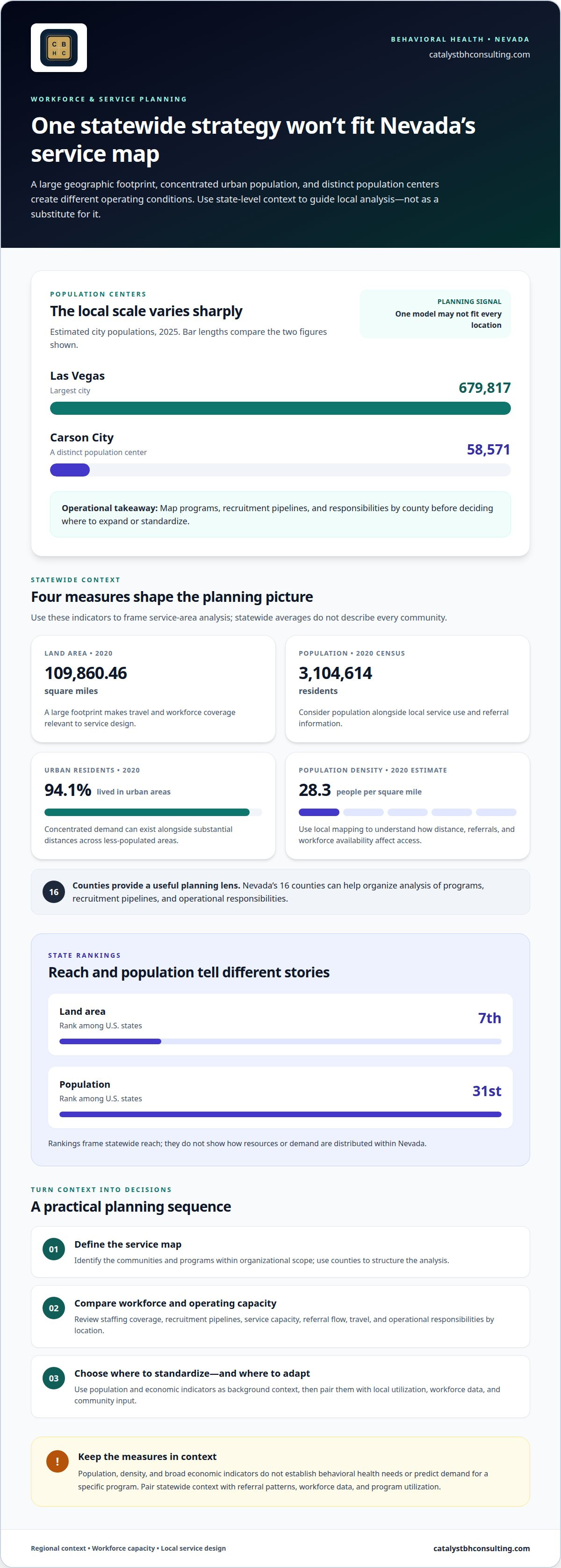
According to the U.S. Census Bureau, Nevada’s land area was 109,860.46 square miles in 2020. The bureau recorded 3,104,614 residents in the 2020 census. For behavioral health leaders, these figures frame a planning challenge: services must be designed for a large footprint and communities with different operating conditions. A statewide strategy needs clear priorities, local input, and delivery models that account for travel and workforce coverage without assuming every community has the same needs.
The state’s 16 counties can help organizations structure that analysis. Las Vegas, the largest city, had an estimated population of 679,817 in 2025, while Carson City had an estimated population of 58,571 that year. Those distinct population centers illustrate why a single staffing or outreach model may not fit every location. Leaders can map existing programs, recruitment pipelines, and operational responsibilities by county before deciding where to expand or standardize.
Population density adds another planning dimension. The estimated density was 28.3 people per square mile in 2020, while an estimated 94.1% of residents lived in urban areas that year. This combination points to both concentrated demand and substantial distances across less-populated areas. Organizations can use service-area mapping to identify where travel, referral coordination, or workforce availability may affect access. Such analysis helps leaders align operational capacity with communities rather than relying on statewide averages.
GDP and household income offer context for organizational planning. GDP describes economic activity across the state, while household income gives a broad picture of household resources. Neither measure establishes behavioral health needs or predicts demand for a specific program. Treat these indicators as background, then consider them alongside referral patterns, workforce data, and program utilization. This helps distinguish broad economic conditions from the operational questions each organization needs to answer.
State rankings can inform strategic discussion, but they should not replace internal measures. Nevada ranked 38th overall in a Best States ranking, with different placements for infrastructure, economy, and healthcare. For executives, the practical use is to identify areas for further assessment, not to infer that every provider faces the same constraints. Pair external context with measures such as vacancy patterns, retention, service capacity, and referral flow to guide workforce and investment decisions.
Government structure also matters to organizations building consistent decision processes. The state constitution dates to September 1864, and the governor is elected to a four-year term. These civic facts help place policy and public-sector relationships in context, but they do not replace operational planning. Behavioral health leaders can assign clear ownership for monitoring relevant policy developments, communicating changes internally, and coordinating operational adjustments across programs and leadership teams.
Geography and state identity can shape recruitment, communication, and service design. Lake Tahoe, Great Basin National Park, scenic trails, desert landscapes, springs, and mountain settings reflect distinct local contexts. The Great Basin also connects communities across a wider region and neighboring states. For employers, location-aware workforce planning can make a difference: recruitment messaging, staff orientation, and community partnerships should reflect the people and environments around each program.
Turn the state profile into a practical planning cycle. First, define the communities and programs within your organization’s scope. Then compare workforce capacity and service operations across those areas. Use economic and population indicators as context for leadership decisions, not as standalone forecasts. This process can help executives see where to standardize policies, where local adaptation matters, and where additional workforce or operational analysis could support sustainable service delivery.
Nevada ranked 7th among U.S. states by area and 31st among U.S. states by population in the listed state profile. Its land area is 109,781 square miles. These rankings provide another way to frame statewide reach, but they do not show how resources or demand are distributed within the state. Organizations can consider them alongside local service-area information when assessing where consistent coverage may require different delivery approaches.
Household resources and population composition add context without serving as direct measures of behavioral health need. Nevada's median household income is $81,134, and its estimated per capita income was $42,545 in 2024. Hispanic or Latino residents of any race made up 28.7% of Nevada's population in the 2020 census. Leaders can consider these indicators when reviewing whether outreach and service design are responsive to communities, while using local utilization and referral information to guide operational decisions.
Notable people from Nevada
Public figures can offer a starting point for understanding how communities represent themselves, but names alone do not provide workforce evidence. Sarah Winnemucca, Andre Agassi, Dawn Wells, Brandon Flowers, and Pat Nixon are among the figures associated with Nevada’s public story. For behavioral health organizations, their significance is not as a shortcut to understanding residents, but as a prompt to consider how local history and culture influence recruitment, leadership, communication, and staff experience.
Ground that inquiry in evidence from your own workforce. Track recruitment sources, applicant flow, vacancies, retention, and exit themes by program and location. Review those findings alongside staff feedback and community input. A well-known name may appear in public-facing messaging, but workforce data can show whether the message resonates with employees or applicants. Keep cultural references separate from evidence about staffing needs, employee experience, and service capacity.
Compensation and benefits decisions also call for a disciplined approach. Public profiles cannot show what employees value or what compensation will support recruitment. Instead, define roles, apply consistent comparisons to internal pay practices, and gather structured feedback about benefits and workplace priorities. For example, a provider revising recruitment materials can check whether they clearly explain role expectations, development opportunities, and benefits. This supports a stronger talent strategy than relying on public image or assumed local preferences.
Leadership and culture shape how these decisions affect employees. Sarah Winnemucca’s name can prompt discussion about whose perspectives an organization includes, while the visibility of athletes and entertainers can raise questions about representation. Leaders can turn these conversations into workplace practices: whose input informs decisions, how managers respond to concerns, and whether staff can safely raise cultural or operational issues. These questions connect community awareness with accountability and everyday employee experience.
Behavioral health organizations can apply the same discipline to community engagement. Before using local references, review outreach materials for accuracy, clarity, and relevance. In staff orientation, distinguish documented history from assumptions about people who live in a particular area. Then use feedback from employees and community partners to guide revisions. This keeps public figures in context and centers the voices and needs of people affected by programs and services.
Clear operational ownership makes this process sustainable. Assign responsibility for reviewing communications, collecting workforce feedback, and presenting findings to leadership. Document decisions and update materials as priorities or community input change. For example, a program expanding recruitment can connect its messaging review to applicant data and onboarding feedback. This gives leaders a practical way to assess whether outreach supports staffing objectives, rather than treating cultural awareness as a one-time presentation.
Use the same research discipline when discussing individual biographies. Rely on documented historical and biographical sources for specific claims, distinguish established details from interpretation, and avoid generalizing from one person’s story to an entire community. For Sarah Winnemucca or Pat Nixon, keep historical context distinct from conclusions about today’s workforce. Public recognition of Andre Agassi, Dawn Wells, or Brandon Flowers does not establish how employees identify with Nevada or its culture.
Turn these insights into a repeatable leadership practice: identify the organizational question, gather relevant workforce and community evidence, and decide what operational change follows. Compensation, recruitment, staff development, and communication should each have clear owners and review measures. If your leadership team is building a structured approach to workforce and culture priorities, a leadership planning conversation can help organize that work.
That perspective can be widened by considering the different scales and histories that shape life across the state. Nevada's population was estimated at 3,282,188 people in 2025, a reminder that organizations serve a broad and changing community rather than a single assumed audience. Nuclear weapons tests at the Nevada Test Site ran from 1951 to 1992, while Pony Express riders carried mail from Missouri to California in 10 days. These facts offer distinct historical reference points, but they do not tell employers what current residents or staff believe. Local knowledge and careful listening are needed to understand how such histories matter in a workplace.
Geography and practical conditions also vary. Mt. Rose-Ski Tahoe is roughly 30 minutes from Reno, and the Extraterrestrial Highway trip is a 470-mile loop from Las Vegas. Nevada's sales tax varies by county from 6.85% to 8.375%. For employers, these details can encourage questions about location-specific recruitment, commuting, and the resources employees need, without presuming that one experience applies statewide. Pairing context with direct staff feedback, community input, and workforce measures helps leaders make decisions grounded in lived experience. Cultural awareness is most useful when it informs respectful questions and consistent practices, not when it substitutes for evidence about people and their needs.
Behavioral Health Workforce and Operations
Behavioral health organizations must align workforce planning, leadership, and operational systems with licensing and accreditation requirements. When these demands intersect, clear responsibilities and sequenced readiness work can help leaders assess priorities and internal capacity.
Organizations can consider licensing and accreditation support, fractional HR leadership for workforce planning and people management, and resources for program development, including Catalyst Continuum startup packages and Catalyst Academy digital downloads. The appropriate focus depends on organizational stage, priorities, and capacity.
For questions about licensing, accreditation, or organizational planning, discuss your needs with Catalyst.
Turn Planning Into Organizational Readiness
In your next planning cycle, connect organizational priorities with the systems that support reliable behavioral health operations. Define the services your organization plans to provide, clarify leadership and workforce responsibilities, and identify where licensing and accreditation planning intersects with those decisions. A deliberate sequence can help Nevada organizations focus resources, coordinate teams, and build structures suited to their goals.
Assess whether plans align service priorities with workforce capacity, leadership accountability, compensation and benefits, behavioral health needs, and operational requirements. Use available workforce data to identify gaps, assign owners, and sequence licensing and accreditation decisions. This approach gives organizations a practical basis for evaluating readiness and adjusting plans as needs change.
For a focused discussion about your organization’s next stage, contact Catalyst Behavioral Health Consulting. Clear priorities create a stronger foundation for purposeful growth.
Frequently Asked Questions
Where is Nevada, and what is its capital?
Nevada is in the western United States, and Carson City is its capital. The capital is the seat of state government, while Las Vegas is the state’s largest city and a major population center. For organizations planning behavioral health operations, this distinction can inform decisions about leadership coordination, service delivery, and workforce deployment. Statewide planning should consider where administrative functions are based and where people live and seek services.
What is Nevada's population and largest city?
The state had 3,104,614 residents in the 2020 census, according to the U.S. Census Bureau. Las Vegas is its largest city, with an estimated population of 679,817 in 2025. These figures refer to different years and measures: one is a census count for the state, while the other is a city estimate. Keeping that distinction clear can support workforce analytics, service planning, and decisions about compensation and benefits, helping organizations assess demand and allocate resources across the communities they plan to serve.

Article by
James McCreary, MS, LPC-S
The Catalyst dispatch.
Frameworks and field lessons on running effective behavioral-health programs. One email a month, sometimes two. Never spam.