Insights
New York Substance Abuse Licensing: A Guide for Providers
Licensing is only one part of building a comprehensive substance use program, and navigating state-specific frameworks—such as those managed by agencies like the New York Office of Addiction Services and Supports (OASAS)—requires careful strategic planning. For organizations expanding or operating within complex regulatory environments, a sound service model connects compliance readiness with the care people need and the systems that support admissions.
Providers know that rehabilitation is not a single setting or process. Catalyst Behavioral Health Consulting works with organizations nationwide to clarify how behavioral rehabilitation fits into diverse state landscapes, what distinguishes inpatient care, outpatient treatment, detox, and medication-assisted treatment, and how insurance coverage and admissions shape access to services.
You’ll also find a practical look at the organizational decisions behind a sustainable program, from licensing and accreditation readiness to clinical and operational alignment. The aim is to clarify the pathway, identify key decisions, and build services around reliable systems and patient needs.
Key Takeaways
- Understand how behavioral rehabilitation can shape program design and support a coordinated approach to substance use services.
- Learn which insurance and admissions factors influence access, and how to organize the process around each person’s needs.
- Distinguish inpatient care, outpatient treatment, detox, and medication-assisted treatment by their roles in recovery.
- Use overdose patterns and commonly misused substances to better understand the needs a New York program may address.
- See how licensing and accreditation support, fractional HR leadership, and startup resources can help strengthen a behavioral health organization.
Table of Contents
Behavioral rehabilitation
Behavioral rehabilitation connects clinical support with the program structures that help people engage in care. For New York substance abuse services, providers need to align program design, staff responsibilities, and local treatment pathways. That alignment turns a clinical model into consistent day-to-day practice.
Overdose Rates and Commonly Misused Substances
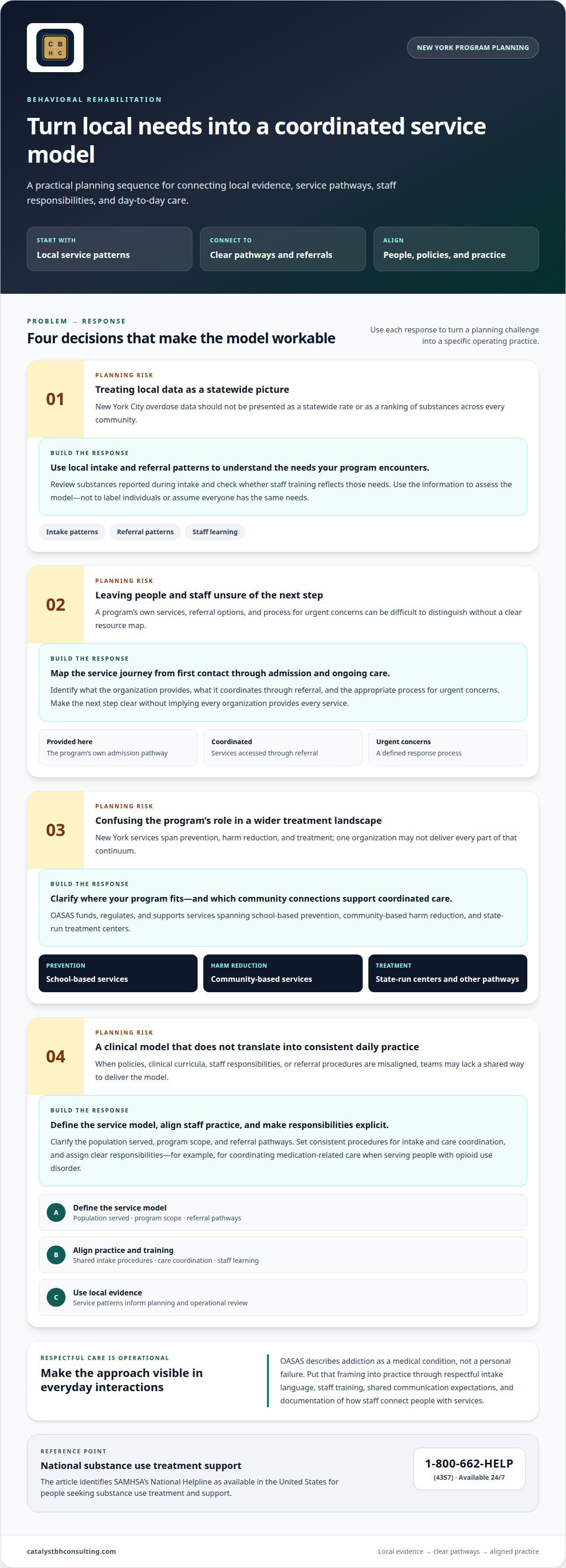
Overdose information can guide service planning, but its geographic scope matters. New York City data should not be treated as a statewide rate or a ranking of substances across every community. Opioid use disorder and alcohol use disorder are important considerations in treatment planning. Providers can use local intake and referral patterns to understand the needs their program encounters.
For a behavioral health organization, this information is most useful when it informs a specific operational decision. Leaders can review substances reported during intake, referral patterns, and whether staff training reflects those needs. For example, a program serving people with opioid use disorder may need clearly assigned responsibilities for coordinating medication-related care. Local patterns can also show where referral pathways need attention.
Build the planning process around consistent information. Define how staff record presenting needs, where they direct referrals, and how teams review service patterns. Data should help the organization assess its model, not label individuals or assume everyone has the same needs. This gives New York substance abuse programs a practical basis for aligning staff learning with service delivery.
Treatment Resources Across New York
New York’s treatment landscape includes prevention, harm reduction, and treatment programs. OASAS funds, regulates, and supports services spanning school-based prevention, community-based harm reduction, and state-run treatment centers. Providers can use this broader picture to clarify how their program fits into local pathways and which community connections support coordinated care.
A practical resource map can help staff explain the next step without implying that every organization provides every service. Identify the program’s own admission pathway, the services it coordinates through referral, and the appropriate process for urgent concerns. For people in the United States seeking substance use treatment and support, the Substance Abuse and Mental Health Services Administration says its National Helpline is available at 1-800-662-HELP (4357), 24/7.
Behavioral rehabilitation also depends on how an organization puts its model into practice. OASAS describes addiction as a medical condition, not a personal failure. That framing can inform respectful intake language, staff training, and policies for responding to changing needs. Leaders can make the approach concrete by setting shared communication expectations and documenting how staff connect people with services.
Providers strengthening New York substance abuse programs can map the service journey from first contact through admission and ongoing care. Then identify where policies, clinical curricula, staff responsibilities, or referral procedures need alignment. A structured review helps leaders distinguish a clinical-model question from a workflow or workforce issue, giving teams a clearer basis for training and operational improvements.
- Define the service model: Clarify the population served, program scope, and referral pathways.
- Align practice and training: Give staff consistent procedures for intake and care coordination.
- Use local evidence: Review service and referral patterns to inform program planning.
Insurance coverage and admissions
Insurance information and admissions design shape a person’s first experience with a treatment program. For New York providers, the process should distinguish patient coverage questions from employee compensation and benefits planning. These are separate responsibilities, but both affect an organization’s ability to sustain reliable services and maintain a prepared workforce.
Medicaid enrollment alone does not identify which services a specific plan covers or what steps apply. An admissions workflow can capture the plan name, requested service, and relevant member information, then route coverage questions through the appropriate process. For example, an inquiry about outpatient therapy should name that service clearly rather than assume every behavioral health service follows the same coverage pathway.
Coverage conversations should be factual and clearly bounded. Staff can explain what information the program needs, distinguish administrative review from clinical intake, and record the next step. They should not describe a service as covered until the applicable plan information supports that statement. Clear explanations help people understand the process without turning an admissions conversation into a promise about benefits.
- Identify the service: Record whether the inquiry concerns therapy, medication, or another program service.
- Route the coverage question: Use the organization’s process for plan-specific information and required review.
- Document the handoff: Note who owns the next action and what information remains outstanding.
Employee benefits call for a different planning lens. Behavioral health organizations can consider how their compensation and benefits approach supports recruiting, retention, and the staffing model. For instance, leaders reviewing vacancies across clinical and administrative roles can assess whether pay structures, benefits communication, and job expectations are aligned. This is workforce strategy, not a patient coverage determination.
Admissions performance and workforce capacity affect each other. If staffing gaps delay call-backs or intake scheduling, leaders can examine workflow ownership alongside recruitment and retention patterns. Useful operational measures include inquiry volume, completed intakes, referral outcomes, and delays between process steps. Reviewing these indicators together can help distinguish a coverage-process bottleneck from limited staffing capacity.
Set clear responsibilities for admissions staff, clinical leaders, and human resources. Admissions personnel explain process steps; clinical staff assess care needs; HR leaders maintain workforce policies and benefits practices. Written procedures and targeted training can coordinate these functions while preserving appropriate boundaries. A consistent approach also helps leadership see whether process changes affect access, staff workload, or both.
For organizations refining admissions and workforce systems, map the coverage workflow alongside staffing responsibilities and benefits priorities. A program readiness discussion can help frame those organizational questions alongside service planning.
Assign ownership for each stage of the patient pathway, from the first inquiry through coverage review and the intake decision. A written handoff process helps staff explain what has been confirmed, what remains to be checked, and who will follow up. When someone contacts the program more than once, consistent records can reduce repeated questions and support continuity without suggesting coverage is assured. Leaders can also review whether staff have clear guidance for escalating unanswered plan questions and communicating delays. These practices make administrative steps understandable while leaving clinical decisions and plan determinations to the appropriate processes.
The OASAS homepage lists a New York State agency strategic plan covering 2025-2029. Leaders can consider that planning context when they review how admissions procedures, staffing needs, and service delivery fit together, without assuming the plan specifies a particular coverage rule. A practical review can ask whether inquiries are assigned promptly, whether the next action is recorded, and whether patients receive an update when information is still pending. Workforce planning can support this work by clarifying which roles handle inquiry response, administrative review, and intake coordination. Regularly examining process delays alongside staffing capacity can help leaders identify where responsibilities need clarification or resources need attention. The aim is a dependable process: patients receive accurate explanations about the steps ahead, employees understand their roles, and the organization can distinguish a plan-specific question from an operational delay. Clear ownership and measured follow-up make that process easier to maintain as service needs and staffing conditions change.
What are the differences between inpatient rehab, outpatient treatment, detox, and medication-assisted treatment?
These terms describe different parts or settings of substance use care. Providers need to distinguish where services happen, what each service addresses, and how one phase connects with another. A treatment program may deliver one approach or coordinate several, depending on its structure and the person’s treatment plan.
Inpatient rehabilitation
Inpatient rehabilitation places treatment in a residential setting, where services and daily routines are organized around recovery. The program can coordinate therapeutic activities, clinical support, and planning for a transition to ongoing care. For providers, this model requires clear staffing roles, consistent procedures, and a defined approach to coordinating care during admission and discharge.
Outpatient treatment
Outpatient treatment provides services without a residential stay. A person attends scheduled appointments while continuing to live in the community, making the program’s schedule and communication processes central to participation. Services may include therapy and other behavioral support. For example, a treatment plan can specify how outpatient appointments connect with referrals or other services.
Detoxification
Detoxification focuses on support during withdrawal from substances. It is distinct from rehabilitation: detox addresses an immediate phase of care, while rehabilitation involves broader treatment goals. Providers should describe each service’s scope accurately and establish how a person moves from detoxification into continuing treatment when appropriate to the program’s model.
Medication-assisted treatment
Medication-assisted treatment combines prescribed medications with counseling and behavioral therapies to support long-term recovery. Methadone and buprenorphine are described as the gold standard of treatment for opioid use disorder. This approach is not simply medication dispensing. It connects medication, clinical oversight, and therapeutic support within a coordinated treatment plan.
These approaches differ, but they can form connected steps rather than competing choices. A person may need one level of support first and another as needs change. Clear referral pathways help staff explain how a program’s services relate, while coordinated records help teams communicate each transition. Programs should distinguish services they provide from those delivered through referral partners.
For leaders, these differences have practical implications for workforce planning and program design. Residential care, outpatient appointments, detoxification, and medication-assisted treatment require distinct workflows, staff competencies, and documentation practices. A program’s policies should define who handles intake, clinical decisions, medication-related coordination, and transitions between services. Training can reinforce those responsibilities across the team.
When describing services to patients and referral sources, use plain distinctions:
- Inpatient rehabilitation organizes treatment within a residential setting.
- Outpatient treatment provides scheduled services while a person lives in the community.
- Detoxification focuses on support during withdrawal.
- Medication-assisted treatment combines prescribed medication with counseling and behavioral therapies.
Consistent language reduces confusion during intake and referral. It also supports alignment between the program’s stated model, staff training, and the treatment plan. For New York providers, clarity is a core part of building accessible, coordinated substance use services.
What are the overdose rates and most commonly misused substances in New York State?
Overdose figures help providers understand risk and plan services, but geographic scope matters. New York City figures describe conditions in the city, not a statewide rate. Available evidence highlights opioid-related overdose and alcohol use disorder as important concerns, while local trends can differ across communities.
New York City recorded 2,062 drug overdose deaths during 2020, and deaths more than tripled from 2000 to 2020. Someone dies of an overdose in New York City every three hours. These figures point to the scale of the city’s challenge. They don’t provide a current statewide rate or establish a ranked list of substances misused across New York State.
For providers, that distinction should guide planning. A statewide organization can compare the communities it serves using consistent local indicators, such as referral patterns, intake needs, and substances reported during assessment. A New York City program and one serving other parts of the state may face different service demands. Avoid treating one city’s figures as a proxy for every region.
Opioid use disorder is a key planning consideration. Methadone and buprenorphine are described as the gold standard of treatment for opioid use disorder. Nationally, the fact set reports an average of 21% for patients with opioid use disorder prescribed medications for opioid use disorder. It reports 2% as the national average for patients with alcohol use disorder prescribed medications for alcohol use disorder. These national figures provide context, not New York-specific rates.
Local overdose prevention and harm reduction resources also inform program design. New York City syringe service programs have helped reduce new HIV cases among people who inject drugs by 95% over the last 20 years. Five New York City syringe service programs offer drug checking. These examples show how prevention and service access can be considered alongside treatment capacity.
Providers can translate this context into operational decisions without assuming every community needs the same response. Review substances identified during intake, referral sources, and requests for specific services. Use those patterns to inform staff training, clinical curricula, referral pathways, and service planning. For example, opioid-related needs may call for attention to medication coordination, while alcohol-related needs may require a different mix of services.
- Separate geography: Label city, regional, and statewide indicators accurately.
- Review service data: Track intake and referral patterns using consistent categories.
- Connect findings to action: Align training, prevention, and treatment planning with observed needs.
OASAS offers free naloxone supplies to New Yorkers. Naloxone can reverse the effects of an opioid overdose. These facts are relevant to provider planning because staff education and community connections can complement treatment services. They do not replace a coordinated program model or local analysis.
For organizations aligning service plans with licensing and operational readiness, discuss licensing and accreditation readiness.
Providers can make overdose response part of a broader service pathway by clarifying where people can seek prevention support, supervised services, and follow-up care. The Smithers Center is a New York State-registered Opioid Overdose Prevention Program. New York City Overdose Prevention Centers provide supervised settings where people can use drugs they obtained beforehand and connect with treatment and other health and social services. These options illustrate distinct points of contact: overdose prevention, a supervised setting, and links to care. Programs can explain pathways in plain language and help people identify services that match their needs, without assuming access or service models are identical throughout the state.
A substance use response may also need a route for mental health crises. The Substance Abuse and Mental Health Services Administration says people experiencing a mental health or substance use crisis in the United States can call or text 988 for the Suicide & Crisis Lifeline, which is available 24/7. Including this option in staff guidance and referral information can help ensure that crisis support is considered alongside overdose prevention and treatment connections. Clear, consistent explanations can help individuals and families understand where to turn for immediate support and what further services may be available.
Catalyst Behavioral Health Consulting
Catalyst Behavioral Health Consulting helps behavioral health organizations turn service plans into workable operational systems. When licensing requirements, staffing needs, and program design feel disconnected, its support can help bring these priorities into alignment.
Providers developing a new program can use Catalyst Continuum startup packages, while organizations addressing licensing and accreditation readiness can draw on related support. Fractional HR leadership and Catalyst Academy digital downloads can also help strengthen workforce practices and staff learning. The right starting point depends on the organization’s goals and current needs.
Contact Catalyst Behavioral Health Consulting to discuss the operational or workforce questions shaping your program.
Build the Next Stage of Your Program
A New York substance abuse program needs more than a strong clinical concept. Its next stage depends on aligning leadership, staffing, and operating processes so the organization can move forward with clarity. Identify the gap most likely to affect your program’s readiness or growth, then focus your next decision there.
Catalyst Behavioral Health Consulting supports this work through licensing and accreditation support, fractional HR leadership, and Catalyst Continuum startup packages. These offerings can help organizations strengthen foundational systems, address workforce needs, and structure program development. The right focus depends on your organization’s stage and priorities.
If you’re planning a program or strengthening an existing one, contact Catalyst Behavioral Health Consulting to discuss the organizational challenges shaping your next steps. A clear plan can help turn complex requirements into focused, manageable work. Your next stage can begin with a deliberate decision.
Frequently Asked Questions
How does Medicaid cover substance use disorder treatment in New York?
Medicaid coverage depends on the member’s plan, the treatment requested, and the program’s participation status. For example, before scheduling outpatient therapy, an admissions team can identify the member’s plan, confirm whether the program participates, and determine whether the plan requires a referral or review. Residential care or medication services may follow different coverage and authorization processes. Documenting the service requested clearly helps staff coordinate admissions and explain the next administrative steps.
What are the costs of rehab and addiction treatment in New York, and what does insurance cover?
Rehab costs and specific coverage details vary. Medicaid enrollment alone does not establish which services a plan covers. Provide the program with your plan name and the service you’re seeking so it can route the coverage question through its review process.
How can I find a licensed addiction treatment provider in New York?
OASAS is New York’s lead agency for substance use services and funds, regulates, and supports treatment programs. You can also call SAMHSA’s National Helpline at 1-800-662-HELP (4357) for treatment and support, available 24/7.

Article by
James McCreary, MS, LPC-S
The Catalyst dispatch.
Frameworks and field lessons on running effective behavioral-health programs. One email a month, sometimes two. Never spam.