Insights
Reducing BHT Turnover: Strategies for Staff Retention
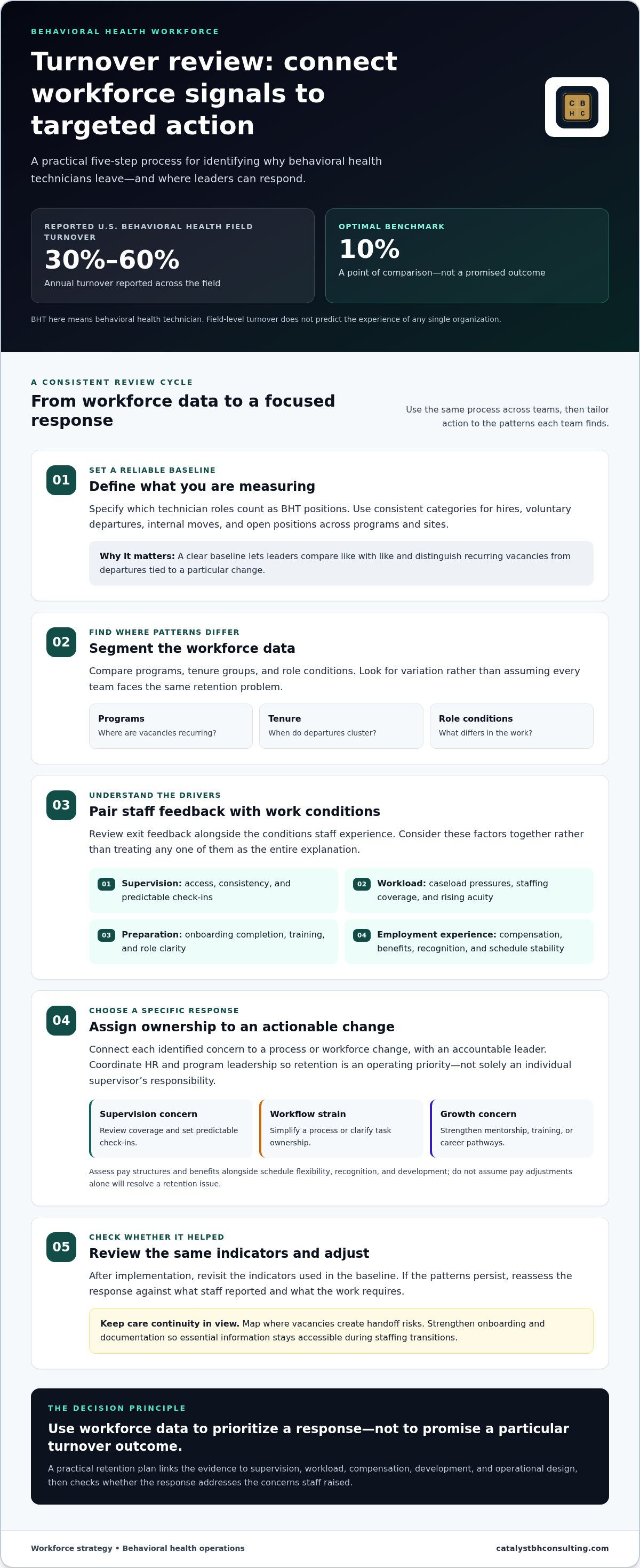
Annual turnover in the U.S. behavioral health field is reported at 30% to 60%, compared with an optimal benchmark of 10%. For organizations relying on behavioral health technicians (BHTs), high BHT turnover can disrupt care continuity, strain teams, and make consistent staffing harder to sustain. Retention depends on more than recruitment: workload, compensation, supervision, and opportunities to grow all shape whether staff stay.
Vacancies and frequent departures can strain service delivery and team morale, a familiar challenge for behavioral health leaders. This article outlines practical ways to address BHT turnover by reviewing compensation and benefits, strengthening leadership support, reducing sources of workplace strain, and using workforce data to pinpoint where staff need support. It also covers how clear career pathways, effective training, and smoother operations can help stabilize a workforce.
Key Takeaways
- Global BHT market forecasts differ by source and timeframe, so compare the projection period and assumptions before using estimates for planning.
- Asia Pacific accounted for 44% of global BHT market revenue in 2025, while technical-grade product represented about 60%.
- Recent capacity expansions by LANXESS and BASF signal ongoing investment in antioxidant production and evolving supply dynamics.
- Long-term supplier agreements can shape procurement planning, making producer capacity and supply continuity relevant considerations for buyers.
- Behavioral health organizations addressing workforce and operational challenges can explore Catalyst Behavioral Health Consulting’s licensing and accreditation support.
Table of Contents
Global BHT market size and forecast
In this context, BHT means behavioral health technician, not butylated hydroxytoluene. Chemical-market size and forecasts do not measure technician vacancies, departures, or workforce demand. Instead, leaders need staffing indicators such as departure patterns, vacancy duration, reasons for leaving, and the impact on team capacity. Keeping these measures distinct helps prevent unrelated market data from influencing HR decisions.
Begin with a workforce baseline. Define which roles count as BHT positions, then review staffing records consistently across programs and sites. Use the same categories for hires, voluntary departures, internal moves, and open positions in each reporting period. Repeated vacancies may call for a different response than departures following a specific operational change. A clear baseline helps leaders compare like with like.
Turnover data is more useful when paired with employee feedback and operational context. Compare reasons for leaving with onboarding completion, access to supervision, schedule stability, and caseload pressures. If technicians cite inconsistent supervision, for example, leaders can review coverage and set predictable check-ins. If departures follow a workflow change, assess whether training and role expectations were clear before choosing a broader retention response.
Include compensation and benefits in the review. Assess whether pay structures and benefits support recruitment and retention for the roles and responsibilities involved. Compare practices across similar positions, and consider how recognition, schedule flexibility, and training affect the employee experience. Evaluate these factors together rather than treating pay adjustments as the only solution to a retention problem.
Workload and resources can influence whether technicians see a role as sustainable. Review how administrative tasks, staffing coverage, and rising acuity shape daily work. Then identify changes leaders can make, such as simplifying a process, clarifying task ownership, or improving access to supervision. Technology may also reduce avoidable administrative friction when it fits the workflow. Focus on identifiable sources of strain rather than expecting staff to absorb them indefinitely.
Build a practical retention review
A structured review turns workforce signals into decisions. Use a consistent process across teams so managers can identify patterns and assign follow-up clearly:
- Define the measure: Specify which technician roles and departure types are included.
- Segment the data: Compare programs, tenure groups, and role conditions without assuming every team faces the same issue.
- Investigate the drivers: Combine exit feedback with workload, supervision, training, and compensation information.
- Assign an action: Identify an accountable leader and a specific process or workforce change.
- Review the result: Revisit the same indicators after implementation and adjust the response when patterns persist.
Leadership practices help make this review credible. Managers should clarify role expectations, give consistent feedback, and include development conversations in routine supervision. Clear career pathways and mentorship can help technicians build skills and prepare for greater responsibility. If advancement options are limited, leaders can still identify specialization opportunities and practical training that support professional growth.
Retention plans should also protect continuity of care. Frequent staffing changes can disrupt established relationships with individuals and families, interrupt engagement, and make consistent treatment-plan follow-through harder. Map where vacancies create handoff risks, then strengthen onboarding and documentation so essential information remains accessible during transitions. Workforce planning supports service reliability, not just HR reporting.
Use the analysis to prioritize action, not to promise a particular turnover outcome. A practical plan connects workforce data to compensation reviews, supervisory practices, training, and operational design. It also gives leaders a regular way to assess whether an intervention addresses the concerns staff raised. Chemical-market forecasts tied to the other meaning of BHT cannot replace an organization-specific workforce review.
The chemical-market figures use different forecast horizons and revenue scales, so they should be read as separate estimates. One estimate puts the global butylated hydroxytoluene market at USD 268.9 million in 2026 and forecasts it to reach USD 419.9 million by 2033. Another report lists a forecast period of 2024 - 2030, without a market value stated here.
A separate projection says the global butylated hydroxytoluene (BHT) market generated USD ~10 billion in revenue in 2022 and was projected to generate USD 20 billion by the end of 2035. The Europe butylated hydroxytoluene (BHT) market is forecast to grow at a CAGR of 5.5% from 2026 to 2034. These chemical-market estimates describe a different subject from technician staffing indicators.
BHT producers and industry developments
For behavioral health organizations, workforce conditions affect whether BHT roles remain viable and attractive. Make retention an operating priority by connecting hiring plans, role design, and employee development. Assign clear ownership across HR and program leadership rather than leaving retention solely to individual supervisors. A shared plan makes staffing decisions more consistent across teams and ties them to service needs.
Recruitment sets expectations before a new technician joins. Use accurate role descriptions, realistic explanations of daily responsibilities, and structured interviews focused on the work. Candidates, for example, should understand how handoffs, documentation, and team coordination fit into the role. Clear expectations help new hires prepare and give managers a consistent basis for onboarding, feedback, and performance discussions.
A defined review process strengthens compensation strategy. Assess pay, benefits, and nonfinancial supports together, then document how decisions relate to role scope and organizational priorities. Consistent criteria help managers explain decisions and spot gaps between responsibilities and recognition. The aim is a coherent employee value proposition, not isolated adjustments made only when a vacancy is difficult to fill.
Managers shape workplace culture through what they reinforce each day. Set shared expectations for respectful communication, timely feedback, and fair treatment across programs. Regular team discussions can surface handoff problems or unclear responsibilities. Assign follow-up so concerns do not linger. These routines make culture visible in day-to-day operations and support trust between technicians and supervisors.
Strengthen the talent pipeline by connecting recruitment with development. Map the skills required for each role, identify learning opportunities, and explain advancement criteria. A technician interested in a specialized responsibility, for example, should be able to discuss the required competencies and preparation with a supervisor. This clarifies growth opportunities for employees and helps leaders plan for internal talent needs.
A workforce strategy can be translated into coordinated actions:
- Set ownership: Name the leaders responsible for hiring, onboarding, development, and retention follow-through.
- Align expectations: Use consistent role descriptions and manager guidance across programs.
- Connect rewards to roles: Review compensation and benefits against responsibilities and organizational priorities.
- Build talent pathways: Make skill expectations and development options visible to staff.
- Review implementation: Discuss progress in leadership meetings and resolve barriers that cross team boundaries.
Workforce analytics can help distinguish isolated events from recurring patterns. Combine staffing records with structured feedback, then review findings by program and role. Keep the purpose clear: identify processes to improve, not blame employees who leave. Managers can turn findings into decisions, such as improving role communication or clarifying who supports onboarding across a team.
Operational leaders should also account for how staffing instability affects service delivery. Map critical responsibilities and handoffs so teams know how work continues during vacancies or transitions. Clear documentation and role ownership reduce dependence on informal knowledge held by one person. This matters when staff changes may disrupt relationships with individuals and families or make care-team coordination more difficult.
Make retention a recurring leadership agenda item, not an issue addressed only after resignations. Review whether recruitment, compensation decisions, manager practices, and development pathways support the same workforce priorities. Assign next steps, communicate changes to staff, and revisit whether actions are being applied consistently. This approach connects employee experience with operational resilience and sustainable team performance.
Industry developments can inform how organizations think about continuity and planning in the BHT market. LANXESS expanded BHT production capacity at its Krefeld-Uerdingen site in Germany in late 2024. For buyers, that development is relevant when considering supply arrangements, but it does not by itself establish what any organization should purchase or when. Procurement teams can use such information as one input in discussions about expected needs, supplier relationships, and the degree of flexibility they want to preserve.
The page says major chemical buyers sign BHT supplier contracts lasting 3-5 years. A contract of that duration can make it important to clarify expected volumes, review points, and the process for responding if needs change. Organizations considering longer-term arrangements can weigh the value of predictability against the need to retain options. Linking those decisions to operational planning helps leaders avoid treating supply commitments as separate from the work they support. Any approach should reflect the organization’s own requirements and the terms it can negotiate.
Catalyst Behavioral Health Consulting: Licensing and accreditation support
Catalyst Behavioral Health Consulting supports behavioral health organizations with licensing and accreditation, as well as fractional HR leadership. These services can support organizations facing workforce instability alongside growth, changing operational demands, or a need to strengthen organizational systems. Clear policies, defined roles, and consistent leadership practices help create a more structured work environment.
Licensing and accreditation support helps organizations organize requirements and processes, while fractional HR leadership provides strategic guidance on workforce priorities. For leaders addressing BHT turnover, connecting operational readiness with HR planning can help surface gaps in role expectations, supervision, and staff support. Catalyst Continuum startup packages and Catalyst Academy digital downloads also provide resources for organizations developing their structures and internal capabilities.
Contact Catalyst Behavioral Health Consulting to discuss your organization’s needs.
Turn retention priorities into a stronger operating plan
Reducing BHT turnover starts with making retention an organizational priority, not a series of isolated vacancies. Look for patterns in departures, role expectations, supervision, onboarding, and workload. Then identify which issues leaders can address with clearer processes, more consistent support, or stronger development pathways.
A practical next step is to select focused workforce priorities, assign responsibility, and review progress using reliable internal data. This helps distinguish recurring system pressures from individual circumstances and directs leadership attention where it can make a difference. Sustainable improvement depends on steady follow-through, not a one-time response to staffing pressure.
Catalyst Behavioral Health Consulting can help behavioral health organizations connect workforce priorities with the structures that support day-to-day operations. Contact Catalyst Behavioral Health Consulting to discuss a path forward for your organization. Thoughtful planning can help build a more stable environment for staff and the people they serve.
Frequently Asked Questions
Does BHT's turnover mean revenue, sales, or employee turnover?
Here, BHT turnover means employee turnover among behavioral health technicians: staff leaving their roles and the organization needing to replace them. BHT can also mean butylated hydroxytoluene in chemical-market discussions, where “turnover” may refer to business activity. This article focuses on workforce retention, so interpret the term in relation to staffing, departures, and continuity of care.
How does BHT's turnover compare with competitors?
The U.S. behavioral health field reports annual turnover of 30% to 60%, compared with an optimal benchmark of 10%. The material provides no competitor-specific turnover figures.
What is BHT's annual revenue or turnover?
The global BHT chemical market was estimated at around USD 284 million in 2024. In the behavioral health context, annual staff turnover is reported at 30% to 60%.
How has BHT's turnover changed over the past five years?
The global BHT chemical market had a reported historical CAGR of 4.9% from 2020 to 2025. In behavioral health, the material gives no five-year turnover trend.

Article by
James McCreary, MS, LPC-S
The Catalyst dispatch.
Frameworks and field lessons on running effective behavioral-health programs. One email a month, sometimes two. Never spam.