Insights
Texas Behavioral Health Compliance: A Provider Reference
Part 2 doesn’t apply to every behavioral health practice in Texas. According to the U.S. Department of Health and Human Services, 42 CFR Part 2 adds protections for certain substance use disorder records, so the key question is whether your organization’s records fall within its scope. That distinction can inform HR strategy, workforce planning, and Texas behavioral health compliance.
It’s understandable to view accreditation, state licensure, privacy rules, and federal oversight as one compliance issue. They are related, but not interchangeable. Gaps between them can affect records, staff materials, training, and operational responsibilities, as well as the culture leaders foster and the workforce data they review.
This reference explains when Part 2 may apply, how national accreditation relates to Texas facility licensure, and what to consider when reviewing records, policies, handbooks, and training. It also outlines federal oversight so behavioral health leaders can connect requirements with workforce planning, compensation and benefits considerations, and focused compliance support.
Key Takeaways
- Part 2 applies to certain substance use disorder records, not automatically to every behavioral health practice.
- National accreditation and Texas facility licensure are separate requirements; accreditation alone does not replace a state license.
- Licenses, employee materials, and training need to align with the rules that apply to the organization and its workforce.
- Texas law creates specific considerations for minors’ mental-health records, including when access to part of a record may be denied.
- Understanding which federal agencies oversee relevant requirements helps organizations coordinate compliance responsibilities.
Table of Contents
- How does 42 CFR Part 2 shape workforce and business decisions in Texas behavioral health?
- Does national accreditation (TJC or CARF) support state licensure and operations?
- Employee handbooks, compensation, benefits, and training materials
- Confidentiality of minors’ mental-health records and behavioral health
- Federal requirements and organizational planning
- Behavioral Health Workforce and Organizational Readiness
How does 42 CFR Part 2 shape workforce and business decisions in Texas behavioral health?
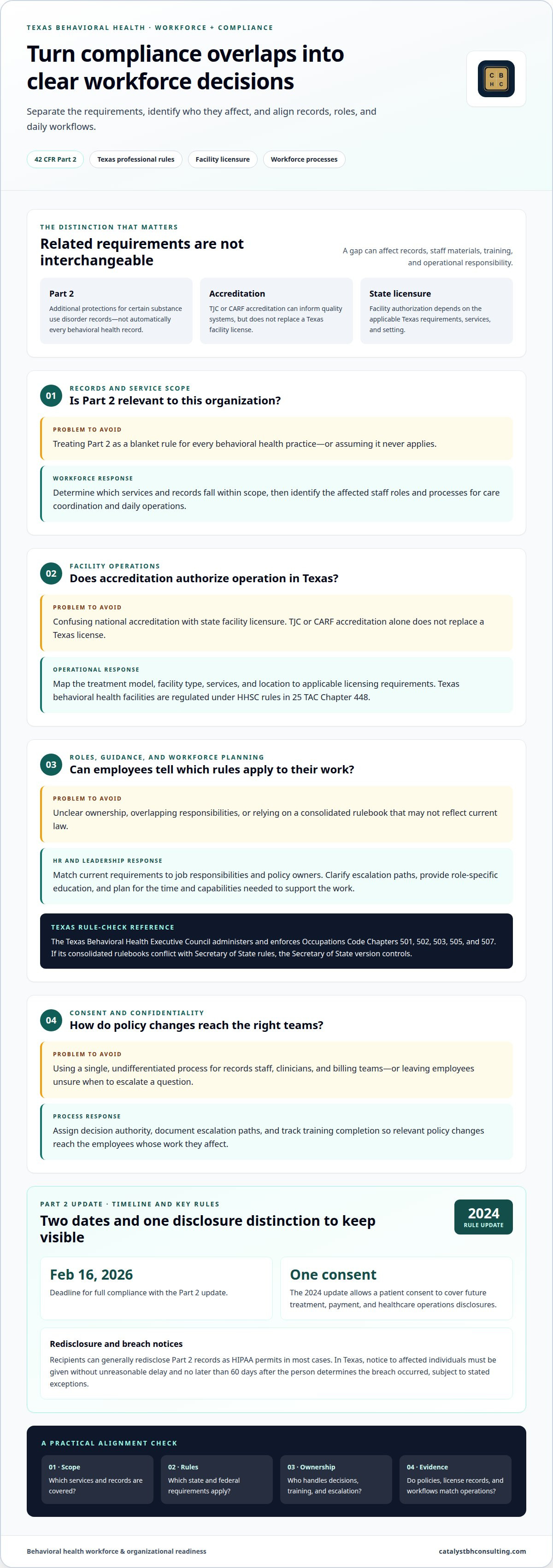
No. According to the U.S. Department of Health and Human Services, 42 CFR Part 2 provides additional protections for certain substance use disorder records. For Texas providers, leaders need to determine which services, records, and workforce processes are affected, and how those requirements fit into care coordination and daily operations.
This is also an HR strategy and operating-design issue. Clear ownership, role-specific education, and updated workflows can help leaders maintain continuity when responsibilities change. Tracking training completion and workflow changes gives organizations a practical way to monitor whether policies are reaching the teams affected. Workforce planning can also account for the time and capabilities needed to support these responsibilities.
How leaders verify rules and align roles with business needs
Rule verification means matching an organization’s services and staff roles to the current requirements governing each profession. The Texas Behavioral Health Executive Council administers and enforces Texas Occupations Code Chapters 501, 502, 503, 505, and 507. Its professional boards cover psychology, marriage and family therapy, counseling, and social work.
A review can map each set of rules to job responsibilities and policy owners, helping leaders identify teams that need guidance and workflows where responsibilities overlap. This role clarity supports consistent management and a culture in which employees know when to escalate questions. The Council cautions that consolidated rulebooks may not reflect current law. If they conflict with Secretary of State rules, the Secretary of State version controls.
Consent, confidentiality, and workforce processes
Consent and confidentiality requirements shape how staff handle permission, disclosure, and access decisions. Part 2’s 2024 rule update allows one patient consent to cover future treatment, payment, and healthcare operations disclosures. Recipients can generally redisclose Part 2 records as HIPAA permits in most cases. Full compliance with the update is required by February 16, 2026.
These distinctions affect records staff, clinicians, and billing teams in different ways. Managers can assign decision authority, document escalation paths, and track training completion so policy changes reach the employees whose work they affect. Clear processes can help behavioral health teams balance privacy responsibilities with care coordination. Texas breach notices to affected individuals must be given without unreasonable delay and no later than 60 days after the person determines that the breach occurred, subject to stated exceptions, according to the Texas Legislature.
Treatment, detention, and organizational oversight
Texas rules governing treatment and emergency detention depend on the applicable law and the professional’s role. A review should distinguish clinical decision-making from administrative duties, then clarify how staff escalate urgent situations under the organization’s approved procedures. This can help leadership align workforce responsibilities with service operations.
What Texas mandatory reporting and duty-to-warn requirements apply? A permitted disclosure under Texas Health and Safety Code § 611.004 does not itself create an independent duty to disclose. Policies should distinguish that permission from duties arising under other applicable laws or professional rules.
What are the Texas telehealth rules for behavioral health services? Applicable professional rules and privacy obligations should guide how an organization assigns responsibilities for remote services and records. Penalties depend on the requirement and enforcement authority involved. Leadership can connect incident reviews with corrective actions, staff education, and oversight to identify process gaps and support reliable service delivery.
Does national accreditation (TJC or CARF) satisfy state licensure requirements?
No. National accreditation and state licensure are separate measures. TJC or CARF accreditation does not replace a Texas facility license. Texas behavioral health compliance requires organizations to identify the facility rules that apply to their services and locations.
A compliance review maps an organization’s treatment model, facility type, and operating states to applicable licensing requirements. This helps distinguish accreditation evidence from state authorization to operate.
Facility Licensing Under HHSC
Facility licensing is state authorization for a behavioral health facility to operate under applicable Texas requirements. Texas behavioral health facilities are regulated under Texas Health and Human Services Commission rules in 25 TAC Chapter 448.
A compliance review identifies the facility’s services and setting, then evaluates the applicable HHSC licensing framework. Accreditation can inform quality systems, but it does not replace a separate state license. Operational documents and license records should align with the facility’s actual treatment model.
Treatment Center Licensing and Compliance
Treatment center licensing means aligning a facility’s operations with the requirements governing its services. A compliance review connects the treatment model, site information, and licensing records, then identifies gaps between documented operations and the relevant state framework.
For an organization operating in multiple states, one approval does not cover every location. Each state where it operates a behavioral health facility requires a separate facility license. A compliance review should track each site independently and distinguish state licensure from TJC or CARF accreditation.
Professional Licensing Statutes
Professional licensing statutes define the legal framework for individual behavioral health professions. Chapter 502 of the Texas Occupations Code is the Licensed Marriage and Family Therapist Act.
A compliance review matches each role to its governing profession and applicable licensing requirements. Staff records can be organized by role, license type, and work location, including for clinicians who provide treatment across organizational programs. A social worker’s professional authorization and a facility’s operating license address different responsibilities.
State-by-State Licensing
State-by-state licensing means obtaining a separate facility license in every state where a behavioral health facility operates. Location is therefore central to expansion planning, even when an organization uses consistent policies and accreditation.
What are Texas Medicaid behavioral health provider enrollment and billing requirements? Medicaid enrollment and managed care organization credentialing are distinct steps. A clean, complete CMS 855B application may take 90 to 180 days to reach an active billing provider ID, and MCO credentialing may add 60 to 120 days.
For an audit or inspection, a compliance professional assembles the facility’s license records, accreditation materials, staff license roster, service descriptions, and relevant policies. Those materials allow the review to compare authorized services and documented operations. A focused licensing and accreditation review can help structure that assessment.
Employee handbooks, forms, and training materials
Employee handbooks, forms, and training materials translate compliance rules into consistent staff practices. In a Texas behavioral health organization, they should reflect the services offered, workforce roles, and privacy requirements that apply to the records staff handle.
Texas Business and Commerce Code Chapter 521 applies alongside HIPAA, and compliance with one regime does not necessarily satisfy the other’s requirements. Texas Health and Safety Code Chapter 181 also imposes privacy obligations on covered entities. An effective update process therefore compares each policy and form against the applicable requirements instead of treating one privacy statement as sufficient.
For example, a handbook can explain how staff route record-access requests, protect information in routine communications, and escalate suspected privacy incidents. A release form should align its consent language with the disclosure process it supports. Training materials can use the same terms and workflow, reducing conflicts between written policy and daily practice.
Staff education is most useful when it connects rules to role-specific decisions. Clinicians, records coordinators, and billing employees may handle different information and workflows. Training can clarify what each role may access, how to document a disclosure, and where to direct questions about sensitive records. Relevant job guidance should also accurately describe Medicaid enrollment or billing processes without confusing payer procedures with privacy authorization.
Staff education can address human trafficking awareness by explaining recognition, internal escalation, and the organization’s response process. Materials should distinguish awareness training from legal reporting duties, which depend on applicable laws and professional requirements. Scenario-based exercises can help staff raise concerns without assuming every employee makes the same clinical or reporting decisions.
Training records show what education was delivered and which workforce members completed it. A structured record can identify the material version, audience, completion status, and follow-up instruction. When a policy changes, an organization can link the update to affected forms and training, then document the rollout. This creates a traceable connection between written rules and staff practices.
A practical review considers documents as a connected system: handbook language, consent and disclosure forms, training content, and completion records. It also examines how changes to services or staff responsibilities affect those materials. Clinical curricula and training systems can organize role-based education, while periodic review helps keep materials aligned with current operations and applicable privacy rules.
Confidentiality of minors’ mental-health records
Confidentiality of minors’ mental-health records shapes how providers manage counseling information, disclosures, and access requests. For organizations, consistent handling supports patient trust and continuity of care. In Texas, Family Code § 32.004 and Health and Safety Code Chapter 611 establish important parts of that framework.
Section 32.004(a)-(b) allows a minor to consent to specified counseling from a licensed or certified physician, psychologist, counselor, or social worker. The professional must have reasonable grounds to believe the minor has suicidality, chemical dependency, or abuse-related concerns. A clear intake process can help staff capture the basis for counseling and support consistent care decisions.
For example, a practice can document who consented, the counseling provided, and the basis for applying § 32.004. Well-defined documentation processes can reduce uncertainty when staff later receive a parent’s request for information. Section 32.004(e) states that a parent, managing conservator, or guardian who did not consent to counseling under that section is not obligated to pay for it.
Parental access requires a separate analysis from payment responsibility. Under Family Code § 32.004(b)(2) and (c), a physician, psychologist, counselor, or social worker providing counseling under § 32.004 may advise the child’s parent, managing conservator, or guardian about treatment given or needed, with or without the child client’s consent. The statute permits that advice; it does not make every record disclosure identical. Staff training can help teams apply this distinction consistently while supporting appropriate care.
Health and Safety Code § 611.0045(b) allows a professional to deny access to a portion of a minor’s mental-health record when releasing it would be harmful to the patient. The provision concerns part of the record, so an access review should identify the information at issue and document the decision. A request involving a treatment note, for instance, calls for attention to the specific content, not an automatic assumption that every record must be handled alike. This measured review can help balance confidentiality, patient well-being, and reliable operations.
Section 611.0045(f) provides a route for a person listed under § 611.004(a)(4) to access a patient’s confidential mental-health record while acting on the patient’s behalf. Section 611.004 also states that a permitted disclosure under its confidentiality exceptions does not create an independent duty to disclose. Staff should therefore distinguish permission to disclose from a requirement to do so, and document the decision-making process.
For a health practice, a consistent workflow can record the requester’s identity, the legal basis considered, the records reviewed, and the outcome. Reviewing request patterns and staff training needs can help leaders identify operational gaps and direct resources toward better processes. Texas Health and Safety Code Chapter 181 also imposes privacy obligations on covered entities. Coordinating that framework with Chapter 611 helps align access handling, staff education, and official records without treating parental status alone as the answer.
Federal requirements and organizational planning
Behavioral health organizations can treat federal requirements as part of a broader workforce and operational planning challenge. For Texas providers, privacy protections, substance use disorder records, and federal program enrollment may affect how teams handle information, assign responsibilities, and plan services.
The U.S. Department of Health and Human Services identifies 42 CFR Part 2 as providing additional protections for certain substance use disorder records. HHS and the Substance Abuse and Mental Health Services Administration finalized a rule aligning Part 2 more closely with HIPAA in February 2024. Organizations can use this context to review record handling, consent materials, and staff workflows, and clarify where training and leadership oversight are needed.
Federal privacy requirements and Texas privacy laws are distinct parts of a provider’s operating environment. A HIPAA policy alone does not establish that every state requirement is covered. Reviewing which staff handle a disclosure, which consent applies, and how the decision is documented can also help leaders identify workflow responsibilities and workforce training needs. Clear processes support operational accountability across behavioral health teams.
Federal program enrollment is a separate planning consideration. A clean, complete CMS 855B application may take 90 to 180 days to reach an active billing provider ID. Under 42 CFR 455 Subpart E, Medicaid provider screening levels are based on categorical risk. These requirements can inform operational planning and workforce capacity discussions; they do not determine whether a record is protected under Part 2.
A useful agency map starts with the organizational issue, not a generic list of federal departments. For each issue, a review can identify the relevant rule, affected function, and documents that demonstrate the organization’s process. Privacy questions may call for reviewing consent forms and record-access workflows, while enrollment questions require a separate review of application records and screening requirements. This distinction helps teams focus analysis on the work and responsibilities involved.
HHS, SAMHSA, and CMS relate to different parts of the organizational picture. An organization’s services, records, and federal program participation help determine which processes need attention. Keeping these areas distinct can support clear policy ownership, staff education, and operational accountability, while giving leaders a basis for reviewing workforce needs and organizational practices.
For a structured review of how regulatory requirements connect to organizational systems, book a compliance planning conversation.
Behavioral Health Workforce and Organizational Readiness
Behavioral health organizations face connected challenges: meeting regulatory requirements, maintaining effective operations, and supporting a capable workforce. Evidence-informed planning can help leaders align licensing, accreditation, HR responsibilities, and compliance processes with organizational priorities. Reviewing workforce data and role expectations can also help identify where leadership practices, benefits, or employee behavioral health support may need attention.
Priorities vary with each organization’s stage and operational needs. Catalyst offers consulting support, fractional HR leadership, Catalyst Continuum startup packages, and Catalyst Academy digital downloads to address selected requirements.
To discuss organizational compliance priorities, contact Catalyst Behavioral Health Consulting.
Build compliance into the next stage of growth
Strong Texas behavioral health compliance supports responsible growth when workforce strategy, operating processes, and leadership accountability develop together. Changes in services, staffing, or locations call for clear role ownership and consistent procedures. Reviewing workforce data can help leaders identify capacity gaps, while considering compensation, benefits, and employee well-being can inform sustainable staffing decisions.
A culture that encourages staff to raise concerns can help organizations surface operational and behavioral health needs. Regularly assessing policies, responsibilities, and workforce patterns gives leaders a basis for prioritizing improvements and coordinating implementation. Catalyst Behavioral Health Consulting offers licensing, accreditation, and HR support to organizations working through these challenges.
Identify where your organization needs greater clarity, coordination, or leadership capacity, then set practical priorities. Contact Catalyst Behavioral Health Consulting to discuss your organization’s needs and next steps.
Frequently Asked Questions
How does 42 CFR Part 2 apply when sharing records across state lines or with an affiliated entity?
Part 2 protections remain relevant when qualifying substance use disorder records are shared; an affiliate relationship or state-line transfer does not itself determine whether disclosure is permitted. A provider should identify the record’s status, the recipient, and the consent or other applicable basis before transferring it. Under the 2024 rule update, recipients can generally redisclose Part 2 records as HIPAA permits in most cases. Build that distinction into transfer workflows.
How does HIPAA behavioral health guidance differ from 42 CFR Part 2?
HIPAA provides the federal baseline for protected health information, while 42 CFR Part 2 adds protections for certain substance use disorder records. The 2024 update brought some requirements closer to HIPAA, including consent for treatment, payment, and healthcare operations disclosures. For example, one patient consent can cover future disclosures for those purposes under the updated Part 2 rules. An organization should distinguish which records receive the additional Part 2 protections.
Which Texas agencies regulate behavioral health providers and facilities?
Texas oversight depends on whether the issue concerns a professional license or a facility. The Texas Behavioral Health Executive Council administers and enforces specified Occupations Code chapters through its professional boards, while Texas Health and Human Services Commission rules in 25 TAC Chapter 448 regulate behavioral health facilities. Federal requirements may also apply, including HHS rules for protected records. A provider can map each service, site, and workforce role to its relevant oversight.
What licenses are required to provide behavioral health services in Texas?
Required authorization depends on the professional role and whether the organization operates a regulated facility. Texas statutes include separate professional acts, such as the Licensed Marriage and Family Therapist Act in Occupations Code Chapter 502. Facilities are separately governed under applicable HHSC requirements, and an operator needs a separate facility license in each state where it operates. A staffing plan should distinguish individual professional credentials from facility authorization.
What are the Texas requirements for behavioral health facility inspections, staffing, and safety?
Facility requirements depend on the services and setting covered by the applicable HHSC rules, including 25 TAC Chapter 448. The available rule framework does not establish one universal inspection or staffing checklist for every behavioral health facility. For an inspection, organize records that show how the site’s licensed services, staffing structure, and written procedures align with its applicable requirements. Accreditation can support quality processes, but it does not replace state licensure.
How do Texas behavioral health compliance requirements differ by provider type and service setting?
Requirements vary with professional discipline, facility status, services, and record types. A counselor’s professional rules differ from those governing a psychologist or social worker, while facility rules apply to regulated settings. A practical example is a multi-service organization employing several professions: each role needs to align with its own board framework, while the site’s services map to applicable facility rules. Records involving substance use disorder treatment may add federal Part 2 considerations.
What Texas mandatory reporting and duty-to-warn requirements apply to behavioral health providers?
A permitted disclosure under Texas Health and Safety Code § 611.004 does not itself create an independent duty to disclose. Providers should distinguish that permission from duties arising under other applicable laws or professional rules.

Article by
James McCreary, MS, LPC-S
The Catalyst dispatch.
Frameworks and field lessons on running effective behavioral-health programs. One email a month, sometimes two. Never spam.