Insights
The Mental Health Clinic Startup Checklist: A Strategic Operating Framework for 2026
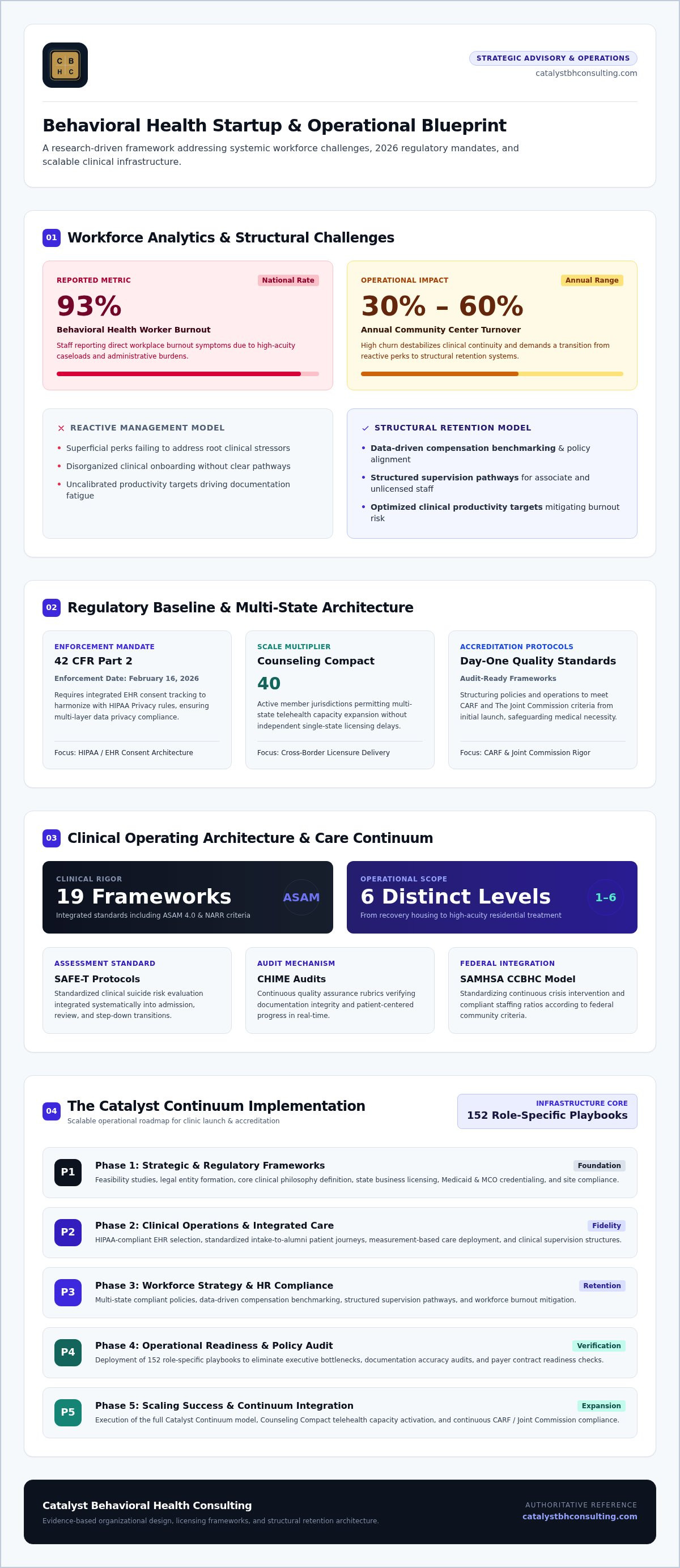
93% of behavioral health workers report experiencing workplace burnout, while annual staff turnover in community centers now reaches between 30% and 60%. These figures represent more than just human resources challenges; they're the predictable results of organizations that lack a comprehensive mental health clinic startup checklist. You likely recognize that opening a facility in 2026 requires more than a clinical passion. It demands a rigorous, audit-ready foundation that can navigate the complexities of 42 CFR Part 2 compliance, manage multi-state licensure compacts, and transition to ASAM 4th Edition standards.
This research-driven guide provides the strategic operating system you need to launch a compliant, scalable, and risk-mitigated organization. We'll show you how to move beyond superficial perks to create structural retention, implement evidence-based workforce analytics, and ensure your facility is prepared for CARF or Joint Commission accreditation from the first day of operation. By aligning your HR strategy, clinical workflows, and operational systems, you can build a stable organization that protects your staff, your patients, and your professional legacy. We'll explore the essential steps to transform your vision into a high-performing reality that remains both clinically excellent and operationally sound.
Key Takeaways
- Leverage data-driven compensation benchmarking and multi-state compliant policies to attract elite clinical talent.
- Align your clinical operations with ASAM 4.0 standards and 19 integrated frameworks to ensure medical necessity and long-term audit readiness.
- Utilize this mental health clinic startup checklist to implement 152 role-specific playbooks, creating a standardized operating system that eliminates leadership bottlenecks.
- Transition from reactive management to a structural retention model. This addresses burnout through clear supervision pathways and optimized productivity targets.
- Deploy the Catalyst Continuum as a scalable framework for licensing, accreditation, and operational excellence.
Table of Contents
- Phase 1: Foundation – Strategic and Regulatory Frameworks
- Phase 2: Clinical Operations – Building an Integrated Care Model
- Phase 3: Workforce Strategy – HR Compliance and Retention
- Phase 4: Operational Readiness – Policy, Audit, and Infrastructure
- Phase 5: Scaling Success – The Catalyst Continuum Implementation
Phase 1: Foundation – Strategic and Regulatory Frameworks
Establishing a behavioral health organization requires more than clinical intent. It demands a structural blueprint that aligns mission, market demand, and operational integrity. Successful founders use a mental health clinic startup checklist to ensure the organization isn't just a collection of services, but a unified entity capable of sustainable growth. This begins with a feasibility study to validate regional demand and determine the financial viability of your proposed service lines. Establishing a legal entity and securing federal and state business licenses provides the necessary protection and legitimacy required for large-scale clinical contracting. Leadership must define a core clinical philosophy that informs every subsequent hire, policy, and patient interaction.
Defining the Clinical Operating Model
Generic policies often fail during accreditation because they lack clinical fidelity. Your foundation must integrate purpose-built frameworks rather than retrofitting medical models. By identifying which of the 19 integrated frameworks, such as ASAM 4.0 or NARR standards, apply to your specific population, you create a baseline for measurable excellence. We categorize these into six distinct levels of care, ranging from recovery housing to high-acuity residential treatment. This strategic alignment ensures that your clinical curriculum, staff training, and patient outcomes are synchronized. It's a method that reduces leadership friction, clarifies clinical expectations, and optimizes service delivery.
Regulatory and Licensing Requirements
Regulatory complexity represents the highest barrier to entry. Organizations must navigate state-specific licensing while preparing for the Certified Community Behavioral Health Clinic model or similar federal standards. As of February 16, 2026, the enforcement of 42 CFR Part 2 requires integrated EHR consent tracking to align with HIPAA Privacy rules. Securing NPI numbers and initiating Medicaid or MCO credentialing are critical path items that shouldn't be delayed. Physical site requirements must also meet strict safety and accessibility standards to pass initial inspections. Beyond these technical hurdles, your licensing strategy should account for the Counseling Compact, which now includes 40 jurisdictions. This allows for rapid telehealth capacity scaling across state borders. These steps form the core of a robust mental health clinic startup checklist, preventing the licensing failures that often derail new organizations during their first year of operation.
Phase 2: Clinical Operations – Building an Integrated Care Model
Clinical variability represents a significant risk to both revenue and patient safety. When providers operate in silos, documentation becomes inconsistent, which often leads to insurance clawbacks and accreditation delays. Integrating a mental health clinic startup checklist into your clinical design ensures that every touchpoint, including initial screening and treatment planning, remains audit-ready. Selecting a HIPAA-compliant EHR that supports measurement-based care allows leadership to visualize outcomes and demonstrate medical necessity to payers effectively. A robust quality assurance rubric further protects the firm by monitoring documentation accuracy in real-time. Founders should reference the SAMHSA CCBHC criteria to ensure their continuous crisis intervention and staffing models align with federal standards.
Standardizing the Patient Journey
Standardized operating procedures for intake, assessment, and discharge minimize the risk of clinical errors. Mapping the patient experience from the first inquiry to alumni support provides a predictable and reassuring flow for both staff and patients. This process requires clear protocols for SAFE-T assessments and CHIME audits to maintain high safety and engagement levels. By establishing a formal feedback loop, organizations ensure that patient satisfaction data informs clinical adjustments. This structured approach creates a sense of security, suggesting that the brand has a well-defined process for every scenario.
Clinical Training and Supervision
Clinical training systems must move beyond basic orientation to ensure long-term fidelity to the clinical model. This involves implementing a formal supervision framework for unlicensed or associate-level staff, which is essential for professional development and risk management. Utilizing interactive tools like ASAM scorers helps standardize placement decisions and reduces the subjective nature of clinical assessments. For leaders seeking to scale their clinical operations without the burden of custom development, adopting pre-built curricula offers a strategic advantage. This ensures consistency, integration, and structural integrity as the organization expands.
Phase 3: Workforce Strategy – HR Compliance and Retention
Labor represents the single largest operational expense and the most significant regulatory risk for a behavioral health organization. A comprehensive mental health clinic startup checklist must prioritize workforce strategy to combat the 30% to 60% annual turnover rates prevalent in community centers. Success requires a data-driven compensation strategy and benchmarking framework that attracts elite talent while maintaining fiscal sustainability. By establishing workforce analytics from day one, leadership can monitor engagement, identify burnout triggers, and refine recruitment pipelines before they impact clinical continuity. An onboarding program that prioritizes mission-alignment and culture ensures that new hires are integrated into the organizational fabric, reducing early-stage attrition and fostering long-term commitment.
Fractional HR Leadership for Startups
Startups often face a seniority gap where they require executive-level HR expertise but lack the budget for a full-time Chief People Officer. Fractional HR leadership provides the strategic authority to build defensible documentation for investigations, terminations, and workplace conflict. This model emphasizes manager coaching programs, which have demonstrated a 32% reduction in staff turnover within six months. It ensures that leadership moves from reactive problem-solving to proactive cultural stewardship. By implementing these systems, founders create a stable environment that supports clinical staff and protects the organization from employment-related litigation.
People Operations and Compliance
Regulatory compliance extends beyond clinical records to include rigorous labor law adherence. Organizations must conduct I-9 audits and maintain strict compliance with FMLA, ADA, and the Pregnant Workers Fairness Act (PWFA) across all jurisdictions. Designing a benefits governance model requires balancing competitive employee value with long-term organizational viability. To ensure total operational clarity, founders should implement 152 integrated role playbooks that define accountability for every position, from reception to executive leadership. This structured approach supports integrated care team models by clarifying professional boundaries and clinical expectations. For founders seeking to bridge the gap between startup chaos and organizational maturity, engaging in executive coaching or fractional leadership provides the necessary structural integrity for sustainable growth.
Phase 4: Operational Readiness – Policy, Audit, and Infrastructure
Operational readiness is the bridge between a strategic concept and a functioning organization. At this stage, a mental health clinic startup checklist must culminate in the finalization of all 152 role playbooks. These documents ensure that every staff member, from medical directors to front-desk receptionists, understands their specific compliance duties and performance expectations. Populating a Quality Assurance (QA) and Compliance Dashboard with real-time data allows leadership to move from reactive management to proactive oversight. This phase also confirms that all IT infrastructure and vendor governance meet strict HIPAA security standards, particularly in light of the February 2026 enforcement of 42 CFR Part 2 regulations. By aligning technical systems with clinical workflows, founders create a stable, risk-mitigated environment for patient care.
Accreditation Readiness
Achieving CARF or Joint Commission accreditation requires more than a simple policy review. Organizations must identify the seven most common compliance gaps, such as inconsistent documentation or inadequate risk management plans, before the official survey. Calibrating your QA rubric against these national standards ensures that internal audits mirror the rigor of external inspections. A professional board briefing deck should be prepared to communicate this readiness to stakeholders, highlighting the organization's commitment to clinical excellence and regulatory integrity. This structured preparation transforms accreditation from a source of organizational anxiety into a validation of your comprehensive operating system.
Infrastructure and Technology
Scaling a behavioral health organization requires a digital backbone that supports workforce analytics and clinical fidelity. Selecting an HRIS that integrates with your long-term growth goals is essential for managing compensation strategy and benefits governance. A formal vendor oversight and governance framework must be established to ensure that all third-party services comply with behavioral health privacy laws. Ensuring all digital resources are audit-ready and accessible via a live portal allows for seamless information sharing during regulatory inspections. This technical clarity mirrors the organized systems required for long-term viability. Founders who want to ensure their infrastructure is audit-ready from day one should focus on integrating these technical components early in the startup process to avoid costly retrofitting later.
Phase 5: Scaling Success – The Catalyst Continuum Implementation
Transitioning from a single-site startup to a multi-site organization requires a shift from individual effort to systemic reliability. A mental health clinic startup checklist provides the initial roadmap, but long-term viability depends on a productized clinical and organizational operating model. The Catalyst Continuum serves as this "Operating System for Behavioral Health," offering 19 integrated frameworks and 152 role playbooks designed to manage, scale, and optimize your organization. Founders must evaluate which tier matches their current scale to ensure they aren't over-investing in infrastructure or under-preparing for growth. Tier 1 allows for self-serve licensing of the Master Playbook, while Tier 2 offers guided implementation for role-based rollouts. For PE-backed ventures or multi-site expansion, Tier 3 provides a turnkey deployment strategy that ensures clinical fidelity across all locations.
The Operating System for Behavioral Health
Behavioral health organizations face unique regulatory and clinical demands that traditional surgical or medical operating models cannot address. To maintain organizational health, leadership must utilize specialized interactive tools that monitor workforce analytics and clinical outcomes. This structural integrity is maintained through the 19 integrated clinical frameworks, including ASAM 4th Edition and NARR standards. As the organization grows, transitioning to a Fractional Chief Clinical Officer (CCO) model, which requires a 6-month minimum commitment, provides the senior-level oversight necessary to monitor fidelity without the cost of a full-time executive. This approach ensures that your leadership, culture, and clinical operations remain synchronized as you scale.
Next Steps for Your Startup
The journey from initial concept to a scalable, audit-ready organization is complex but manageable with the right frameworks. To begin this transition, founders should review the Starting a Behavioral Health Business pillar article for a deeper look at the strategic environment. Scheduling a 20-minute discovery call allows for a tailored assessment of your startup's specific needs, whether you're focused on licensing support or executive coaching. Finally, you can book a consultation to begin your formal Business Health Assessment. This assessment identifies high-risk gaps in your current model and provides a clear, risk-mitigated path to operational excellence and sustainable growth.
Transitioning from Strategy to Operational Excellence
Launching a behavioral health organization in 2026 requires a shift from reactive management to a structured, systems-driven approach. It's about moving from theory to reality by utilizing a mental health clinic startup checklist. This process allows you to move beyond generic policies to implement a scalable operating model that prioritizes clinical fidelity, workforce stability, and regulatory compliance. The journey involves aligning your leadership, refining your clinical frameworks, and optimizing your people operations to ensure long-term viability.
Success is found in the technical details of your organizational infrastructure. We provide 19 integrated clinical frameworks and role-specific playbooks that have delivered a proven 32% reduction in staff turnover within six months. Whether you require senior HR expertise for as little as two hours per week or a turnkey deployment for multi-site expansion, we provide the steady hand needed to navigate these complexities.
Book a Discovery Call to Build Your Audit-Ready Clinic and take the first step toward total organizational excellence. You have the vision to change lives; we have the systems to make that vision sustainable.
Frequently Asked Questions
How long does it typically take to launch a mental health clinic?
Launching a behavioral health organization typically takes six to twelve months, depending on state licensing timelines and payer credentialing. Using a mental health clinic startup checklist can significantly reduce delays by ensuring all regulatory requirements are met correctly the first time. The process involves securing a physical site, obtaining state-specific licenses, and implementing a clinical operating system that is audit-ready from the day you open your doors to patients.
What are the most common licensing mistakes for behavioral health startups?
Common licensing mistakes include failing to align policies with 42 CFR Part 2 requirements and submitting generic clinical manuals that lack specificity. Many startups also struggle with physical site safety standards or failing to account for multi-state compact regulations when offering telehealth. These errors often lead to months of delays, highlighting the need for an integrated operating system that connects clinical workflows with state-specific regulatory demands from the start.
Do I need a full-time HR Director when starting a small clinic?
A full-time HR Director is often unnecessary for a small clinic when fractional HR leadership is available. Senior HR engagements can start at as little as two hours per week, providing executive-level strategy without the full-time executive cost. This model allows startups to professionalize their people operations, manage multi-state compliance, and implement defensible documentation early in their growth cycle to protect the organization against future litigation and audit failures.
What is the difference between CARF and Joint Commission accreditation?
CARF International focuses specifically on health and human services, emphasizing recovery-oriented outcomes, while The Joint Commission provides a broader medical accreditation framework. Both are highly respected by payers and state agencies. The choice often depends on your specific level of care and the expectations of your primary managed care organizations. Regardless of the body chosen, your mental health clinic startup checklist must prioritize accreditation readiness to ensure a successful survey.
How much does it cost to implement a compliant policy manual?
The investment required for a compliant policy manual depends on the scope of services and the level of implementation support needed. Rather than purchasing static documents, startups should look for a productized operating model that includes editable playbooks and live portal access. These systems ensure that your policies aren't just paper in a binder but functional tools that guide your workforce through intake, assessment, and clinical supervision daily.
Can I use a standard medical operating model for my behavioral health business?
No, you cannot successfully use a standard medical or surgical operating model for a behavioral health business. Behavioral health is fundamentally different, requiring specialized governance that accounts for recovery-oriented systems of care and ASAM 4.0 criteria. Success depends on implementing an "Operating System for Behavioral Health" that integrates 19 specialized frameworks to address the unique clinical, regulatory, and workforce challenges found only within this specialized industry.
What is a Fractional CCO and does my startup need one?
A Fractional Chief Clinical Officer (CCO) is a senior leader who provides clinical oversight and fidelity monitoring on a part-time basis. Startups often benefit from this model when they require C-suite expertise but don't yet have the revenue to support a full-time hire. These engagements require a 6-month minimum commitment and focus on maintaining clinical excellence while scaling operations through standardized role playbooks and evidence-based supervision frameworks.
How do I ensure my clinical staff follows the established frameworks?
Ensuring staff follow frameworks requires moving beyond training to active accountability through 152 integrated role playbooks. These playbooks define specific duties for every position, while clinical supervision systems provide the necessary feedback loops for fidelity. Implementing manager coaching and structured onboarding has been shown to reduce turnover by 32% in six months, creating a culture where staff feel supported and competent in their specific clinical roles.

Article by
James McCreary, MS, LPC-S
The Catalyst dispatch.
Frameworks and field lessons on running effective behavioral-health programs. One email a month, sometimes two. Never spam.