Insights
Why clinical staff retention matters and what supports it
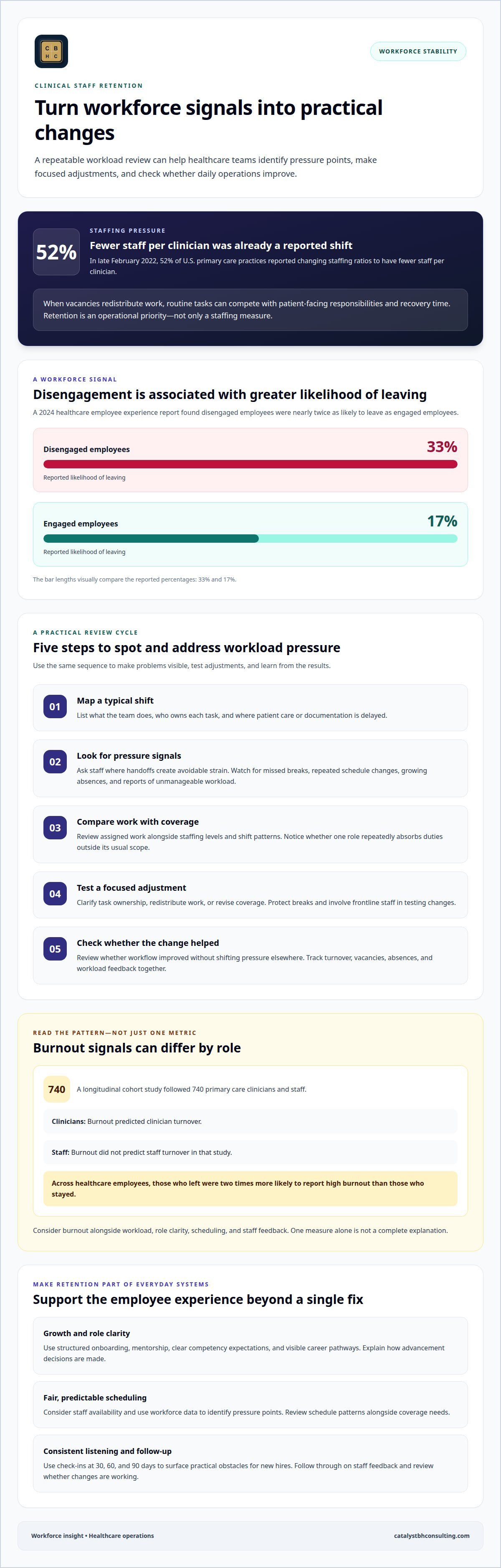
As of late February 2022, 52% of U.S. primary care practices reported changing staffing ratios to have fewer staff per clinician. That pressure makes clinical staff retention an operational priority: when experienced people leave, teams must absorb vacancies while maintaining continuity and day-to-day workflows. Retention is not only about keeping roles filled; it’s about building conditions that help staff stay and contribute.
Healthcare leaders know that workload, scheduling, and opportunities to grow shape the employee experience. The practical challenge is turning those concerns into consistent systems, not isolated fixes. This article explains how career development, predictable scheduling, supportive leadership, and workforce data can strengthen clinical staff retention and support more stable operations. It also shows how to spot warning signs and respond before staffing gaps become harder to manage.
Key Takeaways
- Look for workload and burnout warning signs, then adjust staffing practices before strain becomes a retention problem.
- Build clear career pathways through onboarding, mentorship, and professional development opportunities.
- Make scheduling fair and predictable by considering staff availability and using workforce data to identify pressure points.
- Assess turnover’s wider impact on team capacity, continuity, and daily operations, not only recruitment demands.
- Use retention trends and staff feedback to guide practical changes and strengthen workforce stability.
Table of Contents
- 1. Why is Employee Retention Vital in Healthcare Staffing?
- 2. Professional development and career advancement
- 3. Fair, equitable, and predictable clinician scheduling
- 4. What are the Costs and Consequences of High Turnover Rates in Healthcare?
- 5. Medical staff turnover and its operational effects
- Catalyst Behavioral Health Consulting: Licensing and accreditation support
1. Why is Employee Retention Vital in Healthcare Staffing?
In late February 2022, 52% of U.S. primary care practices reported changing staffing ratios. They moved toward fewer staff per clinician, adding pressure to remaining teams. When vacancies redistribute work, routine tasks compete with patient-facing responsibilities and recovery time. That makes clinical staff retention an operational priority, not simply an HR measure. Stable teams preserve working knowledge, coordinate responsibilities, and make daily workflows more reliable.
Burnout can appear as emotional exhaustion, detachment, or difficulty completing routine work. Leaders can watch for missed breaks, repeated schedule changes, growing absence patterns, and staff reports of unmanageable workload. In a 2024 healthcare employee experience report, disengaged employees were nearly twice as likely to leave as engaged employees: 33% compared with 17%. These figures make regular listening and follow-up useful management practices, not optional gestures.
Burnout and turnover are connected, but the pattern differs across roles. A longitudinal cohort study of 740 primary care clinicians and staff found that burnout predicted clinician turnover but did not predict staff turnover. Healthcare employees who left were two times more likely to report high burnout than employees who stayed. Leaders should therefore examine burnout alongside workload, role clarity, scheduling, and staff feedback, rather than treating one measure as a complete explanation.
Start workload reviews by mapping what each team does during a typical shift. Identify tasks that regularly delay care or documentation, and ask staff where handoffs create avoidable pressure. Compare assigned work with staffing levels and shift patterns. If one role repeatedly absorbs duties outside its usual scope, clarify ownership, redistribute tasks, or revise coverage. Protect breaks and involve frontline staff in testing changes. Then review whether the adjustment improves workflow without shifting pressure elsewhere.
Federal and state rules can affect leave, staffing practices, and scheduling policies. In the United States, companies with 50 or more employees are required to provide eligible employees up to 12 weeks of unpaid leave. State requirements vary, so leaders should identify the rules that apply in their jurisdiction before changing staffing policies or schedules.
Track turnover, vacancies, absences, and workload concerns together to identify where pressure is accumulating. A 2024 survey found that 57% of employers said employee retention was their greatest challenge, underscoring the business relevance of workforce planning. Use check-ins at 30, 60, and 90 days to involve new hires, surface practical obstacles, and address problems early. When leaders review these signals consistently, they can enhance staffing decisions, support well-being, and help more employees remain.
2. Professional development and career advancement
Effective retention strategies connect structured onboarding, mentorship, career pathways, and fair compensation. New employees can follow a role-specific competency plan and meet with a mentor to review progress and raise questions. Clear expectations paired with ongoing learning help employees understand how their responsibilities and skills can develop.
Make career progression visible. For example, outline the competencies needed to advance from medical assistant to lead medical assistant, including training, demonstrated skills, and added responsibilities. Nurses may progress through clinical ladders that recognize specialty expertise, precepting, or leadership contributions. Explain how advancement decisions are made so employees do not have to rely on informal access to managers.
Connect compensation transparently to role scope, demonstrated skills, and added responsibilities. Review pay structures for internal consistency and compare roles with relevant labor-market information. If an employee takes on preceptor duties or a leadership assignment, define how the role and compensation will change before the work begins. Clear criteria build trust and help managers plan workforce needs.
Benefits also affect whether employees can sustain a healthcare career. Review which benefits support well-being, professional learning, and different life circumstances, then communicate eligibility and access clearly. For example, a development benefit has limited value if shift coverage prevents staff from attending training. Aligning benefits with actual work patterns makes the overall employment offer more coherent.
Cross-training can build internal capability when organizations set clear boundaries and provide preparation. Identify shareable tasks, document required competencies, and schedule supervised practice. A nurse learning another unit’s workflow, for example, may better understand handoffs and coverage needs. Cross-training should not become an unrecognized expansion of duties. Review workload and compensation when responsibilities materially change.
Give mentorship defined goals. Schedule regular conversations about role confidence, feedback, and development, then connect employees with relevant courses or leadership preparation. For new graduates and nurses changing specialties, a structured residency can provide guided practice and support. Track participation, advancement, and employee feedback to see whether learning opportunities are accessible across roles and shifts.
Compensation and development decisions work best as connected workforce planning. Review vacancies, internal moves, skill gaps, and compensation structures together; use the findings to prioritize training and clarify advancement criteria. Clinical curricula and training systems can organize role competencies and learning pathways. For help aligning workforce development priorities, consider workforce development planning.
3. Fair, equitable, and predictable clinician scheduling
Fair scheduling makes expectations clear before employees commit their time. Use a consistent process for shift requests, rotations, and coverage changes, and explain how decisions are made. For example, teams can publish schedules in advance, collect availability through self-scheduling, and track last-minute changes. Predictability helps clinicians plan personal commitments and gives managers a clearer view of coverage.
Flexibility works best within defined operational boundaries. Let staff submit preferred shifts, then assess requests against skill mix, patient-care needs, and unit coverage. If two employees request the same shift, use a transparent rotation or documented priority rule. This supports equitable decisions while preserving service continuity and gives managers a clear process when not all requests can be accommodated.
Include fatigue and work-life balance in schedule reviews. Examine consecutive assignments, short-notice changes, missed breaks, and repeated overtime alongside employee feedback. When patterns emerge, leaders can adjust coverage, use an on-call pool, or draw on experienced float-pool staff. These options can address immediate workforce gaps without making recurring schedule disruption the default.
Flexible scheduling can strengthen engagement when employees have meaningful input and managers explain constraints. A scheduling pilot can compare call-ins before and after a change; Riverbend Medical Center’s case study reported that its flexible-scheduling pilot reduced call-ins by 25% six months after the interventions. Treat that result as a case example, then assess local results using the same definitions and time period.
Current U.S. turnover figures offer context: the national hospital turnover rate is nearly 19%, and registered nurse turnover is around 18%. These turnover figures are not retention rates for an individual organization, so leaders should calculate their own results using consistent workforce records.
Measure retention by dividing the employees who stayed for the entire period by the number of employees at the period’s start, then convert the result to a percentage. Use the same period and employee group each time. Review results by role, unit, and schedule pattern to identify where departures cluster.
Connect those measures with schedule data, including shift changes, unfilled assignments, and call-ins. A monthly review can compare patterns across units and guide targeted adjustments, while employee feedback helps explain what the figures alone cannot. If scheduling problems coincide with turnover in a specific team, a Business Health Assessment can help evaluate organizational priorities and workforce systems.
4. What are the Costs and Consequences of High Turnover Rates in Healthcare?
Clinical staff turnover adds recruitment, onboarding, coverage, and workflow demands. The full organizational impact depends on the role, vacancy duration, and how much work remaining employees absorb. Replacing an experienced clinician, for example, also means rebuilding team knowledge, handoff habits, and working relationships. Assess these operational effects alongside hiring activity.
Replacement costs include the time required to recruit, interview, orient, and support a new employee. Temporary coverage and overtime can add further strain, while supervisors and experienced colleagues spend time training instead of completing other responsibilities. To understand the financial impact, map each stage of a vacancy and identify which teams absorb the work. This shows where labor and replacement demands accumulate.
Turnover’s nonfinancial consequences can affect patient care and workplace satisfaction. Departing employees take practical knowledge of local workflows, communication routines, and team coordination with them. A new hire, for example, may need support learning escalation paths or documentation processes. During the transition, remaining staff may take on extra tasks, face more interruptions, and have fewer opportunities to focus on improvement.
What does clinical staff turnover cost healthcare organizations? The impact depends on the position, recruitment and onboarding requirements, coverage arrangements, and the time a new employee needs to work independently. Leaders can estimate it by recording these inputs consistently and accounting for lost capacity and the burden on existing teams.
Tailor retention strategies to role-specific challenges. Nurses may need reliable unit coverage, specialty training, and clear clinical pathways. Physicians may value manageable workloads, effective team coordination, and leadership opportunities. Allied health professionals may benefit from role-specific development and cross-training that respects professional boundaries. In every case, employee feedback can reveal which workplace factors most affect satisfaction and intent to stay.
Use a practical review process to connect turnover with organizational effects. Compare departures by role and department, document time spent filling vacancies, and track overtime or temporary coverage. Then review patient-care disruptions, onboarding progress, and staff feedback with managers. If a unit repeatedly loses experienced employees, examine workload, communication practices, and advancement opportunities before applying a broad solution.
Leaders can also track knowledge transfer before an employee leaves. Ask departing staff to document recurring workflows, key handoffs, and training needs, then assign an owner for each item. This step helps preserve operational knowledge while the team recruits and onboards replacements. Reviewing those records after each transition can reveal recurring gaps and inform stronger workforce planning.
5. Medical staff turnover and its operational effects
Medical staff turnover can disrupt practice operations even before a position becomes vacant. In the authors’ experience, turnover as low as 20% can interrupt clinic operations. Departures shift work to remaining team members, slow handoffs, and reduce time for routine tasks. For organizations, the central issue is not only replacing people. It is maintaining the coordinated work that supports patient care.
A cross-sectional analysis of 77 family medicine practices found a two-year staff turnover rate of 53%. That finding illustrates why leaders should examine turnover across teams and time periods, rather than relying on a single organization-wide figure. A practice can track departures by role, unit, and tenure, then compare those patterns with unfilled shifts, delayed work, and onboarding demands.
Turnover can create a cycle: departures increase the workload for remaining staff, while disrupted workflows make work harder to sustain. If an experienced employee leaves a clinic, for example, colleagues may need to repeat training, cover unfamiliar tasks, or rebuild communication routines. Map where work stalls, assign clear ownership, and review whether temporary coverage is protecting essential operations.
Hospital data also show how operational outcomes can change over time. NYC Health + Hospitals’ staff nurse turnover rate was 46% in 2019 and 7.3% in 2025; the national average staff nurse turnover rate was 16.4% in 2025. These figures provide context, not a target that fits every organization. Unit structure, staffing needs, and workforce practices affect how leaders interpret local results.
When turnover rises, start with a focused review. Identify affected roles and recurring vacancies. Compare turnover with schedule gaps, overtime, and incomplete work. Then gather employee and manager feedback on handoffs, role clarity, and workload. This sequence helps distinguish a hiring bottleneck from a deeper culture or workflow problem, so leaders can respond more precisely.
Track whether changes improve stability by reviewing the same measures consistently. Riverbend Medical Center’s case study reported a nursing vacancy rate of 17% and an annual nursing turnover rate of 22% in early 2026. Six months after its interventions, the case study reported a 10% vacancy rate and a 13% turnover rate. Treat the example as a reason to measure operational changes, not as a universal forecast.
When turnover is disrupting coverage, communication, or daily workflows, map those effects before selecting corrective actions. Book a workforce operations discussion to identify where staffing patterns and organizational systems need attention.
Catalyst Behavioral Health Consulting: Licensing and accreditation support
Catalyst Behavioral Health Consulting supports behavioral health organizations with licensing and accreditation, areas that shape the systems and operating standards behind workforce stability. When retention challenges point to gaps in staffing structure or HR processes, fractional HR leadership can help organizations strengthen their approach. Catalyst Academy digital downloads offer practical learning resources, while Catalyst Continuum startup packages support organizations building their operations.
These offerings can complement an internal retention plan by helping leaders align people practices, training, and organizational requirements. For support with your organization’s priorities, book a conversation with Catalyst Behavioral Health Consulting.
Build a workforce plan your team can sustain
Stronger clinical staff retention starts when workforce decisions become part of routine operational planning. Set a clear review schedule, assign responsibility for follow-up, and connect staff feedback with decisions about workload, scheduling, and development. Revisit the plan as staffing needs and team conditions change. Consistent action helps leaders move beyond isolated fixes and build an environment where employees can contribute over time.
Choose one priority to address first, such as recurring coverage gaps or unclear growth pathways. Define what progress looks like, decide how leaders will monitor it, and communicate the next steps to staff. This creates a practical starting point without assuming every department faces the same challenges.
If your organization would benefit from strategic support, Catalyst Behavioral Health Consulting can help you assess priorities and strengthen the systems behind your workforce plan. Contact Catalyst Behavioral Health Consulting to discuss a next step for your organization. A steady, deliberate approach can help your team build lasting capacity.
Frequently Asked Questions
Why is Employee Retention Vital in Healthcare Staffing?
Retention helps healthcare teams preserve continuity, institutional knowledge, and dependable coordination. When a familiar team member leaves, colleagues may need to rebuild working relationships while taking on that person’s responsibilities. A behavioral health program, for example, may experience delays if staff who understand its referral process depart together. Review departure patterns alongside handoff issues and service interruptions to identify where staffing instability affects performance.
What are the Costs and Consequences of High Turnover Rates in Healthcare?
High turnover creates direct staffing demands and less visible disruptions to service delivery. Beyond recruitment and onboarding, organizations may spend time redistributing tasks, orienting replacements, and correcting workflow gaps. Track each vacancy from departure through independent role performance, noting where other teams provide coverage. This gives leaders a fuller view of operational impact without treating hiring activity as the only consequence of turnover.
What are the most common reasons healthcare workers leave their jobs?
Healthcare workers may leave because of persistent workload pressure, unpredictable schedules, limited development opportunities, weak manager support, or compensation concerns. The reasons often differ by role and team, so leaders should avoid assuming one organization-wide explanation. Stay interviews can reveal what current employees value and what could improve their work. Compare those conversations across departments to spot recurring concerns, then assign an owner to address each actionable issue.
What does it cost to replace a healthcare worker?
Replacement costs vary by position and by the organization’s recruitment, onboarding, and coverage processes. A practical estimate accounts for recruiting time, interviews, orientation, temporary coverage, and the time experienced staff spend training a newcomer. A specialized role, for example, may require additional preparation before the new employee can take on the full workload. Track these components separately to see where replacement demands arise and which processes need improvement.
What is clinical staff retention and why does it matter?
Clinical staff retention is an organization’s ability to keep its clinical employees over a defined period. It matters because stable teams can maintain role knowledge and established coordination as programs operate and grow. A behavioral health provider expanding services, for example, may need experienced employees to support consistent workflows as responsibilities change. Leaders can use retention patterns to assess whether workforce practices support continuity, rather than viewing departures only as individual staffing events.
What are the main causes of clinical staff turnover and burnout?
Sustained workload pressure, insufficient recovery time, unclear responsibilities, limited influence over work, or feeling undervalued can contribute to burnout and turnover. Burnout is a workforce well-being concern; turnover is an employment outcome. They can overlap, but leaders should examine them separately. Review staff feedback, absence patterns, and workflow obstacles together, then investigate whether the same conditions affect an entire unit or particular roles.
What are effective onboarding, mentorship, and career development programs for clinical staff?
Effective programs connect role preparation with continued learning and visible progression. A new employee might receive a written competency plan, observe experienced colleagues, practice core tasks with feedback, and meet with a mentor to discuss questions. As skills develop, managers can outline options such as specialty learning, preceptor responsibilities, or leadership preparation. Clear criteria show employees how to pursue opportunities and help organizations recognize developing internal capability.

Article by
James McCreary, MS, LPC-S
The Catalyst dispatch.
Frameworks and field lessons on running effective behavioral-health programs. One email a month, sometimes two. Never spam.