Insights
How to Scale a Treatment Center: Strategic Growth and Workforce Architecture
With national clinician turnover exceeding 30% to 50% across behavioral health, adding licensed beds often accelerates organizational collapse rather than sustainable enterprise value. When executive teams evaluate how to scale a treatment center, they frequently encounter an exhausting operational reality: aggressive admissions targets are impossible to achieve when frontline turnover destabilizes your census capacity, documentation inconsistencies jeopardize billing compliance, and leadership spends its days fighting fires. True organizational growth isn't a marketing sprint or a physical footprint race; it's an engineering challenge that requires deliberate workforce architecture, dependable supervisory systems, and rigorous operational fidelity.
You don't have to sacrifice clinical quality to build a profitable, multi-site continuum. Discover how to scale your treatment center sustainably by aligning clinical capacity, workforce analytics, and operational systems. Ahead, we break down the predictive staffing ratios, retention-driven compensation frameworks, and audit-ready clinical operating playbooks required to expand your census while keeping your clinical team intact and engaged.
Key Takeaways
- Discover how to scale a treatment center sustainably by replacing ad-hoc bed expansion with predictive workforce modeling that balances census targets against clinical capacity.
- Protect operational margins and curb frontline attrition by anchoring total rewards around clinical career ladders and structured retention incentives rather than transactional sign-on bonuses.
- Separate clinical quality oversight from executive business management, transitioning founders from daily crisis intervention into structured organizational governance.
- Safeguard multi-site expansion against regulatory citations by deploying standardized clinical operating playbooks and disciplined internal mock survey routines.
Table of Contents
- The Treatment Center Scaling Paradox: Why Census Growth Breaks Unprepared Facilities
- Step 1: Deploy Workforce Analytics to Align Bed Capacity with Clinical Staffing
- Step 2: Restructure Compensation and Benefits to Anchor Talent Retention
- Step 3: Establish Clinical Leadership Infrastructure and Standardized Operating Culture
- Step 4: Scale Quality Systems, Licensure Compliance, and Multi-Site Governance
The Treatment Center Scaling Paradox: Why Census Growth Breaks Unprepared Facilities
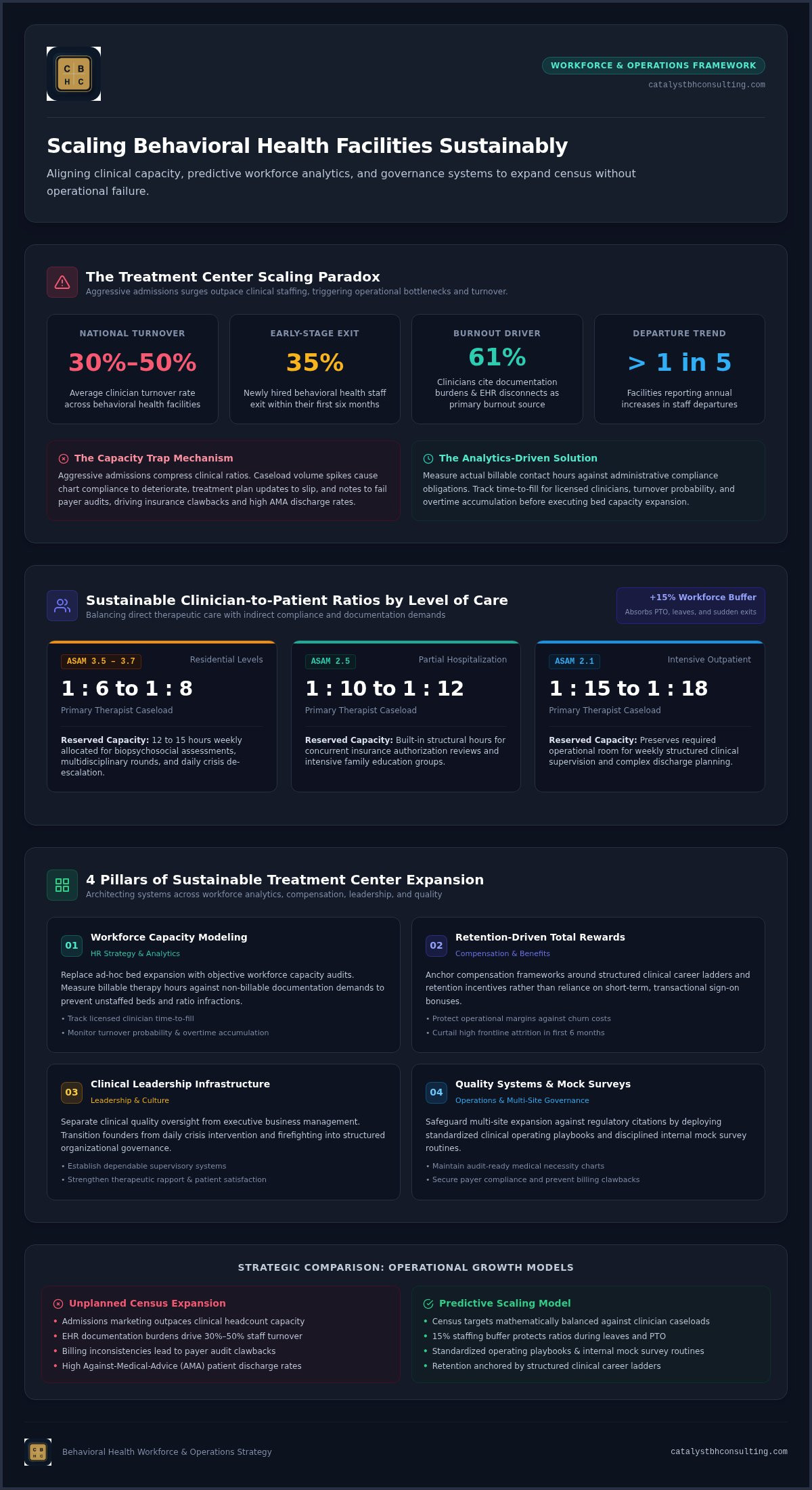
Many leadership teams assume that learning how to scale a treatment center simply means filling licensed beds and accelerating digital marketing. In reality, aggressive patient acquisition without an equivalent workforce expansion creates an acute operational bottleneck. When marketing outpaces clinical staffing capacity, the entire organization buckles. National behavioral health data indicates clinician turnover rates hover between 30% and 50%, with more than one in five facilities reporting annual increases in staff departures. True scaling requires balancing census targets with coordinated human resources planning, clinical operations, and regulatory rigor.
Deconstructing the Clinical Capacity Trap
Rapid admissions surges inevitably compress clinical ratios, pushing therapist caseloads beyond sustainable boundaries. Research shows that 61% of behavioral health clinicians cite documentation burdens and electronic health record disconnects as their primary burnout drivers. As caseload volume spikes, chart compliance deteriorates, treatment plan updates slip, and medical necessity notes fail payer audits. This clinical erosion quickly compromises insurance authorizations, invites clawbacks, and damages relationships with regional medical centers and community referral partners. Sustainable expansion depends directly on establishing sound clinical governance frameworks that protect caseload limits before beds are occupied.
The True Cost of Unmanaged Turnover in Expanding Facilities
When clinical and direct-care teams burn out, the resulting turnover creates crippling operational drag. Approximately 35% of newly hired behavioral health staff exit within their first six months. Continuous recruitment, credentialing, and onboarding for behavioral health technicians divert executive focus away from strategic expansion. Even worse, frequent staff turnover disrupts therapeutic rapport, elevating patient dissatisfaction and driving up against-medical-advice (AMA) discharge rates. As detailed in our guide on starting a behavioral health business, establishing stable workforce systems from the ground up provides the only reliable defense against census volatility. Without disciplined workforce planning, facility growth merely scales existing operational dysfunction.
Step 1: Deploy Workforce Analytics to Align Bed Capacity with Clinical Staffing
Mastering how to scale a treatment center begins with an objective workforce capacity audit, not physical lease agreements. Expanding operators must measure actual billable clinical contact hours against administrative responsibilities rather than assuming an eight-hour shift yields eight hours of therapy. According to HRSA health workforce projections, nationwide deficits in behavioral health practitioners make talent scarcity a permanent operating condition. Tracking metrics like time-to-fill for licensed clinicians, turnover probability, and overtime accumulation prevents unstaffed beds and regulatory ratio infractions.
Calculating Sustainable Clinician-to-Patient Ratios by Level of Care
Caseload mathematical models must shift according to programmatic intensity. When determining clinical ratios across continuous levels of care, leadership teams need to account for both direct therapy and indirect compliance obligations:
- Residential Levels (ASAM 3.5 to 3.7): Maintain an active caseload of 1:6 to 1:8 per licensed primary therapist. This ratio reserves 12 to 15 hours weekly for biopsychosocial assessments, multidisciplinary rounds, and daily crisis de-escalation.
- Partial Hospitalization Programs (ASAM 2.5): Structure ratios at 1:10 to 1:12, factoring in concurrent authorization reviews and family education groups.
- Intensive Outpatient Programs (ASAM 2.1): Target 1:15 to 1:18, preserving operational room for weekly clinical supervision and discharge planning.
Facilities should build a structural 15% workforce buffer. This absorbs planned paid time off, medical leaves, and sudden resignations without exceeding state administrative caps or Joint Commission staffing guidelines.
Implementing Predictive Talent Pipelines for Expanding Treatment Programs
Predictive staffing links recruitment velocity directly to admissions momentum. Waiting until census reaches 90% before posting clinical vacancies creates immediate operational bottlenecks, as credentialing and background clearances often take 45 to 60 days. Executive teams should project census growth 60 days forward, triggering talent acquisition when forward bookings indicate sustained intake acceleration. As outlined in the mental health clinic startup checklist, establishing standard candidate scorecards ensures prospective hires possess both therapeutic competencies and the organizational agility needed for multi-site scale. If your leadership team needs objective clarity on staffing bottlenecks before adding physical beds, you can schedule a consultation with our strategic advisory team to evaluate your organizational architecture.
Step 2: Restructure Compensation and Benefits to Anchor Talent Retention
Relying on one-time sign-on bonuses creates a transactional hiring dynamic that fails to anchor staff. When operators research how to scale a treatment center, they often treat wage competition as a simple bidding war. Research on behavioral health workforce turnover and attrition confirms that compensation dissatisfaction pairs with emotional exhaustion and limited upward mobility to drive mass clinician departures. High-growth centers must replace short-term signing gimmicks with structured career pathways that decouple salary progression from administrative management, allowing master clinicians to advance compensation tiers while staying in direct care.
Designing Value-Based Incentive Models for Clinical and Operations Staff
Effective variable pay aligns employee rewards with clinical rigor and operational health rather than patient volume. Treatment centers expanding across multiple sites should tie incentive distributions to objective quality metrics:
- Documentation Timeliness: Award monthly stipends for completing concurrent review notes, intake biopsychosocial assessments, and discharge summaries within mandated 24-hour windows.
- Audit Readiness: Reward clinical teams whose charts pass peer review rubrics and state administrative sampling without citations.
- Technician Shift Stability: Incentivize behavioral health technicians through quarterly retention bonuses tied to shift reliability and tenure milestones.
Every incentive structure must be vetted to maintain strict compliance with federal anti-kickback statutes and patient brokering laws. Bonuses must never reward admissions quotas or referral volumes.
Evaluating Total Rewards Structures Against Industry Competitors
Monetary compensation alone will not curb turnover when secondary traumatic stress remains unaddressed. Expanding organizations gain competitive advantages by enhancing non-monetary total rewards. Providing employer-paid clinical supervision toward independent licensure (LCSW, LPC, LMFT) transforms associate-level clinicians into loyal, fully licensed staff. Pair this with structured secondary trauma support, including protected clinical debriefing hours and dedicated wellness allowances. Operational leaders can also deploy compressed four-day workweeks or remote administrative documentation days for outpatient programs to reduce burnout. As detailed in our fractional HR for healthcare guide, structured workforce governance transforms human capital into an engine for sustainable multi-site growth. To assess how your current benefits framework compares against market benchmarks, book an executive consultation with our advisory team.
Step 3: Establish Clinical Leadership Infrastructure and Standardized Operating Culture
A primary structural barrier in learning how to scale a treatment center is the founder-dependent clinical bottleneck. In early-stage facilities, executive founders often balance admissions intake, license maintenance, and daily crisis de-escalation themselves. As census expands and multi-facility footprints emerge, this centralization stalls decision-making and burns out executive leadership. Sustainable expansion demands a clear operational boundary separating executive business management from clinical quality oversight, replacing ad-hoc founder intervention with structured governance frameworks.
Transitioning from Founder-Led Operations to Distributed Clinical Governance
Transitioning to multi-facility governance requires formal authority matrices that delineate clinical and administrative responsibilities. Facility-level program directors must possess unambiguous authority over immediate patient safety, level-of-care determinations, and therapist supervision, while executive leadership steers capital allocation, labor modeling, and enterprise compliance. Establish a disciplined weekly operational cadence uniting clinical directors, admissions leads, nursing managers, and utilization review specialists. This cross-functional rhythm resolves admissions bottlenecks, aligns concurrent review milestones, and eliminates communication silos before programmatic quality deteriorates.
Developing Clinical Supervisors into Accountable Department Leaders
Most behavioral health providers promote exceptional therapists into supervisory roles without providing foundational managerial training. Unprepared supervisors often struggle to balance clinical empathy with operational accountability, which accelerates burnout across frontline teams. Mid-level clinical leaders require structured development focused on three key operational areas:
- Workforce and Labor Management: Training supervisors to balance shift coverage, manage paid time off, and monitor caseload distribution objectively.
- Clinical Quality Auditing: Standardizing weekly chart reviews against state licensing and accreditation rubrics to catch compliance gaps before billing submission.
- Objective Performance Coaching: Implementing structured progressive discipline frameworks that establish clear accountability while protecting the organization from employment-related liability.
When supervisors actively coach direct-care staff and conduct methodical chart audits, turnover stabilizes across the entire continuum. To install disciplined clinical leadership infrastructure and professionalize your management tier, book a leadership strategy session with our executive advisory team.
Step 4: Scale Quality Systems, Licensure Compliance, and Multi-Site Governance
Expanding across locations quickly strains static documentation. While single facilities often survive on informal oversight, discovering how to scale a treatment center across multiple sites requires transforming binders of policy manuals into living operational playbooks. Regulators and payers expect uniform care delivery regardless of location. Standardizing workflows across intake, medication management, and clinical transitions ensures that every satellite campus operates under identical quality benchmarks.
Maintaining Continuous Accreditation Readiness Across Multiple Facilities
Treating survey preparation as an episodic scramble before an audit inevitably leads to severe operational deficiencies. Multi-site platforms must maintain continuous compliance by establishing systematic quality routines:
- Centralized Credentialing and HR Files: Unify primary source verification, professional license monitoring, and criminal background checks in a national administrative hub rather than keeping fragmented paper records at individual sites.
- Clinical Quality Improvement (CQI) Architecture: Form an active CQI steering committee that meets monthly to evaluate adverse incident trends, patient grievances, and medication administration error patterns across all active programs.
- Methodical Peer Chart Auditing: Run bi-weekly peer reviews verifying that individualized treatment plans, clinical progress notes, and ASAM dimension documentation consistently satisfy medical necessity requirements.
To insulate your enterprise from sudden survey findings, conduct quarterly internal mock audits using official Joint Commission or CARF survey methodologies. Leveraging specialized behavioral health accreditation support enables expanding providers to spot chart deficiencies, training deficits, and environmental safety risks long before state surveyors arrive.
Building an Scalable Operational Engine for Sustainable Growth
Opening additional residential beds or outpatient clinics demands substantial regulatory and operational overhead. Operators must decide whether to expand permanent executive payroll or utilize agile leadership models. Fractional executive leadership allows growing behavioral health organizations to deploy veteran human capital and clinical compliance expertise without carrying excessive administrative expenses. This approach professionalizes human resources, operationalizes new service lines, and manages multi-state licensure filings efficiently. To evaluate your organization's readiness for sustainable expansion, book an operational growth assessment with our advisory practice.
Operationalize Your Expansion with Sustainable Workforce Architecture
Sustainable multi-facility growth requires more than capital and physical beds; it demands deliberate structural integrity. Successfully executing how to scale a treatment center depends on aligning admissions velocity with predictive workforce analytics, restructuring total rewards to anchor licensed talent, and replacing founder-led firefighting with distributed clinical governance. When expanding operators deploy standardized role playbooks and continuous mock survey routines, census expansion strengthens clinical quality rather than diluting it.
Catalyst Behavioral Health Consulting brings a nationwide footprint guiding providers through licensing readiness, accreditation standards, and complex multi-site expansions. Our specialized operational playbooks span multiple behavioral health care levels, backed by proven human resources architecture engineered to stabilize census capacity and reduce clinician turnover. You don't have to choose between clinical excellence and organizational growth. Schedule your growth strategy session and book a consultation today to build a resilient operational foundation ready for scale.
Frequently Asked Questions
What is the biggest operational mistake treatment centers make when attempting to scale?
The biggest operational mistake is expanding licensed bed capacity before establishing adequate clinical workforce capacity. Facility leaders often invest heavily in admissions marketing and physical real estate while neglecting recruitment pipelines and retention infrastructure. When intake volume outpaces clinical staffing, therapists experience severe burnout, caseload ratios breach regulatory thresholds, chart documentation lapses, and clinical quality erodes. Sustainable expansion requires aligning physical bed expansion directly with predictive talent modeling.
How do I know when my treatment center is ready to open a second location?
A treatment center is ready to open a second facility when its flagship location operates reliably without daily founder intervention. Readiness requires achieving consistent census stability, maintaining at least six consecutive months of audit-ready clinical documentation, and codifying standard operating procedures into living playbooks. Your executive team must also demonstrate predictable workforce retention metrics and have established clinical supervisors capable of upholding compliance standards across sites independently.
How can an expanding treatment center maintain clinical care quality across multiple sites?
Maintaining clinical quality across distributed campuses requires shifting from informal oversight to productized clinical governance systems. Organizations learning how to scale a treatment center across multiple facilities must deploy standardized role playbooks, unified electronic documentation templates, and structured weekly peer chart audits. Establishing a continuous quality improvement committee ensures clinical directors systematically track patient outcomes, medication administration records, and incident reports under identical organizational benchmarks.
What role does fractional HR leadership play in scaling a behavioral health business?
Fractional HR leadership provides expanding providers with senior people operations and regulatory compliance expertise without the expense of full-time executive hires. A fractional HR partner establishes defensible compensation frameworks, builds structured onboarding systems, and standardizes multi-facility supervisor coaching. This strategic oversight professionalizes credentialing, streamlines talent acquisition, and protects the organization against wage-and-hour or licensing liabilities during rapid operational expansion.
How should caseload ratios be adjusted as outpatient programs expand?
Caseload ratios in expanding outpatient programs must account for direct client hours alongside indirect administrative and care coordination demands. While intensive outpatient programs typically operate safely at 1:15 to 1:18 clinician-to-patient ratios, partial hospitalization programs require tighter caps near 1:10 to 1:12. As outpatient volume climbs, centers must reserve adequate time for weekly treatment plan updates, insurance concurrent reviews, family consultations, and crisis interventions to prevent clinician exhaustion.
What key metrics must executives monitor to ensure sustainable treatment center growth?
Executives evaluating how to scale a treatment center must monitor operational workforce indicators alongside financial performance. Essential metrics include clinician time-to-fill, 90-day employee retention rates, average length of stay, and chart documentation timeliness within 24 hours of service delivery. Tracking the ratio of staffed beds to licensed beds, alongside concurrent review authorization denial percentages, provides leadership with early warnings before staffing shortages compress operating margins.

Article by
James McCreary, MS, LPC-S
The Catalyst dispatch.
Frameworks and field lessons on running effective behavioral-health programs. One email a month, sometimes two. Never spam.